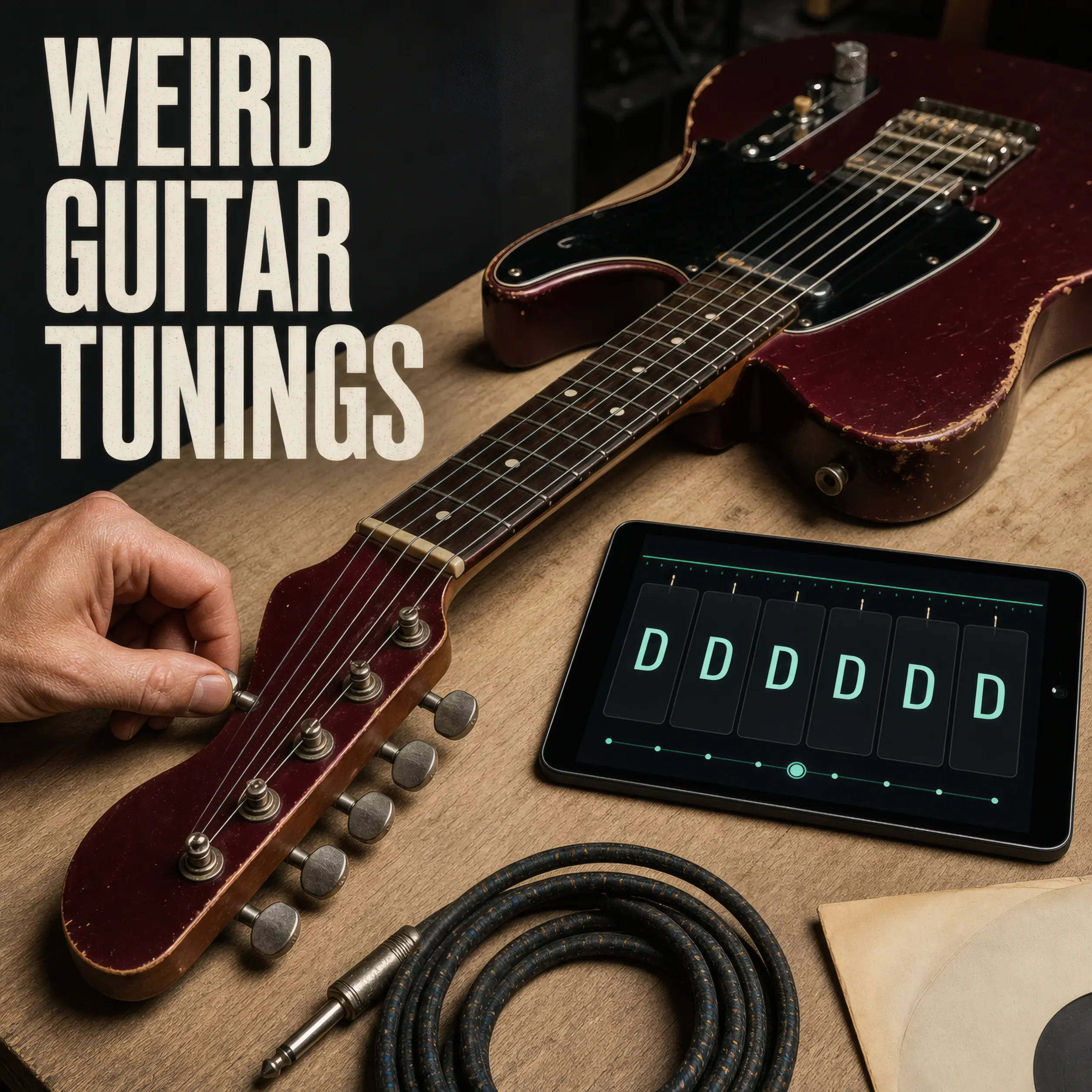
Alternate guitar tunings are any setup other than standard E A D G B E — and they're the fastest way to make your guitar sound like a different instrument for free. Drop the 6th string and riffs get heavier. Tune the open strings to a chord and slide guitar suddenly makes sense. Detune to DADGAD and everything turns Celtic and droney.
This guide maps the whole territory: a note-by-note chart of the tunings worth knowing, what each family is for, the songs that made them famous, and how to reach any of them with a free preset tuner — or build your own from scratch.
Shortcuts:
- Browse every preset tuning — guitar, bass, and ukulele
- Open the custom tuner — build and save any tuning that doesn't have a preset
What are alternate guitar tunings?
An alternate tuning changes the pitch of one or more open strings away from standard. That one decision reshapes everything downstream: which chords are easy, which notes ring as drones, where the fretboard patterns sit, and what the instrument wants to play.
Almost every alternate tuning belongs to one of four families:

- Drop tunings — lower just the 6th string (drop D, drop C). Power chords become one finger; the rest of the neck stays familiar.
- Step-down tunings — lower all strings equally (Eb standard, D standard). Same shapes, darker sound, slinkier bends.
- Open tunings — tune the open strings to a chord (open G, open D, open E). Strum nothing and you're already playing music; barre one finger anywhere for a new chord. This is slide guitar's home.
- Modal and experimental tunings — neither plain major nor minor (DADGAD, FACGCE, and anything you invent). Open, ambiguous, droney.
None of this requires new gear or setup changes for casual use — just a tuner that knows the target notes and two minutes of peg turning.
Alternate guitar tunings chart: notes for every tuning
Low string first. Every linked tuning has a free preset tuner that listens through your mic.
| Tuning | Notes (low → high) | Family | Hear it in |
|---|---|---|---|
| Drop D | D A D G B E | drop | Everlong — Foo Fighters |
| Double drop D | D A D G B D | drop | Cinnamon Girl — Neil Young |
| Drop C | C G C F A D | drop | Aerials — System of a Down |
| Drop B | B F# B E G# C# | drop | Duality — Slipknot |
| Eb standard (half step down) | Eb Ab Db Gb Bb Eb | step-down | Sweet Child O' Mine — Guns N' Roses |
| D standard (whole step down) | D G C F A D | step-down | Sad but True — Metallica |
| C standard | C F Bb Eb G C | step-down | Queens of the Stone Age's early records |
| Open G | D G D G B D | open | Start Me Up — Rolling Stones |
| Open D | D A D F# A D | open | Little Martha — Allman Brothers |
| Open E | E B E G# B E | open | She Talks to Angels — Black Crowes |
| Open C | C G C G C E | open | much of Devin Townsend's catalog |
| Open A | E A E A C# E | open | slide and Delta blues staple |
| DADGAD | D A D G A D | modal | Kashmir — Led Zeppelin |
| FACGCE | F A C G C E | experimental | Never Meant — American Football |
| All fourths | E A D G C F | experimental | jazz players who hate memorizing two shapes per chord |
| New standard | C G D A E G | experimental | Robert Fripp / King Crimson |
For the truly deep end — there are dozens more documented — Wikipedia's list of guitar tunings is the reference. For everything on this chart, though, the fastest path is a preset: pick it, pluck, center the needle.
How to tune to alternate tunings (free, online)
The mechanics are the same for every tuning on this page:
- Open the preset for your target — from the chart above or the full tunings library.
- Tap Start listening and allow mic access. Unplugged electric or acoustic both read fine at close range.
- Tune strings low to high, and always finish each string by tuning up into the note — strings settle sharper when the last peg motion tightens.
- Do a second pass. Changing several strings at once shifts neck tension enough to nudge the ones you tuned first.
Two habits that save pain with bigger detunes like open C or drop B:
- Go down in stages. Dropping a string four semitones in one continuous slack-off invites the string to slip at the post. Two passes are more stable.
- Recheck after five minutes of playing. Fresh detunes drift as the string finds its new equilibrium — especially wound strings.
If a tuning keeps drifting no matter what, the string itself is usually the story: why your guitar won't stay in tune.
Open tunings for guitar: one finger, full chords
Open tunings deserve their own spotlight because they change the logic of the instrument, not just its pitch. In open G (D G D G B D), strumming all six open strings sounds a G major chord. Barre your index finger flat across the 5th fret: C major. 7th fret: D major. That's a I–IV–V progression with one finger — and precisely why Keith Richards has spent fifty years in open G (with the low D string often removed entirely).
They're also the doorway to slide guitar. A slide sits straight across all strings, so a tuning where straight-across is a chord makes every position musical — that's open D and open E for the Allman/Elmore James lineage, open G for the Stones and Delta blues.
I keep one Telecaster permanently in open G in the studio. Not because retuning is hard — because open-tuning parts written on an open-tuned guitar come out different: you stop playing shapes you know and start listening. If you write, try it for one afternoon: open G guide here, open D here.
Alternate tunings on acoustic guitar
Acoustic players arguably get more from alternate tunings than electric players do — all that body resonance loves ringing open strings:
- DADGAD and open D turn a dreadnought into a drone machine for Celtic and fingerstyle playing (DADGAD for beginners).
- Double drop D keeps familiar chord shapes but adds low-string weight under fingerpicking.
- FACGCE and friends power the modern emo/math-rock acoustic scene — tap an open string mid-arpeggio and it's instantly that sound.
One acoustic-specific warning: big up-tunings stress a light acoustic top. Open E (which raises three strings) is safer played as open D with a capo on the 2nd fret; open A likewise works as open G capoed up. Same chord, much less tension — a trick borrowed from generations of slide players.
David Bennett walks through famous songs in alternate tunings — a great ear-tour of the chart above.
Famous songs in alternate tunings (and what Kurt Cobain used)
A quick tour of what each family sounds like on record, beyond the chart:
- Drop tunings: Killing in the Name (RATM, drop D), Heart-Shaped Box (Nirvana, drop D), Chop Suey! (System of a Down, drop C).
- Step-down: nearly all of Hendrix and Stevie Ray Vaughan (Eb standard), Come as You Are (Nirvana, D standard).
- Open: Brown Sugar (open G), Statesboro Blues (open E slide), Little Martha (open D).
- Modal: Kashmir and Black Mountain Side (DADGAD), the entire American Football catalog (FACGCE and cousins).
Since it's one of the most-asked questions: Kurt Cobain mostly played standard, half step down, and drop D. Smells Like Teen Spirit is half step down, Come as You Are is a full step down, Heart-Shaped Box and All Apologies are drop D. No exotic tunings — just detuned, loud, and perfectly chosen.
How many alternate tunings are there for guitar?
Mathematically? Practically unlimited — six strings with even a modest per-string range gives tens of thousands of combinations. Documented and named, you'll find 60–100 in serious references. In actual circulation, the chart above plus a dozen regional and player-specific tunings covers what you'll meet in the wild.
Which is the real answer to "what if the tuning I want isn't a preset": build it. The custom tuner lets you:
- set any string count (6, 7, 8-string, bass, uke, banjo — anything)
- assign any note and octave per string, plus per-string cents offsets for those slightly-flat vintage-record tunings
- save it in your browser with a name and share it as a link, so the whole band tunes to the same targets before rehearsal
I use the cents offsets more than I expected: old records were often tuned to whatever the tape machine ran at, and matching a track that sits 20 cents flat of A440 beats retuning conceptually "correct" notes that clash with the audio.
String tension: do alternate tunings need different strings?
Rule of thumb by how far you're going:
| How far from standard | Stock strings? | Notes |
|---|---|---|
| 1–2 strings down a step (drop D, double drop D, most open tunings) | fine | maybe a floppier low string; nothing breaks |
| everything down 1 semitone (Eb) | fine | this is what lighter-feel players tune to on purpose |
| everything down 2 semitones (D standard) | playable | one gauge up (10s → 11s) restores normal feel |
| drop C and below | want heavier | 11–54 or a baritone-leaning set; expect a setup and intonation check |
| tuning up (open E, open A) | caution | extra tension; on acoustics prefer the capo trick above |
Alternate tunings are not bad for your guitar — tension changes of a step or two are well inside design limits. The instrument just plays best when strings and setup match the tuning it lives in.
What is the best alternate tuning for guitar?
Depends entirely on what you're chasing:
- First alternate tuning ever: drop D. One string, instant payoff, easy to undo.
- Most haunting sound: DADGAD — the modal ambiguity is the haunt. Open D minor (D A D F A D) if you want outright melancholy.
- Slide guitar: open G or open D.
- Heavier riffs without relearning anything: D standard, then drop C.
- Songwriting rut: any open tuning you've never used — the unfamiliarity is the feature.
FAQ: alternate guitar tunings
Are alternate tunings bad for a guitar?
No. Tuning down reduces string tension, and moderate up-tunings stay within normal limits. The only real considerations are playability (floppy strings on deep drops) and intonation if the guitar lives in one alternate tuning permanently.
Can a beginner use alternate guitar tunings?
Yes — some are easier than standard. Open tunings give beginners one-finger full chords, and drop D power chords are simpler than standard two-finger versions. Just learn to retune confidently first so standard doesn't feel like home you can't get back to.
Do chords work the same in alternate tunings?
No — chord shapes are tied to the tuning that defines them. That's most of the point: new tuning, new shapes, new sounds. Drop tunings are the exception, since strings 5–1 keep standard relationships.
How do I tune to an alternate tuning without breaking strings?
Tune down in stages rather than one big slack-off, tune up into each target note, and be gentle with up-tunings (use the capo trick instead of tuning acoustics up to open E/A). Breakage almost always comes from tuning up past the target, not down.
What alternate tunings should a 7-string or 8-string player use?
Extended-range standards (B E A D G B E and beyond) plus drop A are the common homes — see the 7-string standard guide, or build any extended tuning in the custom tuner.
Pick one tuning and go
- Browse all preset tunings and pick tonight's experiment
- Nothing fits? Build and save your own in the custom tuner
- Start with the crowd favorite: drop D in under a minute
- Prefer open chords and slide? Pick a track from Open G tuning songs.
- For lower one-finger power chords, Drop C# songs lists checked tunings and beginner-friendly rhythm parts.