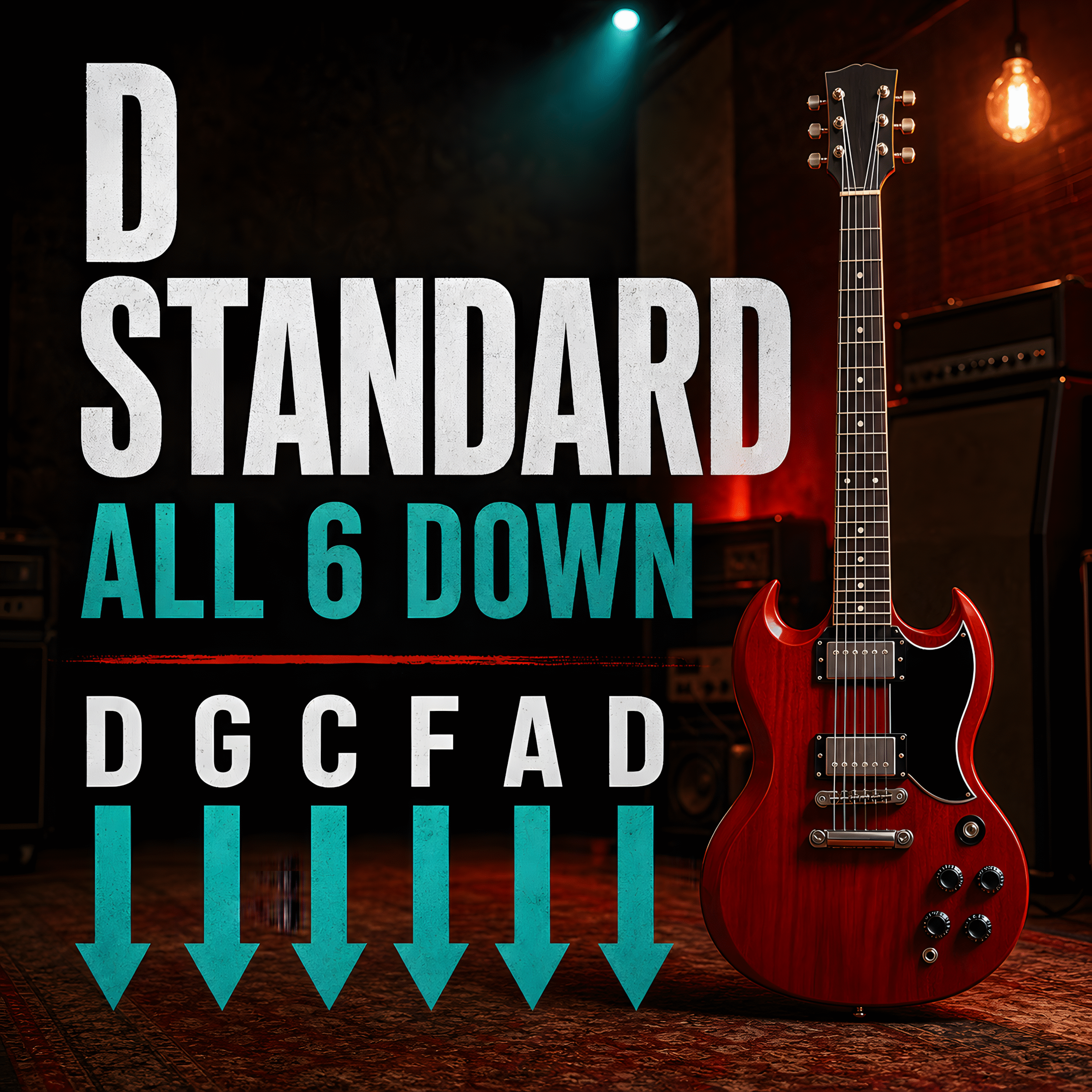
D standard tuning (also called whole step down tuning) drops every string on your guitar two semitones: E A D G B E becomes D G C F A D. Your chord shapes stay exactly the same — everything just sounds lower, heavier, and a little looser under your fingers.
This guide covers the exact notes and frequencies, the fastest way to tune down, what it does to your string tension, and the records that made this tuning famous.
Tune down right now:
- Open the whole step down guitar tuner — the preset shows every target note so you can't get lost
- Coming from Eb? Read Eb standard tuning first
What is D standard tuning?
D standard is standard tuning shifted down a whole step (two semitones) on every string. Nothing about the relationships between strings changes — a G chord shape is still a G chord shape, a minor pentatonic box is still a minor pentatonic box. The whole fretboard simply sounds one whole step lower, so that G shape now rings out as an F chord.
You'll see the same tuning under several names:
- D standard
- whole step down (or "full step down")
- DGCFAD
They all mean the same six notes. Guitarists use it for two big reasons: the sound gets darker and thicker, and the strings get slack enough that big bends feel easy. That's why it shows up everywhere from Metallica to death metal to modern emo.
D standard tuning notes: D G C F A D
Here is every string with its exact target pitch. If your tuner shows cents, aim for ±2 cents of dead center.
| String | Standard | D standard | Frequency |
|---|---|---|---|
| 6th (thickest) | E2 | D2 | 73.42 Hz |
| 5th | A2 | G2 | 98.00 Hz |
| 4th | D3 | C3 | 130.81 Hz |
| 3rd | G3 | F3 | 174.61 Hz |
| 2nd | B3 | A3 | 220.00 Hz |
| 1st (thinnest) | E4 | D4 | 293.66 Hz |

How to tune a whole step down, step by step
- Open the whole step down tuner preset, tap Start listening, and allow microphone access.
- Pluck the 6th string and turn its peg to lower the pitch from E to D. Go slightly below D, then tune back up to it — strings settle better when the last motion tightens them.
- Repeat low to high: A → G, D → C, G → F, B → A, E → D.
- Do a second pass. Dropping all six strings removes a lot of tension from the neck, and that relief nudges the strings you tuned first. One quick recheck fixes it.
- Strum a big open chord and listen for slow "beating" between notes — that wobble means one string is still a few cents off.
If the tuner needle jumps around, mute the strings you aren't tuning with your fretting hand and pluck once with a medium, consistent attack. Struggling to get a stable reading at all? See why an online tuner stops picking up your guitar.
Here's a solid video reference if you want to tune along by ear:
Reference tones for tuning one whole step down. Match each string, then confirm with the mic tuner.
Why would you tune a whole step down?
Four practical reasons come up constantly:
- Vocals. The most common one I see at rehearsals: the singer can't quite reach the top notes, so the whole band drops a step and keeps every shape they already know.
- Heavier tone. Lower pitch plus slightly slack strings reads as "thicker" instantly, which is why so much metal lives here.
- Easier bends. A whole step down, a full-step bend feels like a half-step bend. Blues and lead players tune down for this alone — it's a big part of how those wide vocal-style bends on old SRV and Hendrix records feel (they went down a half step; D standard is one step further).
- Matching records. If the band you're learning recorded in D standard, learning it in standard means everything you play is a step sharp against the track.
The tradeoff is tension. Light strings that feel great in E standard can turn rubbery and buzzy in D. More on gauges below.
Is drop D tuning a full step down?
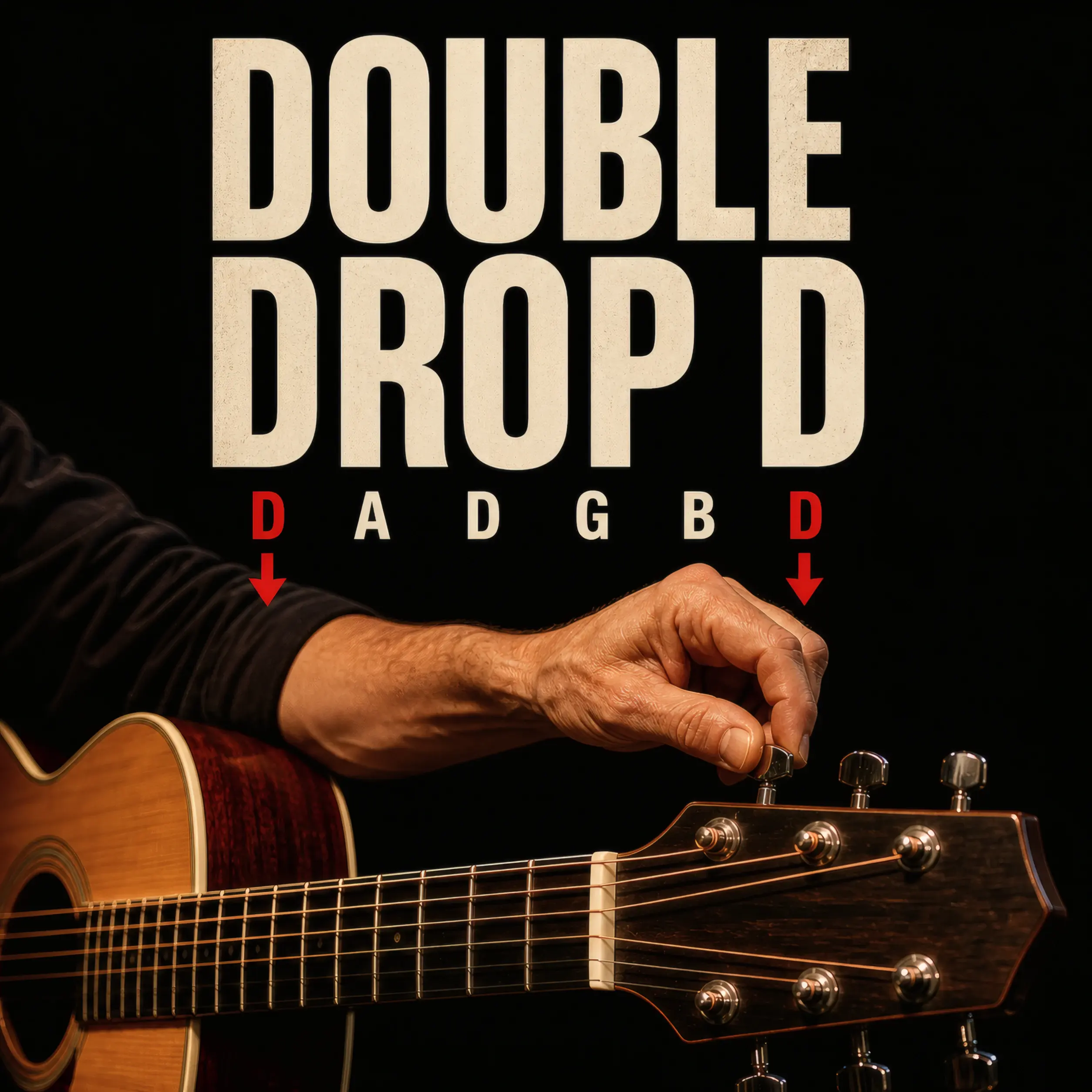
No — and this is the single most common mix-up with this tuning. Drop D lowers only the 6th string (D A D G B E). D standard lowers all six (D G C F A D). Here's how the common downtunings actually compare:
| Tuning | Notes (low → high) | What moved | One-finger power chords? |
|---|---|---|---|
| Standard | E A D G B E | nothing | no |
| Drop D | D A D G B E | 6th string only | yes |
| Eb standard | Eb Ab Db Gb Bb Eb | all strings, −1 semitone | no |
| D standard | D G C F A D | all strings, −2 semitones | no |
| Drop C | C G C F A D | D standard, then 6th down again | yes |
A useful way to remember it: drop C is to D standard what drop D is to E standard. If you're comfortable in D standard and your riffs want that one-finger power chord shape, drop C is one peg turn away.
String gauges and setup for D standard
Tune a guitar with 9s down a whole step and the low D flops. It still works, but palm mutes lose their snap and hard picking pushes notes sharp. If you're staying in this tuning, match your strings to it:
| Strings you use in E standard | Feel in D standard | If you live in D standard |
|---|---|---|
| 9–42 | very loose, buzzy | move to 10–46 or 10–52 |
| 10–46 | playable but soft | move to 11–49 |
| 11–49 | comfortable, close to "normal" | you're set |
On my own hardtail I keep a set of 11–49 for D standard work; with 10s the low D turned into a rubber band above the 12th fret. Skinny-top/heavy-bottom sets (10–52, 11–54) are popular here for exactly that reason: normal feel on the plain strings, real tension on the wound ones.
Three setup notes that matter more when you tune down:
- Nut binding. If you hear a ping while tuning or pitch jumps in little steps, the string is catching in the nut slot. Common after moving to heavier gauges — a tech can fix it in minutes.
- Floating tremolos. Less string tension means the springs pull the bridge back. Tune all strings down gradually in passes rather than one string fully at a time, and expect to adjust spring tension if the bridge should sit level.
- Intonation. If the guitar stays in D standard permanently, check your guitar intonation at the 12th fret. Open strings in tune but chords sour up the neck is the classic symptom.
New strings drifting flat for the first hour is normal in any tuning — stretch them gently and retune. If tuning instability persists, run through why your guitar won't stay in tune.
The capo trick: get back to standard without retuning
Keep your guitar in D standard and clamp a capo at the 2nd fret — you're back at standard pitch. Every open shape sounds in its "normal" key again.
This is genuinely useful at practice when one song in the set is in E standard and everything else is down a step. It isn't a perfect substitute — string tension stays slack and your reachable low note is still capo-limited — but it beats retuning six strings twice mid-set.
It works in reverse for learning, too: some players tune down and capo up just to get lighter-feeling strings at standard pitch.
Songs in D standard tuning
A short list that covers a lot of stylistic ground — all of these sit in whole step down tuning:
| Song | Artist | Notes |
|---|---|---|
| Sad but True | Metallica | the classic D standard riff |
| The Thing That Should Not Be | Metallica | slow, heavy, great palm-mute practice |
| Come as You Are | Nirvana | that intro riff is D standard, not standard |
| Spirit Crusher | Death | Chuck Schuldiner's later albums live here |
| Voice of the Soul | Death | instrumental, beautiful in this tuning |
| Walk | Pantera | close to D standard — Dimebag tuned slightly flat of it |
| Poor Aileen | Superheaven | the modern grunge-revival end of the tuning |
| Promise Everything | Basement | melodic emo/alt in full step down |
Learning any of these? Tune down first, then loop the riff slowly against the online metronome — downtuned riffs hide sloppy timing under all that low end.
D standard tuning on bass and acoustic
Bass: the same idea applies — E A D G becomes D G C F. Bassists follow the guitars down so the band stays locked. Use the bass whole step down tuner; the low D on a 4-string sits at 36.71 Hz, so give the tuner a clean, firm pluck near the neck.
Acoustic: D standard sounds gorgeous on acoustic — slack, warm, almost baritone. Light strings (11s) get noticeably floppy, though, and fixed acoustic saddles mean you can't easily re-intonate. Mediums (12s or 13s) handle the drop much better. Singer-songwriters often use it to sit a song lower without changing fingerings.
FAQ: whole step down tuning
Is whole step down the same as D standard?
Yes. Whole step down, full step down, DGCFAD, and D standard all describe the same tuning: every string lowered two semitones from standard.
What tuning is Eb Ab Db Gb Bb Eb?
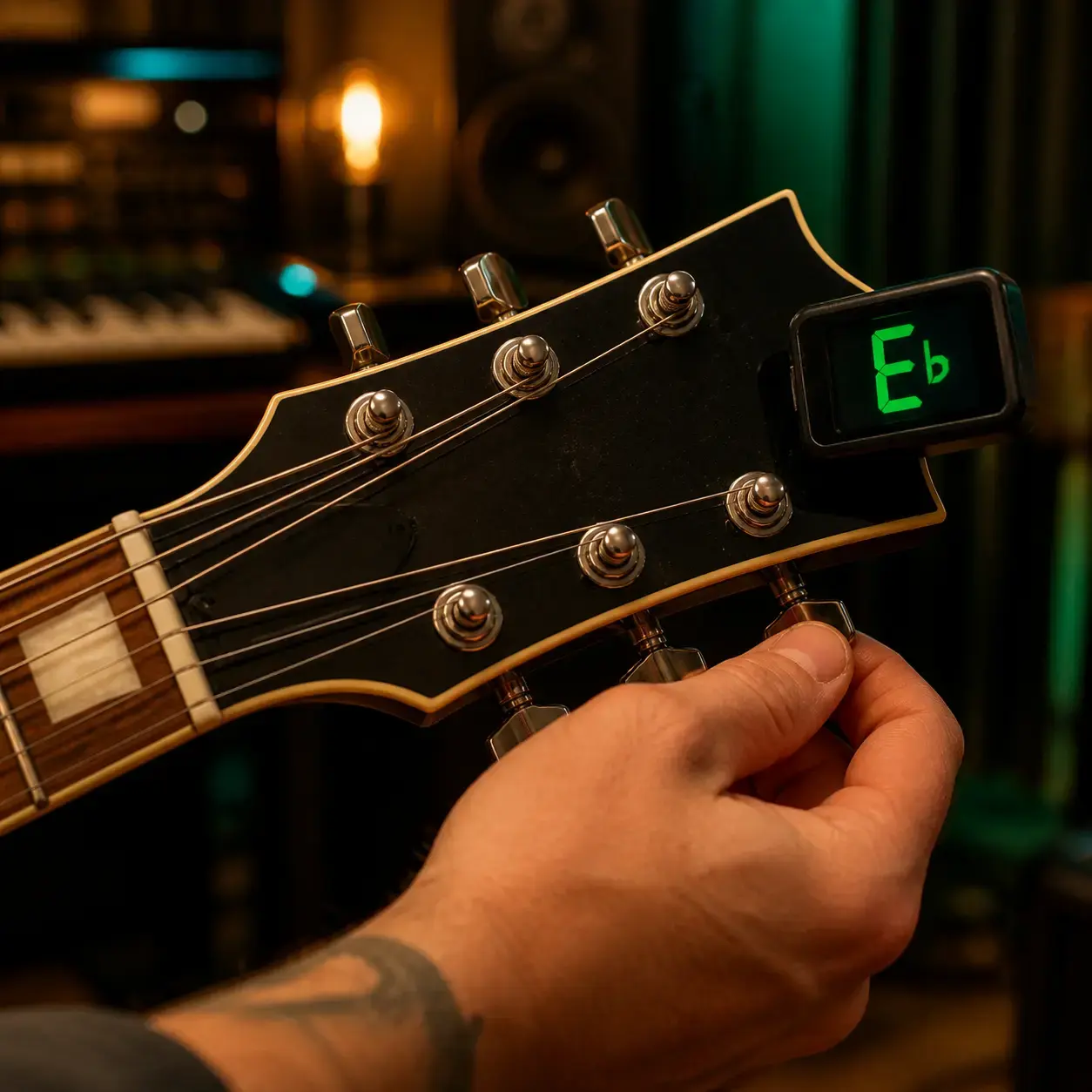
That's half step down (Eb standard) — every string lowered one semitone, not two. It sits exactly between E standard and D standard. Guns N' Roses, Jimi Hendrix, and SRV are the famous residents. Eb standard guide here.
Do I need heavier strings for D standard?
Not necessarily. If your current set feels fine and doesn't buzz, keep it. If the low strings feel floppy or you're getting fret buzz, going up one gauge (10s → 11s) restores roughly the tension you had in standard.
Will my chord charts still work?
Yes — every fingering works unchanged. Only the sounding pitch changes: your E-shape chord sounds as D, your G shape sounds as F. If you play with someone in standard tuning, agree on whether you're calling shapes or concert pitch, or you'll spend the rehearsal confused.
What is step-down tuning?
"Step-down tuning" is the family name for any tuning where all strings drop by the same interval: half step down (Eb), whole step down (D), one-and-a-half steps (C#/Db standard), two steps (C standard). D standard is the most popular stop after Eb.
Tune down and play
- Open the whole step down guitar tuner — mic-based, free, with every target note on screen
- Want one-finger power chords instead? Drop D tuning is the easier first step
- Keep the low end tight: practice with the online metronome
- Don't confuse D standard with a dropped tuning. These Drop C# songs use C# G# C# F# A# D#, with one-finger power chords.