Stevie Ray Vaughan strung his Strat with 13s, bass-guitar-thick by electric standards, and the only reason his hands survived them is that he tuned the whole guitar down a half step. That trade, thicker strings paid for with lower pitch, built one of the biggest tones ever recorded.
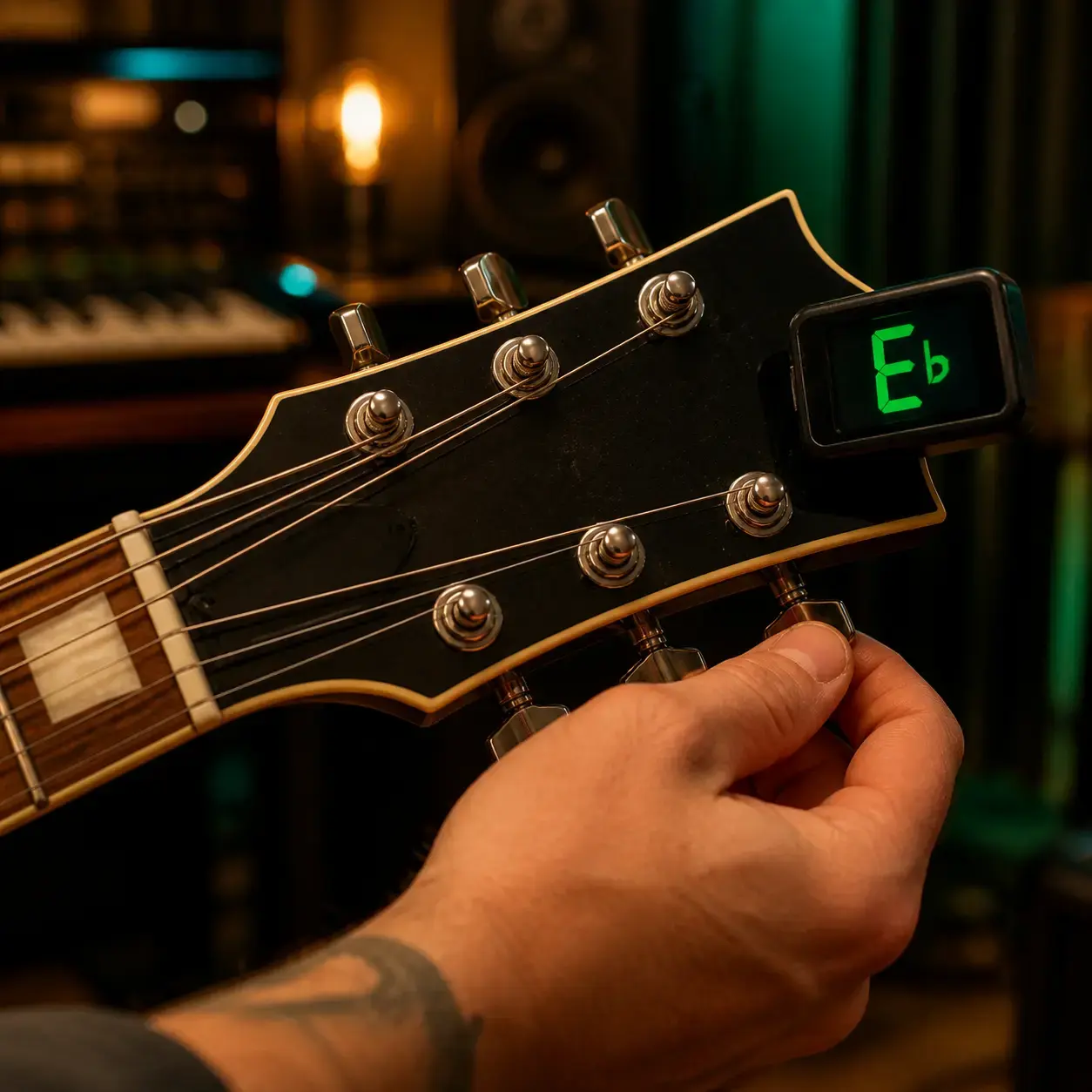
Eb standard is that tuning. Every string drops one semitone, Eb Ab Db Gb Bb Eb, and every chord shape you know comes along unchanged.
Two links before your pegs move:
- Half-step down tuner preset — mic tuner with all six Eb targets on screen
- Not sure what you're tuned to right now? Start from standard
Eb standard, string by string

Some tuners and tab sites spell it sharp instead of flat, D# G# C# F# A# D#. Same six pitches. Guitarists say "Eb" almost universally, and the tab site that writes D# is describing the identical tuning, so don't let the spelling spook you.
The intervals between strings haven't changed. That is the entire point. Your E-shape barre is still an E-shape barre; at any fret, it sounds one semitone lower than it did in standard tuning.
Why bands live a half step down
I spend a lot of session time in Eb, and it's almost never about tone first.
- Singers. A vocalist fighting the top note of a chorus gets it back when the whole band drops a semitone. Nobody relearns anything. I've retuned in the studio hallway mid-session for exactly this reason more times than I can count.
- Bends and vibrato get noticeably easier. Less tension means your fingers push less metal.
- Heavier strings become playable. The SRV trade. Tune down, gauge up, and you keep familiar tension with a thicker core sound.
- The guitar sits a shade darker. Subtle on its own, obvious when a whole mix lives there.
And there's history pulling people in. Jimi Hendrix spent most of his catalog a half step down. Slash's Appetite-era parts, Van Halen's first records, huge stretches of SRV. Learning those songs from tab in standard tuning is how most players discover Eb exists, usually after twenty confusing minutes of "why does this sound wrong?"
How to tune half step down
Open the half-step down preset, let it hear you, and take the strings in order.
- 6th string from E to Eb. Loosen slowly. A semitone is a small move, maybe a quarter turn on most machine heads.
- 5th to Ab, 4th to Db, 3rd to Gb.
- 2nd to Bb, then 1st to Eb.
- Sweep all six again. Dropping total tension lets the neck relax a hair, which nudges the strings you tuned first.
Overshot a target? Go slightly below the note and come back up to it. Strings settle better approaching from underneath, and it's the same habit that keeps you stable in any tuning.
A fixed-bridge guitar is done in ninety seconds. A floating tremolo is a different story. The bridge tilts back as string tension falls, so every string you lower pulls the other five slightly sharp, and your first pass lands comically wrong. Expect two or three passes. If the guitar lives in Eb permanently, a tech can rebalance the trem springs in ten minutes so the bridge sits level again, worth every penny of the bench fee.
Eb tuning songs worth learning
The repertoire is enormous, and these five teach the tuning's personality fast.
- Pride and Joy, Stevie Ray Vaughan. The Eb shuffle. Fat strings, fat tone, and the open low string is the song's engine.
- Little Wing, Jimi Hendrix. The chord-melody style leans on open-string embellishments that only ring right a half step down.
- Sweet Child O' Mine, Guns N' Roses. That opening riff in standard tuning sounds close and wrong. In Eb it locks to the record.
- Voodoo Child (Slight Return). The wah intro alone justifies the retune.
- Van Halen's Runnin' with the Devil era, if you want to hear Eb under a brighter, bouncier band instead of blues.
Play along with the originals and your open strings finally agree with the recording, which is the moment Eb stops feeling abstract.
Reference tones for all six Eb strings — useful for ear-matching if you're tuning somewhere the mic tuner can't hear you.
Strings and setup in Eb
Most guitars take a half step down with zero drama. Your 9s or 10s get slightly bendier and a little buzzier, and that's the whole cost.
If the looseness bothers you, move up one gauge. A 10 set at Eb feels close to a 9 set at standard, near enough that most hands can't tell. Going the full SRV route with 12s or 13s is legitimate too, but that jump changes nut slots and neck relief, so budget for a proper setup rather than fighting a guitar that suddenly behaves strangely.
Fret buzz that appears only after tuning down usually means your action was already marginal. And if chords ring fine open but sour up the neck after the change, that's intonation, its own adjustment.
One more practical trick from the old-timers. Eb plus a capo on the 1st fret equals standard pitch exactly, so a band living in Eb can still play that one song in E without anyone retuning. I keep a capo on the mic stand for it.
FAQ: Eb standard tuning
Is Eb standard the same as half step down tuning?
Yes, identical. "Eb standard," "half step down," "Eb tuning," and "D# standard" all describe the same six notes, Eb Ab Db Gb Bb Eb. The name just depends on who you learned it from.
What tuning did Jimi Hendrix use?
Eb standard, on the overwhelming majority of his recordings. Down a half step gave his big hands looser strings for the thumb-over voicings and let his vocals sit in friendlier keys. Learning Hendrix in standard tuning is possible but it will never quite match the records.
Do I need heavier strings for Eb?
Need, no. A regular set works fine one semitone down. If the strings feel too slack or you're getting new buzz, one gauge heavier restores the familiar tension. Players chasing the SRV thing go much heavier, and that requires a setup.
How is Eb standard different from D standard?
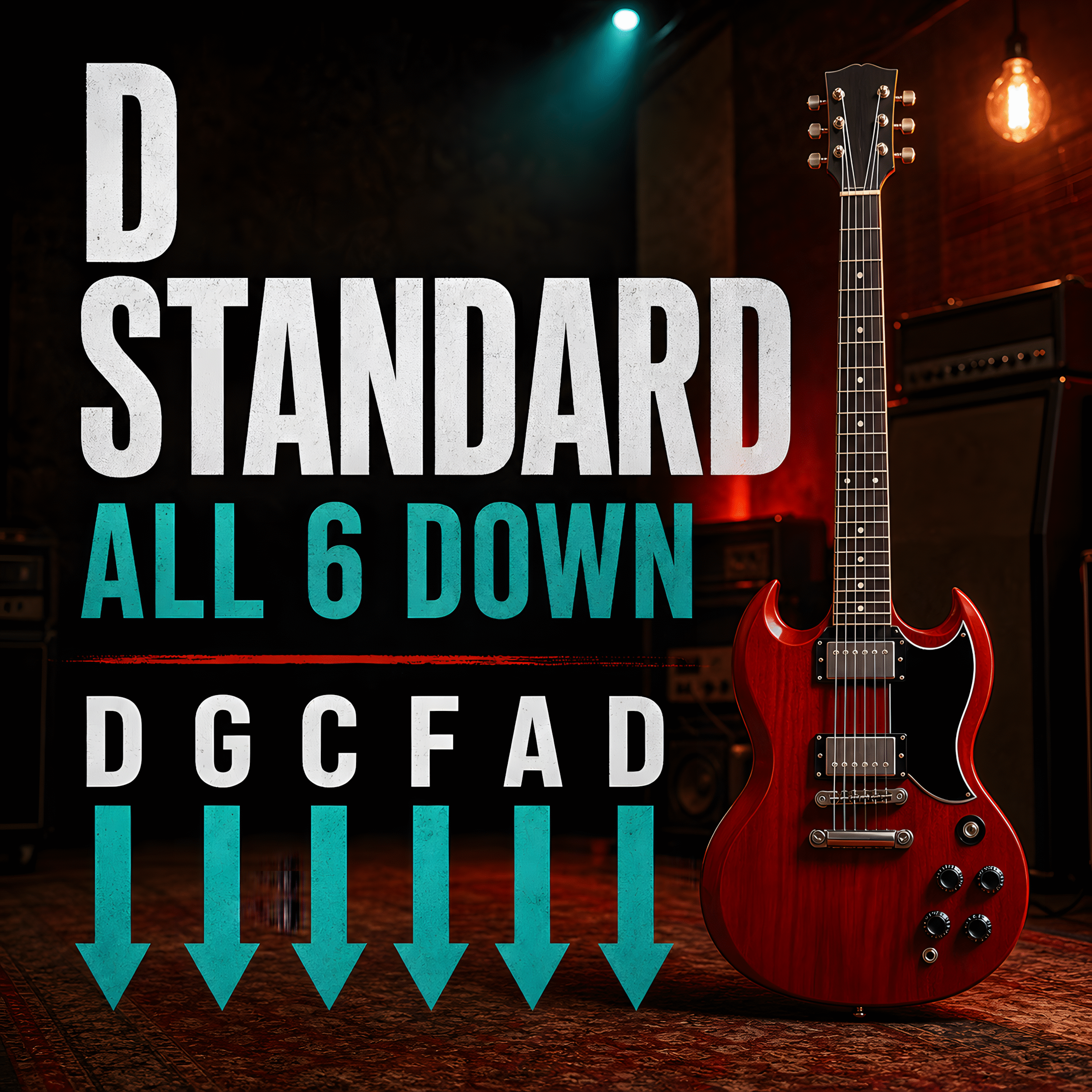
D standard is a whole step down (D G C F A D), twice the drop of Eb. It's darker and looser again, popular for heavier styles. The D standard guide covers it, and Eb is the sensible first stop on the way there.
Can the online tuner hear Eb notes?
Yes. The half-step down preset listens through your mic with each string's exact Eb-family target displayed, so you're never converting note names in your head while a peg is moving.
Drop the half step
Open the half-step down tuner, take all six strings down a semitone, and play something you know well. Same fingers, warmer guitar. If the singer smiles, you'll know why half the classic rock canon lives here.