Open G tuning turns your guitar into a chord the moment you strum it. It's a favorite for slide, chunky rhythm parts, and songwriting because you can grab big chord sounds with simple shapes.
This guide shows you how to tune to Open G (D G D G B D) and what to play once you're there.
Quick CTA:
- Open the preset: Open the Open G guitar tuner
- Browse shapes by tuning: Open the chord library
What Open G tuning is
In Open G, the open strings spell a G major chord. From low to high:
D - G - D - G - B - D
Compared to standard tuning (E A D G B E), you change three strings:
- 6th string: E down to D
- 5th string: A down to G
- 1st string: E down to D
Everything else stays the same.
Tune to Open G in under two minutes
Start here:
1. Drop the 6th string from E to D
- Play the 6th string open.
- Loosen until the tuner reads D and centers.
2. Drop the 5th string from A to G
- Play the 5th string open.
- Loosen until the tuner reads G.
Tip: this is a bigger drop than the low string. Go slow so you do not overshoot.
3. Drop the 1st string from E to D
- Play the 1st string open.
- Loosen until the tuner reads D.
4. Recheck all strings once
Do a fast pass:
D - G - D - G - B - D
Then strum all six strings. If it does not sound like a clean chord, one string is off. Check them one by one with the tuner.
The core Open G chords (one shape, three chords)
Open G is popular because you can get a full chord by barring straight across one fret.
Your I chord: G (open strings)
Strum everything open:
0 0 0 0 0 0
That is the whole point of Open G. It's an instant, full sound.
Your IV chord: C (barre at the 5th fret)
Lay one finger across all strings at fret 5:
5 5 5 5 5 5
You get a C chord sound (with extra ringing notes that work for most rhythm parts).
Your V chord: D (barre at the 7th fret)
Barre at fret 7:
7 7 7 7 7 7
Now you have D. With these three positions, you can play a lot of songs.
Add one finger for richer chords
If you want more than straight barre chords, start with small changes:
- Add a finger on the 2nd string to change the color.
- Hammer-on one note inside the barre chord.
- Leave the top string ringing for a drone.
When you want exact names and fingerings, use the chord library in your tuning:
Slide tips that make Open G sound clean
Open G is a slide tuning for a reason. The barre-chord idea becomes even easier with a slide.
Aim for the fret wire, not the space
With a slide, pitch centers when the slide sits over the fret wire, not between frets like a normal note. If you're sharp or flat, move the slide a few millimeters.
Use light pressure
Pressing down hard pushes the string to the fretboard and makes the note go sharp. Let the slide rest on the strings and do the work.
Mute with both hands
Open tunings love to ring. That's good, but it can also get messy fast.
- Picking hand: palm-mute the low strings when you do not need them.
- Fretting hand: use spare fingers behind the slide to kill extra noise.
Practice the three positions first
Set a slow tempo and play:
- open (G)
- 5th fret (C)
- 7th fret (D)
Use a metronome so your slide moves land on time:
Common Open G problems (and fixes)
The tuner keeps jumping between notes
- Pluck one string at a time.
- Move closer to the mic.
- Turn down other instruments and backing tracks.
If you're in a noisy room, the built-in mic can struggle. Face the guitar toward the mic and pick closer to the bridge for a clearer attack.
One chord sounds wrong even though the open chord sounds fine
That often points to intonation or old strings.
- Check your 12th-fret harmonic vs the 12th-fret fretted note.
- If they do not match, your guitar needs intonation adjustment.
If you want a full checklist, start here:
Why your guitar won't stay in tune
The 5th string feels too loose after dropping to G
That's normal on light gauge strings. If it feels floppy:
- pick lighter
- try a heavier set next restring
- consider tuning to Open G with a capo up a fret or two for practice (then retune for recording)
FAQs: Open G tuning
Is Open G the same as Drop D?
No. Drop D changes one string (low E down to D). Open G changes three strings and gives you a full chord when you strum open.
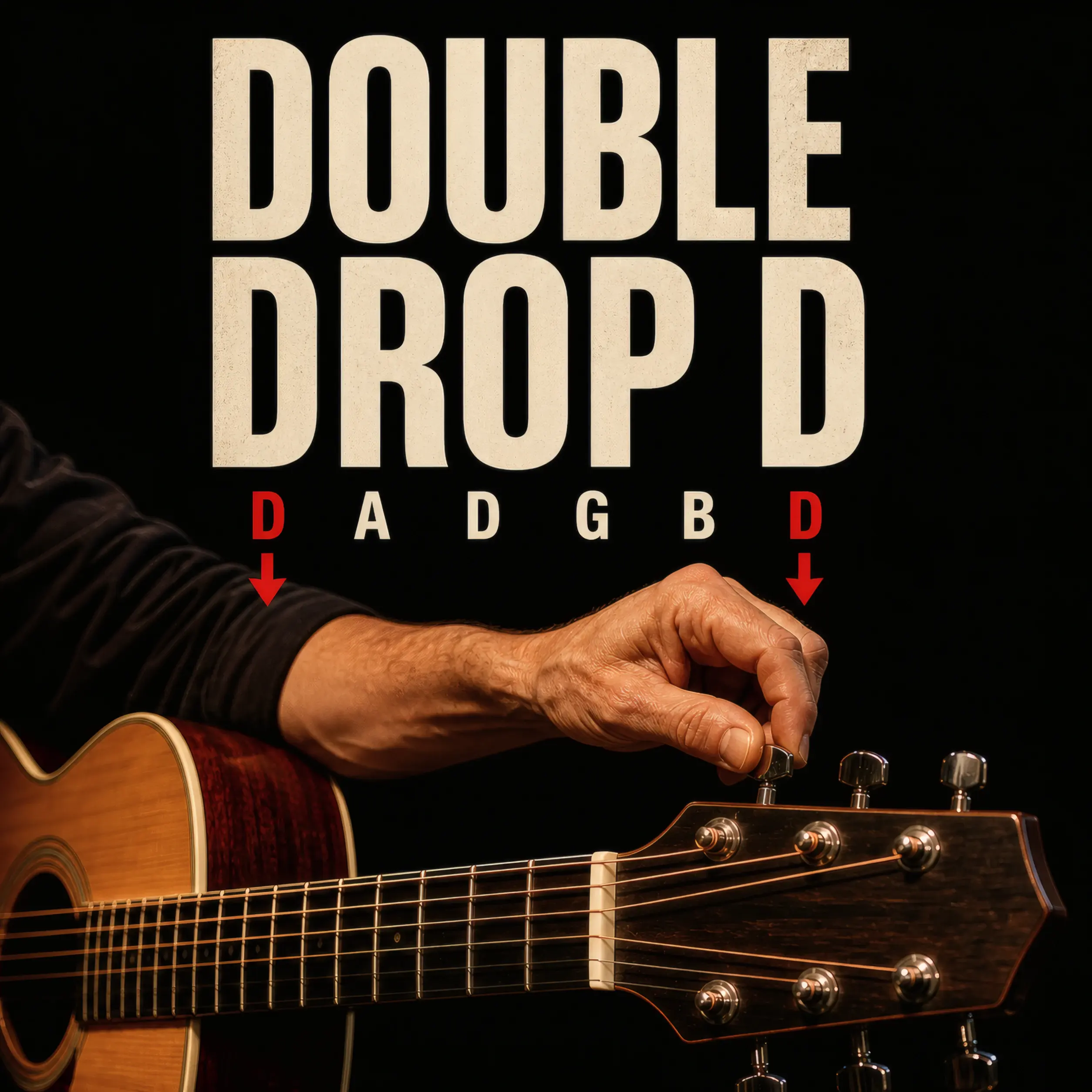
If you want the Drop D path, use this guide:
Do I have to use a slide in Open G?
No. Open G works for rhythm guitar, riffs, and fingerpicking. Slide is optional.
Can I use Open G on acoustic guitar?
Yes. Open tunings can sound huge on acoustic because the whole body resonates with the chord.
Will Open G damage my guitar?
No. You're tuning down, which reduces tension compared to standard.
What is the quickest way to check I'm in Open G?
Strum all six open strings. It should sound like a stable chord, not a wobbling cluster. If it wobbles, open the preset and check each string:
Next step: tune, strum, and build a progression
Open the preset, tune the three strings that change, then play a simple progression using open, 5th, and 7th fret barres:
If you want a tuning that keeps more standard shapes, half-step down is a good next stop: