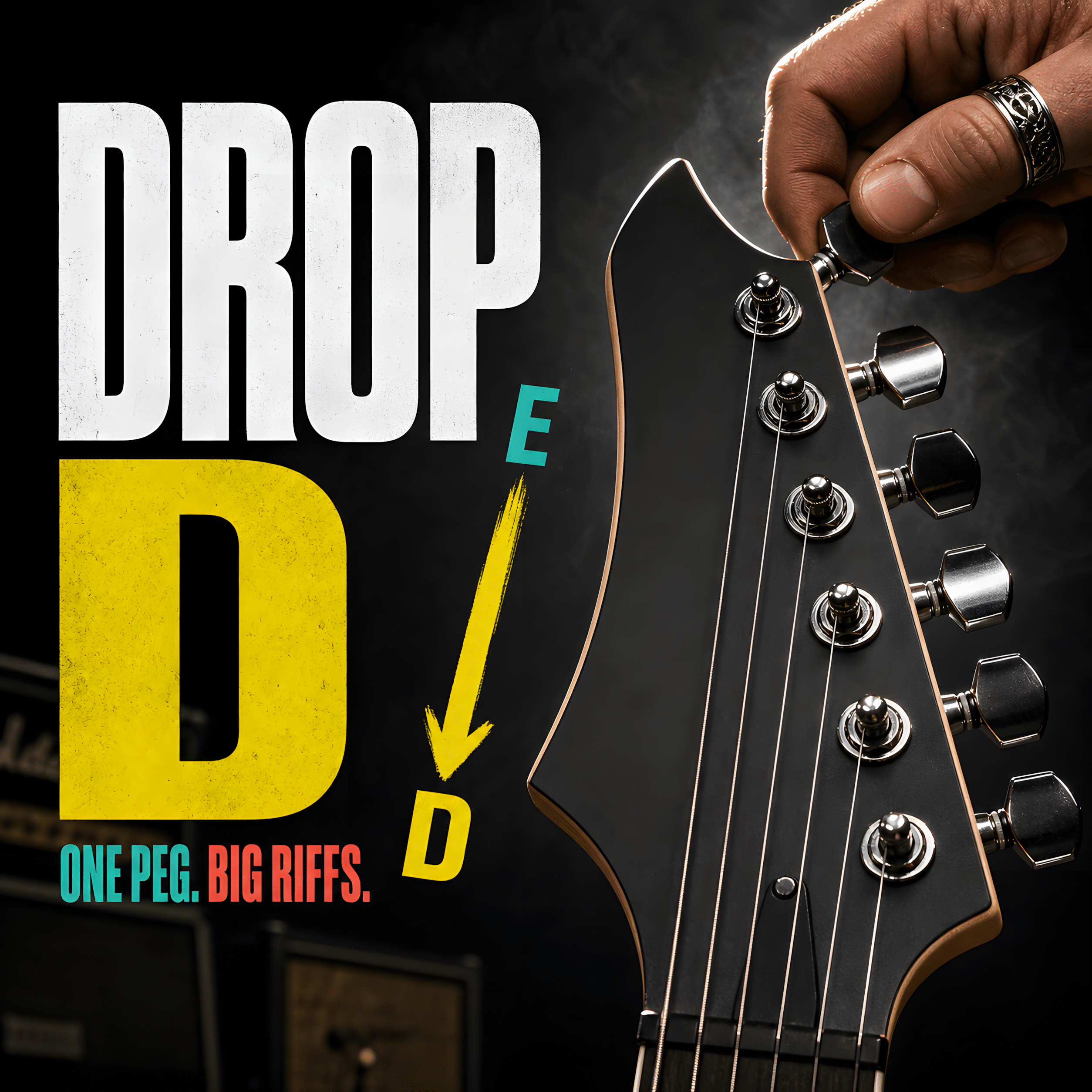
Drop D tuning changes exactly one string: the low E comes down a whole step to D, turning E A D G B E into D A D G B E. That single peg turn gets you one-finger power chords, a heavier low end, and access to a huge catalog of rock, metal, and worship songs — which is why it's the first alternate tuning most guitarists ever learn.
Tune down now: open the drop D tuner — mic-based, free, with the low string's target marked as D.
What is drop D tuning?
Drop D is standard tuning with the 6th string (the thickest one) lowered two semitones, from E2 to D2. The other five strings don't move. That has two immediate consequences:
- The bottom three strings become D–A–D — a root, fifth, and octave. Barre one finger flat across them at any fret and you get a full power chord.
- Everything you already play on strings 5–1 still works. Open C, Am, Em, D — same shapes, same sound. Only chords that use the 6th string need adjusting.
That's the whole trick: maximum riff payoff for a one-string change. It's a much smaller commitment than D standard, where all six strings come down.
Drop D tuning notes: D A D G B E
| String | Note | Frequency |
|---|---|---|
| 6th (thickest) | D2 ← was E2 | 73.42 Hz |
| 5th | A2 | 110.00 Hz |
| 4th | D3 | 146.83 Hz |
| 3rd | G3 | 196.00 Hz |
| 2nd | B3 | 246.94 Hz |
| 1st (thinnest) | E4 | 329.63 Hz |

How to tune a guitar to drop D (step by step)
- Open the drop D tuner preset, tap Start listening, and allow microphone access.
- Pluck the open 6th string and let it ring. The tuner will read E (or close to it).
- Turn the 6th string's peg to lower the pitch. Go slowly — you'll see E → Eb → D on the display.
- Overshoot slightly below D on purpose, then tune up into it until the needle centers and the cents readout sits near 0. Finishing on a tightening motion helps the string hold pitch.
- Quickly confirm the other five strings still read A, D, G, B, E — dropping one string barely changes neck tension, but a 10-second check costs nothing.
- Play the open bottom three strings together (D–A–D). If it sounds like one big, solid chord, you're done.
If the tuner won't lock onto the low D, mute the other strings with your fretting hand, pluck once with medium attack, and get closer to the mic — 73 Hz is the hardest note on the guitar for a phone mic to hear cleanly.
Prefer to follow along with a lesson? This one is short and gets it right:
How to tune to drop D without a tuner (by ear)
Drop D is the easiest tuning to reach by ear because the guitar hands you the reference note:
- Pluck the open 4th string — that's a D, one octave above where your 6th string is headed.
- Pluck the 6th string and lower it until the two notes stop clashing and lock into a clean octave. Listen for the "wah-wah-wah" beating to slow down and disappear.
- Cross-check: the 12th-fret harmonic on the 6th string (touch lightly above the fret, don't press) should now match the open 4th string exactly — same pitch, not an octave apart.
I use the harmonic check on dark stages between songs; harmonics ring long and pure, so you can tune while the singer is still talking. Do a proper tune-up by ear practice session and this becomes a five-second move.
Drop D tuning chords: one-finger power chords
The signature move — lay one finger flat across strings 6–5–4 at the same fret:
| Fret (strings 6–5–4) | Power chord |
|---|---|
| open | D5 |
| 2 | E5 |
| 3 | F5 |
| 5 | G5 |
| 7 | A5 |
| 10 | C5 |
| 12 | D5 (octave) |
Three things to try in your first ten minutes:
- Chug and slide. Palm-mute the open D–A–D, then slam the one-finger shape at the 3rd and 5th frets. Congratulations, you've written a rock riff.
- Full-neck D chords. Strum an open D chord shape but include all six strings. In standard that low E would clash; in drop D you get a huge three-octave D major.
- Pedal tone. Let the open low D ring while you move shapes on the higher strings — the anchor note under everything is the sound of half the post-rock and worship catalog.
Chords that used the low E string need editing: a standard E-major shape now needs its bass note at the 2nd fret of the 6th string. Everything rooted on the 5th string is untouched. Browse drop-D-friendly voicings in the chord library.
Songs in drop D tuning
All of these live in drop D — a decent starter set from easy to riff-heavy:
| Song | Artist | Why it's worth learning |
|---|---|---|
| Everlong | Foo Fighters | the definitive drop D strumming workout |
| Dear Prudence | The Beatles | fingerpicked arpeggios over a droning low D |
| Outshined | Soundgarden | slow, heavy riffing on the open low D |
| Black Hole Sun | Soundgarden | drop D used for color, not heaviness |
| Killing in the Name | Rage Against the Machine | one-finger power chords doing exactly their job |
| Grace | Jeff Buckley | drop D far outside rock-riff territory |
| Slither | Velvet Revolver | classic modern-rock chug |
| The Beautiful People | Marilyn Manson | two notes, massive sound |
One myth worth killing: "Kashmir" is not drop D — Led Zeppelin played it in DADGAD. If a song sounds droney and modal rather than chuggy, it may be in DADGAD instead. And if you drop both E strings, you get double drop D — Neil Young territory. Nirvana's "Heart-Shaped Box" gets mislabeled as drop D too, but the record is a half step lower, in drop C#.
Want a gentler order to learn them in? The easy Drop D songs list ranks riffs by how fast they come together.
Once you can play a riff, tighten it against the online metronome at 80 BPM before you speed up. Palm-muted drop D riffs expose loose timing fast.
Drop D vs D standard: not the same thing
People say "tuned to D" for both, which causes endless confusion:
- Drop D = D A D G B E — only the 6th string drops. Shapes on the top five strings are unchanged; you get one-finger power chords.
- D standard = D G C F A D — all strings drop a whole step. Every shape sounds lower; power chords stay two-finger.
If a song sounds heavier than standard but the power chords clearly need one finger, it's drop D. If the whole song — melodies included — sits a step low, it's D standard. Going heavier still? Drop C vs drop D compared here.
Is drop D tuning bad for your guitar?
No. Lowering one string a whole step reduces tension slightly — roughly 15–20% on that string — which is well within what any guitar handles daily. A few honest caveats:
- Floppy low string. With 9-gauge strings the low D can buzz and sound undefined. A heavier bottom (10–52) keeps it tight. If your riffs sound blurry, that string is the first thing I check — full checklist in why drop D sounds muddy.
- Floating tremolos. On a Floyd Rose or floating Strat bridge, one string's tension change makes the other five drift. Retune in two or three passes, or keep a hardtail in drop D.
- Intonation. If the low string is in tune open but chords up the neck sound sour, check your intonation — the thicker string travel in drop D exposes it.
Constantly bouncing between standard and drop D in one session won't hurt the guitar either; it's just tedious. Gig trick: group your drop D songs together in the set, or bring a second guitar already tuned.
Drop D tuning on bass and acoustic guitar
Bass: same move, same payoff — E A D G becomes D A D G, and metal bassists follow the guitars down. The bass drop D tuner marks the low D target (D1, 36.71 Hz — pluck firmly and let it ring so the mic catches it).
Acoustic: drop D is arguably even more useful on acoustic. Fingerstyle players use the low D as a thumb drone, and big open D voicings sound enormous on a dreadnought. No setup changes needed for occasional use.
FAQ: drop D tuning
What notes is drop D tuning?
D A D G B E, from thickest string to thinnest. Only the 6th string differs from standard tuning — it drops from E2 down to D2 (73.42 Hz).
Is drop D the same as DADGBE?
Yes — DADGBE spells out drop D's six strings. But it is not the same as DADGAD, which also changes the 2nd and 1st strings and sounds modal rather than riff-oriented.
Can I play normal songs in drop D?
Mostly. Anything played on strings 5–1 sounds identical. Songs that use the open low E or 6th-string root shapes will sound wrong until you adjust those notes up two frets — or just tune back up for that one song.
Do I need a special tuner for drop D?
No — any chromatic tuner works. A drop D preset just makes it faster because the target note for each string is on screen, so you can't accidentally stop at Eb.
Is drop D good for beginners?
Yes — it's the gentlest introduction to alternate tunings. One string changes, the payoff is instant, and returning to standard is one peg turn. Many teachers use drop D power chords to get new players riffing in their first week.
Tune down and start riffing
- Open the drop D tuner and drop that low E
- Lock in your palm mutes with the online metronome
- Ready for the next step down? Compare drop C vs drop D or go all-strings-down with D standard