Lou Reed tuned all six strings of his guitar to the same note, called the result his ostrich guitar, and cut two Velvet Underground classics with it. So the bar for weird guitar tunings is low. Most of the famous ones were accidents, or jokes that hung around long enough to become a sound.
This page is the strange end of the tuning universe. Nine tunings that shouldn't work but do, the stories behind them, and a six-step method for inventing your own. Every one of them can be built in the free custom tuner, which listens through your mic and shows how far each string is from its target.
Shortcuts:
- Open the custom tuner — build any tuning on this page, hear it, save it
- Browse the preset tunings — the tamer catalog for guitar, bass, and ukulele
The weird guitar tunings chart
Low string first. Four of these already have ready-made preset tuners, linked in the table.
| Tuning | Notes (low → high) | What it does | Hear it in |
|---|---|---|---|
| Ostrich D | D D D D D D | one giant drone | Venus in Furs — The Velvet Underground |
| Nashville (high strung) | E3 A3 D4 G4 B3 E4 | bottom four strings jump an octave, instant shimmer | Wild Horses — The Rolling Stones |
| Sonic Youth's paired strings | F# F# G G A A | three detuned unisons, pure texture | Schizophrenia — Sonic Youth |
| New standard tuning | C G D A E G | stacked fifths, cello range on a guitar | Robert Fripp and the Guitar Craft school |
| All fourths | E A D G C F | one scale shape works everywhere | Stanley Jordan |
| Major thirds | E G# C E G# C | every chord fits inside four frets | jazz chord-melody experimenters |
| Rain Song tuning | D G C G C D | orchestral suspended haze | The Rain Song — Led Zeppelin |
| Nick Drake's Pink Moon tuning | C G C F C E | close cluster voicings under fingerpicking | Pink Moon — Nick Drake |
| Open C6 | C A C G C E | an open chord with a soft sixth in it | Friends — Led Zeppelin |
Nashville gets octave numbers in the chart because the octaves are the whole trick. And ostrich needs them too, quietly. Nobody tunes six strings to the same D — you land on D2 D3 D3 D3 D4 D4, which is covered below.
Wikipedia keeps a much longer list if nine isn't enough for you.
Strange guitar tunings behind real records
The ostrich started as a novelty single. Before the Velvet Underground existed, Lou Reed cut "The Ostrich" with a studio band called the Primitives, all strings on one note, and liked the drone so much it ended up under Venus in Furs and All Tomorrow's Parties.
Sonic Youth built a career on cheap guitars that stayed in strange tunings permanently. Unison pairs like F# F# G G A A, drumsticks wedged under strings, that kind of thing. When one guitar held one tuning, they just bought another guitar.
Joni Mitchell is the deep end. Her own site catalogs more than fifty tunings, and she notated them her own way, a bass note plus fret numbers, C77354 style. Some of that came from adapting to a left hand weakened by childhood polio. Most of it came from chasing chords standard tuning simply does not contain.
And then there's Robert Fripp, who rebuilt the instrument from scratch in the mid-80s with C G D A E G, fifths nearly all the way up. Guitar Craft players spec something like a .007 for that high G — I could be wrong on the exact gauge, but it's thinner than anything in a normal set.
Nick Drake recorded Pink Moon, the whole album, more or less alone in two late-night sessions, most of it in tunings like C G C F C E. That one might be the prettiest tuning ever put on tape.
David Bennett plays through famous songs in genuinely odd tunings — a good ear-tour of the chart above.
Ostrich tuning, string by string
From standard, here's the common route to D2 D3 D3 D3 D4 D4:
- 6th string: E2 down a whole step to D2.
- 5th string: A2 up to D3. This is the scary one, five semitones of extra pull. Go slowly, with strings that aren't ancient.
- 4th string: already D3. Leave it.
- 3rd string: G3 down to D3.
- 2nd string: B3 up to D4.
- 1st string: E4 down to D4.
I snapped a fifth string doing this once on a set that had been on the guitar since spring.. Fresh strings stretch, old ones argue. If the upward pulls worry you, there's a lazier version — drop the 5th to D2 instead, unison with the 6th — and it drones almost as hard.
Detune when you're done for the day. The neck will drift back to its usual relief and your next standard-tuning session won't fight you. Play it with one finger barring across everything and you have the entire Velvet Underground rhythm technique.
How to make your own guitar tuning
Nobody on the chart above asked permission first. Here's the method I use when a tuning idea shows up, usually mid-practice when I'm supposed to be doing something else.

- Start from a sound you already want. A drone note under everything. A chord you wish rang open. Hum it first, then chase it with the pegs.
- Move two strings, no more. On the first pass anyway. Two changed strings keeps most of your muscle memory usable, and you can always go further next week.
- Tune down before you tune up. Down means floppy and forgiving. Up means added tension, and plain strings pulled more than a couple of semitones start snapping. The exception that proves it, ostrich, still stresses people out.
- Keep neighboring strings within about seven semitones. Past that, chord shapes need impossible finger stretches and the tension across the neck gets lopsided.
- Run the numbers. A string tension calculator shows what each detuned string now pulls. If a string sits far below its neighbors, a heavier gauge on just that string fixes the flop. Takes two minutes and it's oddly satisfying.
- Build it in the custom tuner and save it with a real name. The custom tuner uses standard A4 = 440 Hz. If the track calls for a reference pitch from 415 to 465 Hz, use the main tuner's reference-pitch control instead. Then record a voice memo of what it sounds like, because tomorrow you will not remember why C G D G B D felt important.
The one experiment that stuck for me is an open D variant I keep saved for a quiet fingerstyle arrangement of an old hymn — it comes out a few Sunday mornings a year and never in between. That's the point of saving these. They wait for you.
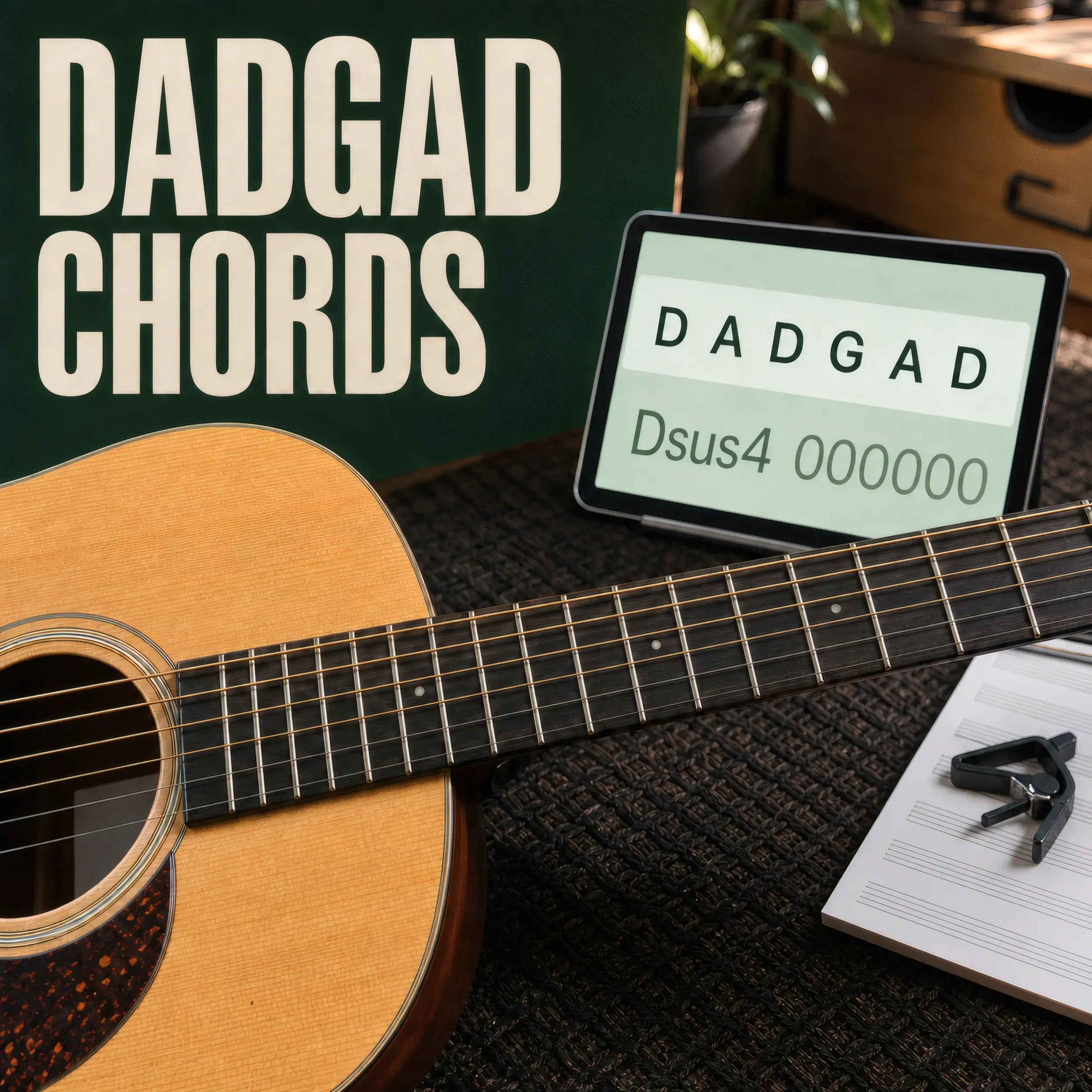
Related reading once you've built something: alternate guitar tunings covers the respectable families, and DADGAD is the friendliest first step off the map.
Weird tunings on an acoustic
A little extra care here. Acoustic tops are thin, braced wood under roughly 70-80 kg of pull, and big up-tunings add real stress to the the bridge. Tune down freely; tune up reluctantly.
The old trick for reaching a raised tuning safely is to build it downward and capo to pitch. To get everything a step above open D, tune plain open D and capo the 2nd fret. Same notes, less pull.
Nashville tuning on acoustic is a special case because it's a restring, honestly a string-set decision more than a tuning. You want the octave strings from a 12-string set for the bottom four. Once it's on, that guitar becomes a shimmer machine layered behind normal guitar, which is exactly how the Stones used it.
Big drops have their own small tax, and it's the nut. A .046 low E flapping at C can buzz in a slot cut for tighter tension. If a dropped string rattles open but frets fine, that's usually why — more on tuning stability here.
Chords in strange tunings
Your open strings are the chord now. Barre one finger flat across any fret and you get the same shape transposed, which is the entire playbook for ostrich and the open tunings. For the in-between tunings, the chord library can show you shapes so you're not deriving everything from scratch by ear.
FAQ: weird guitar tunings
What is the weirdest guitar tuning ever used on a record?
Ostrich D is the usual answer, six strings on one pitch class, and it's hard to top for pure commitment. But Sonic Youth's unison-pair tunings with objects wedged under the strings arguably get stranger, since the tuning was only half the preparation.
What tuning is Schizophrenia by Sonic Youth in?
F# F# G G A A, low to high, per the band's own gear archives. Both guitarists used paired near-unison strings on much of the Sister album, which is where that hovering, detuned shimmer comes from.
What is the most haunting guitar tuning?
Ask five players and you'll get five answers, but open D minor — D A D F A D — is the one that sounds like weather. Strum it open and it's already a lament. DADGAD gets honorable mention for hauntedness per minute of effort.
What is the 55545 method?
It's the old ear-tuning trick for standard tuning. Fret the 5th fret of each string and match the next open string, except on the G string, where you fret the 4th. The name is just those fret numbers in a row. It breaks completely in altered tunings, which is why a chromatic tuner earns its keep the moment you leave standard.
Will weird tunings damage my guitar?
Tuning down, no. Tuning up significantly, or leaving extreme tension on an acoustic for months, can matter — necks shift and tops belly. Strings are the realistic casualty, so keep spares around. If a guitar lives in one weird tuning permanently, a proper setup for that tuning is worth the money.
Can a regular tuner handle weird tunings?
A chromatic tuner can, as long as you already know your target notes and octaves. Preset guitar modes get confused and try to drag you back to E A D G B E. The custom tuner sidesteps that by letting you define the exact targets first, then showing cents offset per string.
Build one before it cools off
If a tuning on this page grabbed you, open the custom tuner and build it while the itch is live. And when you invent your own, save it under a real name. "Untitled tuning 7" helps nobody, least of all you in six months.