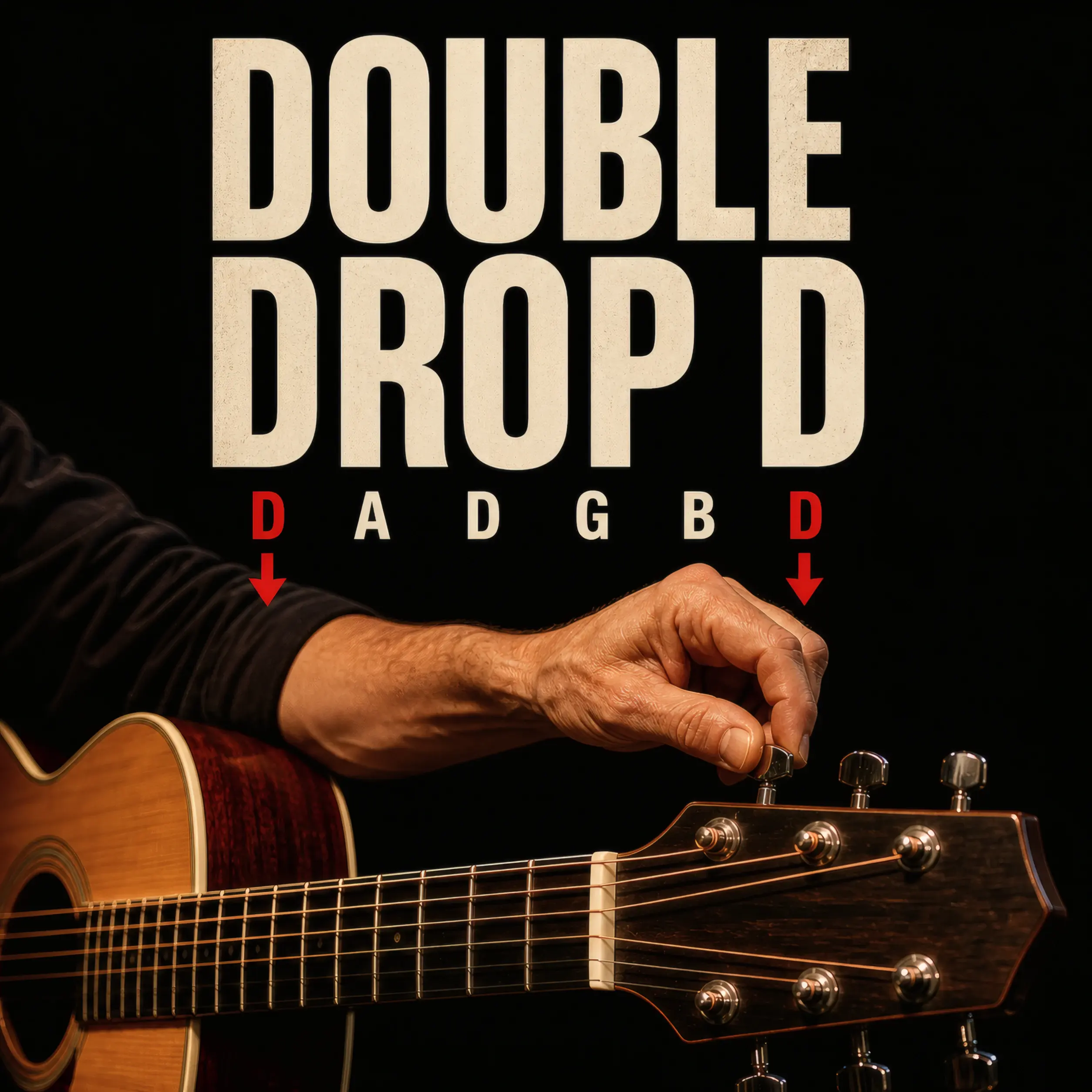
Drop C is one of the most common “heavy guitar” tunings because it gives you a low C for chunky riffs and easy power chords, while still feeling familiar under your fingers. In this guide you’ll learn the exact notes (C G C F A D), the easiest way to tune down without confusion, and how to use the TuneMode Drop C preset to lock in fast.
Quick CTA:
- Open the preset: Open the Drop C guitar tuner
- Compare with Drop D: Drop C vs Drop D (what changes and why)
Key takeaways
- The easiest path is Standard → Whole Step Down (D G C F A D) → Drop the low string to C.
- Drop C power chords are simple: you can play many riffs with one-finger shapes on the lowest three strings.
- If the low string feels floppy or buzzes, you may need heavier strings or a small setup tweak.
- Use the preset so you always see the correct target notes: Drop C tuner
Who this is for
This is for you if:
- a song says “tune to Drop C” and you want it done correctly in minutes
- you’re writing heavier riffs but Drop D still feels too high
- you tuned down and now your guitar feels buzzy or unstable
What is Drop C tuning?
Drop C is a 6‑string guitar tuning where the guitar is tuned down and the lowest string is “dropped” to make power chords easier.
From lowest (thickest) string to highest (thinnest), Drop C is:
C – G – C – F – A – D
For reference, standard tuning is:
E – A – D – G – B – E
If you like octave labels, Drop C is commonly written:
C2 – G2 – C3 – F3 – A3 – D4
(You don’t need to memorize the numbers — the note letters matter most.)
The easiest way to tune to Drop C (without getting lost)
You can tune straight from standard to Drop C, but it’s easy to overshoot because every string changes.
The simplest method is a two-step approach:
- Tune the whole guitar down one whole step to D Standard: D G C F A D
- Drop only the lowest string down to C: C G C F A D
This keeps you oriented: “everything down a step, then drop the low string one more step.”
Step 1: Open the Drop C preset in TuneMode
Open the preset so the tuner shows the target notes clearly:
Step 2: Tune to Whole Step Down (D G C F A D)
Starting from standard E A D G B E, tune each string down two semitones:
- 6th string: E → D
- 5th string: A → G
- 4th string: D → C
- 3rd string: G → F
- 2nd string: B → A
- 1st string: E → D
Go slowly. When you tune down, you’re loosening the string, so small peg movements can make bigger pitch changes than you expect.
Step 3: Drop the lowest string from D down to C
Now only change the lowest string:
- 6th string: D → C
Once the tuner shows C and the cents are close to 0, you’re in Drop C.
Step 4: Re-check all strings once
Dropping the low string can slightly shift tension across the guitar. Do a quick pass again:
C G C F A D
Drop C vs C Standard (don’t mix these up)
These two get confused a lot:
- Drop C: C G C F A D (the 5th and 4th strings are both C‑related for one‑finger power chords)
- C Standard: C F Bb Eb G C (every string is tuned down evenly)
If your song says “Drop C,” it almost always means C G C F A D.
What Drop C changes (chords, riffs, and feel)
One-finger power chords (the reason Drop tunings exist)
On the lowest three strings (6–5–4), you can play a power chord with one finger:
- Barre the same fret on strings 6–5–4
- Examples (6–5–4):
- Open (0) → C5
- 3rd fret → D#5 / Eb5
- 5th fret → F5
- 7th fret → G5
This is why Drop C is riff-friendly: fast, tight shapes with minimal left-hand movement.
Familiar shapes still work (with one important warning)
Your top five strings are tuned like a “whole step down guitar,” so many shapes feel familiar. But the lowest string is different, so:
- Standard open-chord shapes can sound wrong if you hit the 6th string by accident.
- When in doubt, strum from the 5th string down for “normal chord” shapes.
Want chord diagrams that match your tuning? Start in the chord library and select your tuning:
Common Drop C problems (and how to fix them)
Problem 1: The low string feels floppy or buzzes
This is normal if you’re using light strings and tuning down.
Try:
- A slightly heavier set (many players move up a gauge for Drop C)
- A firmer picking hand (less “digging under” the string)
- Raising the action a touch if the buzz is extreme
If you’re unsure, a quick setup from a tech can make Drop C feel dramatically better.
Problem 2: The tuner keeps jumping between notes
Drop tunings can produce big, boomy notes that confuse pitch detection.
Fixes:
- Pluck one string at a time and mute the others.
- Pick closer to the neck pickup (electric) for a stronger fundamental.
- Tune with a clean tone (distortion adds harmonics).
If your tuner isn’t responding at all, use this checklist:
Problem 3: It sounds in tune open, but riffs sound off up the neck
That’s usually intonation. Tune the open string, then check the 12th fret:
A simple Drop C riff starter (no song required)
Here’s a basic “feel” exercise that uses the open low C and one-finger shapes. Palm-mute lightly and keep it tight.
- Chug the open 6th string (C) for a bar.
- Move to the 5th fret (F5) for a bar.
- Move to the 7th fret (G5) for a bar.
- Return to open (C5).
Once it feels good, set a tempo and practice clean transitions:
FAQs: Drop C tuning
Do I need heavier strings for Drop C?
Not strictly, but many players prefer heavier strings because the low string stays tighter, buzz is reduced, and tuning feels more stable.
Is Drop C the same as C Standard?
No. Drop C is C G C F A D. C Standard is C F Bb Eb G C.
Can I tune to Drop C from standard in one step?
Yes, but it’s easier to stay oriented if you go Standard → Whole Step Down → Drop the low string.
Will Drop C damage my guitar?
Tuning down reduces overall tension, so it’s usually safe. The main risk is setup-related: if you jump to much heavier strings, you may need a nut/action/intonation adjustment.
What’s the fastest way to get Drop C right?
Use a preset so the tuner always shows the target notes per string:
Next step: tune up and try it in context
Tune to Drop C, then test it with something musical:
- Play open C5 (0–0–0 on the lowest three strings)
- Practice moving that shape to the 5th and 7th frets with a click
When you’re ready to compare tunings for a setlist, this guide helps: