Tuning an electric guitar takes about two minutes, needs no amp, and works the same whether you're holding a Squier from a starter pack or a vintage Les Paul. Standard tuning is E A D G B E from the thickest string to the thinnest, and the fastest way to get there is a chromatic tuner that listens while you pluck.
This guide gives you the five-step version first, then everything electric-specific that generic tuning guides skip: amp on or off, tuning unplugged, floating bridges, locking tuners, and what to do when a brand-new guitar refuses to stay in tune.
Ready now? Open the free online guitar tuner — it uses your mic and shows every target note.
How to tune an electric guitar in 5 steps
- Open a tuner. Start the online tuner, tap Start listening, and allow microphone access. No amp or cable needed.
- Pluck the 6th string (thickest) once and let it ring. The display shows the note it hears and how many cents sharp or flat you are.
- Turn that string's tuning peg slowly while re-plucking. Below E? Tighten to raise the pitch. Above E? Loosen, dip slightly below the note, then tune back up into it — strings hold better when the last movement tightens.
- Repeat across all six strings in order: E → A → D → G → B → E, thickest to thinnest.
- Do a second pass. Tuning changes neck tension slightly, which nudges the strings you did first. The second pass takes 20 seconds and is the difference between "close" and "in tune."
Finish by strumming an open E minor chord. If it shimmers instead of wobbling, you're done.
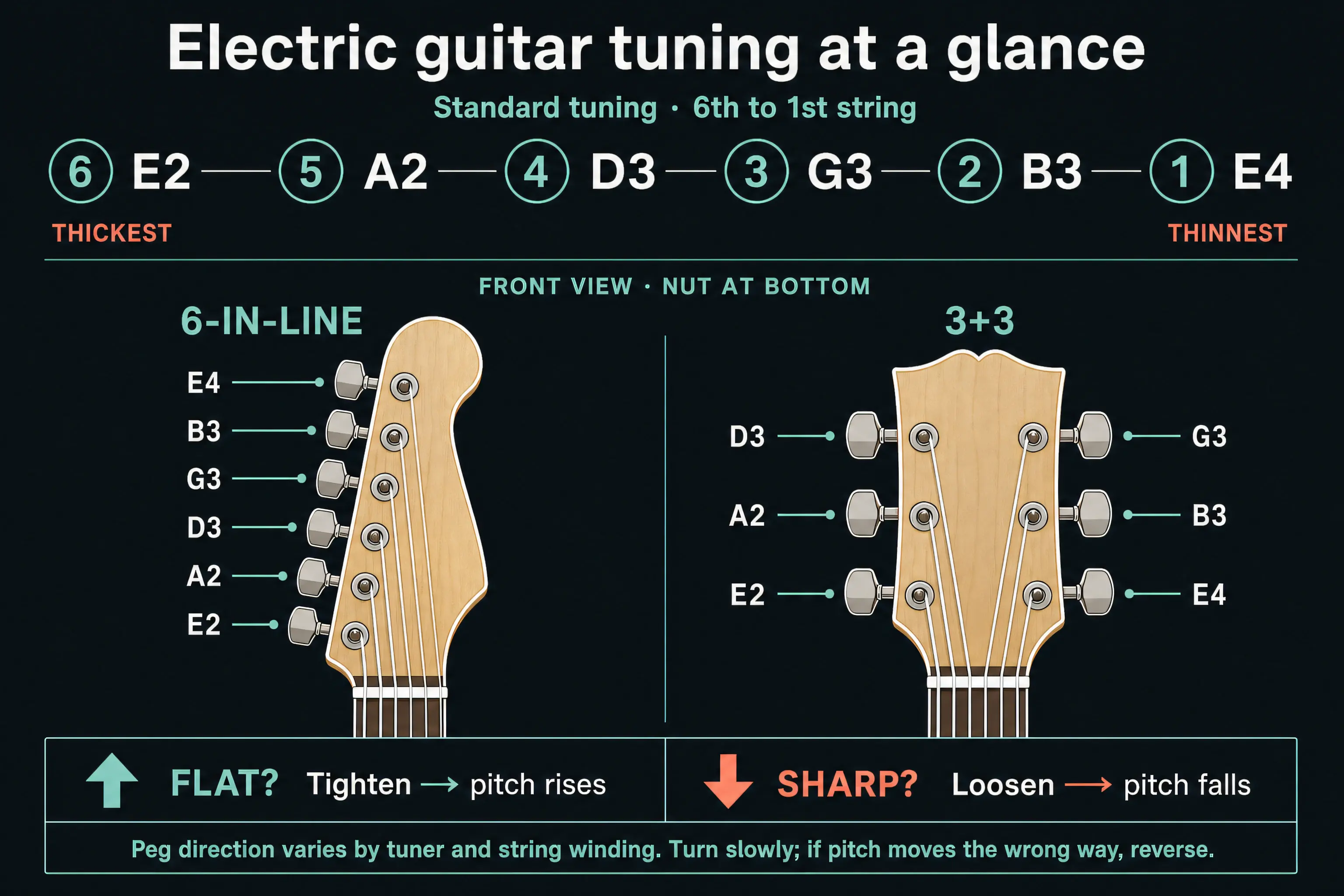
Electric guitar tuning notes: E A D G B E
| String | Note | Frequency | Mnemonic |
|---|---|---|---|
| 6th (thickest) | E2 | 82.41 Hz | Eddie |
| 5th | A2 | 110.00 Hz | Ate |
| 4th | D3 | 146.83 Hz | Dynamite |
| 3rd | G3 | 196.00 Hz | Goodbye |
| 2nd | B3 | 246.94 Hz | Bye |
| 1st (thinnest) | E4 | 329.63 Hz | Eddie |
Note the octave numbers: both E strings are E, two octaves apart. The single most common mistake I see with new students is tuning the thin E toward E5 — the string gets tighter and tighter until it snaps. If a string feels alarmingly tight and still reads "flat," you're an octave too high. Stop, slacken it, and come up again. (More on how frequencies and A440 work in guitar tuning Hz explained.)
Peg direction depends on the tuning machine and how the string is wound, so use the pitch change on your tuner instead of memorizing a universal clockwise rule:
Do you tune an electric guitar with the amp on or off?
Either works — the amp is optional. What actually matters is which tuner you're using:
- Mic-based tuner (online tuner, phone app): no amp needed. An unplugged electric produces plenty of acoustic sound for a microphone at close range. Amp on also works fine — a clean tone a couple of feet from the mic reads great.
- Clip-on tuner: amp irrelevant. It reads string vibration through the headstock, which is exactly why clip-ons rule loud stages. (Online vs clip-on compared here.)
- Pedal or interface tuner: the signal goes down the cable, so "amp on or off" doesn't matter — but the guitar's volume knob must be up, the most common "my pedal tuner is dead" cause.
One genuine tip for plugged-in tuning: use the neck pickup and roll the tone down a touch. A bright bridge pickup emphasizes harmonics, and some tuners chase those instead of the fundamental.
How to tune an electric guitar without an amp
Unplugged is my default at home — here's how to make a mic-based tuner read a quiet electric reliably:
- Get within about 30 cm / 12 inches of your device's microphone. Laptop mics sit above the keyboard; phone mics at the bottom edge — point the guitar's body roughly toward it.
- Kill background noise. A fan or TV in the room is louder than an unplugged solid-body.
- Pluck firmly, once, over the end of the fretboard rather than right at the bridge — you'll get a rounder, louder fundamental.
- Mute every string you're not tuning with your fretting hand. Sympathetic ringing is the top cause of a jumpy needle.
If the tuner still won't lock on, run through why an online tuner stops working — it's nearly always mic permissions or input selection, not the guitar.
How to tune an electric guitar with a tuner: know your four options
| Tuner type | Best for | Watch out for |
|---|---|---|
| Online mic tuner | tuning anywhere with zero gear | needs a reasonably quiet room |
| Clip-on | noisy rooms, stages | cheap ones read ±3 cents — fine live, loose for intonation |
| Pedal | players with a pedalboard | needs cable + power; volume knob up |
| Phone app | same as online tuners | ad-covered free apps; mic quality varies |
They all get you to the same six notes. What separates them is accuracy and convenience — a cents readout you can actually see matters more than the format. If you're curious how accurate is accurate enough, the Hz and cents guide covers it.
Fender's beginner walkthrough — worth a watch to see peg technique up close, then verify with the mic tuner.
How to tune an electric guitar by ear
The 5th-fret method, for when your phone is dead:
- Get the low E from any reference — a piano, another guitarist, a song you know is in standard.
- Fret the 6th string at the 5th fret — that's an A. Tune the open 5th string to match it.
- 5th string, 5th fret → tune the open 4th string (D).
- 4th string, 5th fret → tune the open 3rd string (G).
- 3rd string, 4th fret → tune the open 2nd string (B). This is the one exception everyone forgets.
- 2nd string, 5th fret → tune the open 1st string (E).
Listen for the beating — the "wah-wah-wah" pulse when two notes are close but not identical — and slow it to a stop. Ear tuning is a skill worth building even in the tuner era; the full method with harmonics and reference-pitch tricks is in how to tune a guitar without a tuner.
Tuning an electric guitar for the first time
Fresh out of the box, guitars behave badly for a week. Three things every beginner should know:
- New strings stretch. Factory strings (and any new set) drift flat for the first hours of playing. Tune, then gently pull each string away from the fretboard at the 12th fret, retune, repeat twice. After that, they settle.
- Tune twice, always. The two-pass habit from step 5 above matters most on fresh strings and cheap tuners-shipped-detuned guitars.
- Shipping detune is normal. Guitars often arrive tuned down or slack on purpose. A brand-new guitar reading D on every string isn't broken.
Also normal: needing 30+ seconds per string at first. Within a month it's a two-minute ritual you do half-consciously — and it should stay a ritual. Tune every single session; here's how often and why.
Why your electric guitar keeps going out of tune
Electric-specific culprits, in the order I check them on students' guitars:
- String stretching — new strings, see above. Cause of most first-week complaints.
- Nut binding — hear a ping while tuning, or pitch that jumps in steps? The string is sticking in the nut slot, common on guitars with string trees. A tech fix, or a touch of graphite from a pencil in the slot.
- Floating tremolo — on a Strat-style or Floyd Rose bridge, every string's tension affects the others. Tune the set in two or three passes; it's physics, not a fault. Dive-bombing without a locking nut will knock anything out.
- Locking tuners misunderstanding — locking tuners clamp the string so it can't slip at the post, which helps a lot. But they don't lock the tuning; you still tune normally, just with fewer wraps to stretch.
- Temperature — a guitar from a cold car needs 15 minutes to acclimate before tuning is worth doing.
Persistent drift after all five? Work through the full checklist in why your guitar won't stay in tune.
Electric guitar tunings beyond standard
Once standard feels easy, the popular next steps — each is a preset on the tuner:
- Drop D (D A D G B E): one string down, one-finger power chords. The gateway tuning.
- Eb standard / half step down (Eb Ab Db Gb Bb Eb): Hendrix, Guns N' Roses, SRV.
- D standard (D G C F A D): everything a whole step down — Metallica's "Sad but True" territory.
There are dozens more — open tunings, DADGAD, and beyond (Wikipedia's list of guitar tunings is a rabbit hole). The mechanics you learned here apply to all of them: same pegs, same needle, different target notes.
FAQ: electric guitar tuning
Can I tune my electric guitar myself?
Yes — tuning is a player skill, not a tech skill, and every guitarist does it before every session. All you need is a tuner (the online one is free) and two minutes. Setup jobs like intonation and action are the ones worth handing to a tech at first.
What are the notes to tune an electric guitar to?
Standard tuning is E A D G B E from thickest string to thinnest — specifically E2, A2, D3, G3, B3, E4. Both outer strings are E, two octaves apart.
How do you tune an electric guitar as a beginner?
Use a tuner that shows the note name and a needle: pluck one string, turn that string's peg slowly until the needle centers on the right note, and repeat for all six. Avoid by-ear methods for your first weeks — you'll be fighting your ear and the pegs at the same time.
Do I need to tune an electric guitar every day?
Check it every time you pick it up. Guitars drift with temperature, humidity, and playing — usually only a few cents, which takes seconds to correct. A daily check also trains your ear to notice "slightly off" early.
Why does my low E string sound wrong even when the tuner says E?
Make sure it reads E2, not E3 — a string tuned to the wrong octave can center the needle on the right letter. If the octave is right but chords up the neck sound sour, check your intonation.
Plug in (or don't) and play
- Open the online guitar tuner — works unplugged, no download
- New strings? Stretch, retune, repeat — then lock your rhythm in with the online metronome
- Chords sour up the neck even in tune? Run the guitar intonation check