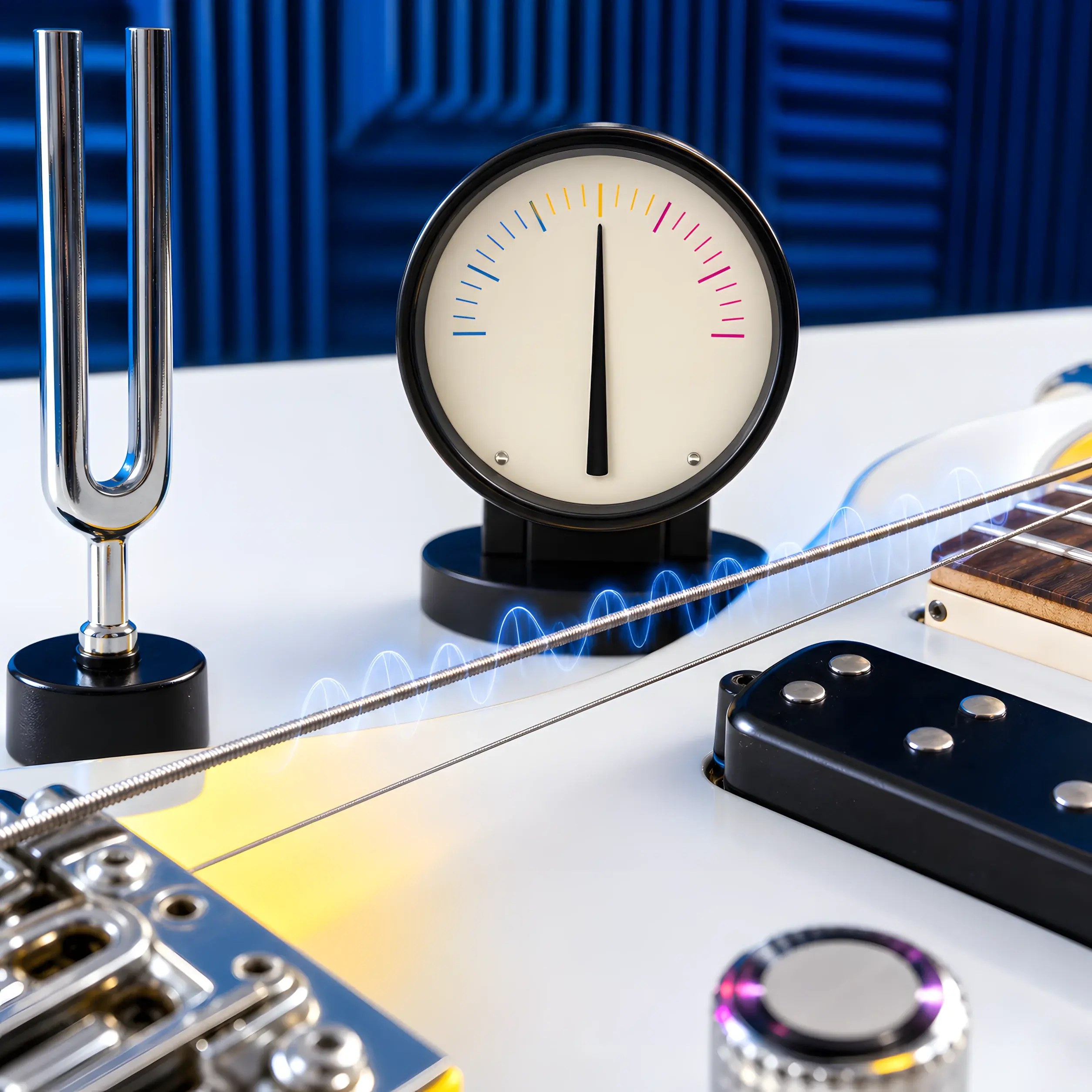
Standard guitar tuning at A4=440 Hz is E2 82.41, A2 110.00, D3 146.83, G3 196.00, B3 246.94, and E4 329.63 Hz. Those are open-string fundamentals, not six arbitrary settings for the tuner.
Open the standard guitar tuner and leave Reference Pitch at 440 Hz unless another instrument or recording requires a different value.
Guitar tuning Hz chart for standard E
| String | Note | Frequency | 12th-fret octave |
|---|---|---|---|
| 6, lowest | E2 | 82.41 Hz | E3, 164.81 Hz |
| 5 | A2 | 110.00 Hz | A3, 220.00 Hz |
| 4 | D3 | 146.83 Hz | D4, 293.66 Hz |
| 3 | G3 | 196.00 Hz | G4, 392.00 Hz |
| 2 | B3 | 246.94 Hz | B4, 493.88 Hz |
| 1, highest | E4 | 329.63 Hz | E5, 659.26 Hz |
The values are rounded to two decimals. A tuner should aim for 0 cents, not chase the last displayed hundredth of a hertz while the string is naturally moving.
Why 440 Hz is not a guitar string
The 440 setting means A4, the A above middle C, equals 440 cycles per second. ISO 16 defines A4=440 Hz as the standard tuning reference, and ISO confirmed the standard as current in 2022.
The guitar's open A is A2, two octaves below A4. Each octave halves frequency:
440 / 2 / 2 = 110 Hz
So a tuner showing "440" in its calibration control is correct while the open A string reads 110 Hz. Tuning that string itself to 440 Hz would raise it two octaves and likely break it.
How guitar tuning frequencies are calculated
In 12-tone equal temperament, every semitone multiplies frequency by the twelfth root of 2. Using MIDI note number m:
frequency = 440 x 2^((m - 69) / 12)
The University of New South Wales note-frequency reference gives the same formula and note table. This is why E2 is 82.4069... Hz and rounds to 82.41, while the E one octave higher is exactly double.
To see the Hz of any note you play or sing, not only the six open strings, use the pitch detector. It shows the note name, its frequency, and how many cents you are off.
Hz vs cents on a guitar tuner
Use hertz to identify the target and cents to finish the tuning. A one-hertz error is not musically equal on every string:
- 1 Hz at low E2 is about 21 cents.
- 1 Hz at high E4 is about 5.2 cents.
- 1 cent is about 0.048 Hz at E2 but 0.190 Hz at E4.
Cents are logarithmic, so the same cent error represents the same musical interval anywhere on the fretboard. Our rule: stop reading raw Hz once the tuner has identified the right note; center the cents display instead.
Guitar tuning frequencies at 432 Hz
Changing the reference from 440 to 432 scales every target by 432/440, about 0.9818.
| String | A4=440 | A4=432 |
|---|---|---|
| E2 | 82.41 Hz | 80.91 Hz |
| A2 | 110.00 Hz | 108.00 Hz |
| D3 | 146.83 Hz | 144.16 Hz |
| G3 | 196.00 Hz | 192.43 Hz |
| B3 | 246.94 Hz | 242.45 Hz |
| E4 | 329.63 Hz | 323.63 Hz |
Use 432 only when the track, keyboard, ensemble, or production session uses it. There is no practical upside to being eight hertz below everyone else in a normal A440 rehearsal. NIST describes A440 as the internationally recognized musical-pitch reference.
How to get a stable guitar frequency reading
- Select the correct note or standard-tuning preset.
- Mute the other five strings.
- Pluck once with normal force, near the bridge.
- Ignore the first sharp attack and read the sustain after about half a second.
- Approach the target from flat to in tune.
- Recheck all strings after the first pass.
Fender's tuning tips also note that the initial attack runs sharp before the string settles. Repeated hard picking keeps restarting that sharp transient and makes the display look less stable.
Guitar frequency troubleshooting
The note is correct but chords sound out of tune
The open strings can match the table while fretted notes fail. Check the 12th-fret harmonic against the fretted note with the guitar intonation test. Also reduce fretting pressure; squeezing a string toward the fretboard raises its pitch.
The tuner shows double the expected frequency
It is hearing the second harmonic. For example, low E2 may appear near 164.81 Hz. Mute other strings, pluck closer to the center of the string for more fundamental, and lower distortion or room noise.
The number drifts after every pluck
A real string is not a laboratory oscillator. Attack, decay, finger contact, temperature, and pitch modulation move the reading. Judge the stable middle of the sustain, not a frozen exact number.
FAQ about guitar tuning in Hz
Is low E 82 Hz or 83 Hz?
At A4=440 equal temperament, low E2 is 82.41 Hz. An integer-only display may round it to 82; 83 Hz is about 12 cents sharp.
What Hz should a guitar tuner be set to?
Set the reference pitch to 440 Hz for ordinary practice and performance. Change it only to match a fixed-pitch instrument or recording using another reference.
Why is the open A string 110 Hz instead of 440 Hz?
It is A2, two octaves below A4. Two octave halvings turn 440 Hz into 110 Hz.
Does every fret have one exact frequency?
Equal temperament provides a mathematical target, but string stiffness, action, fretting pressure, and intonation create small real-world offsets. A good setup minimizes them; it cannot turn a fretted guitar into an ideal oscillator.


