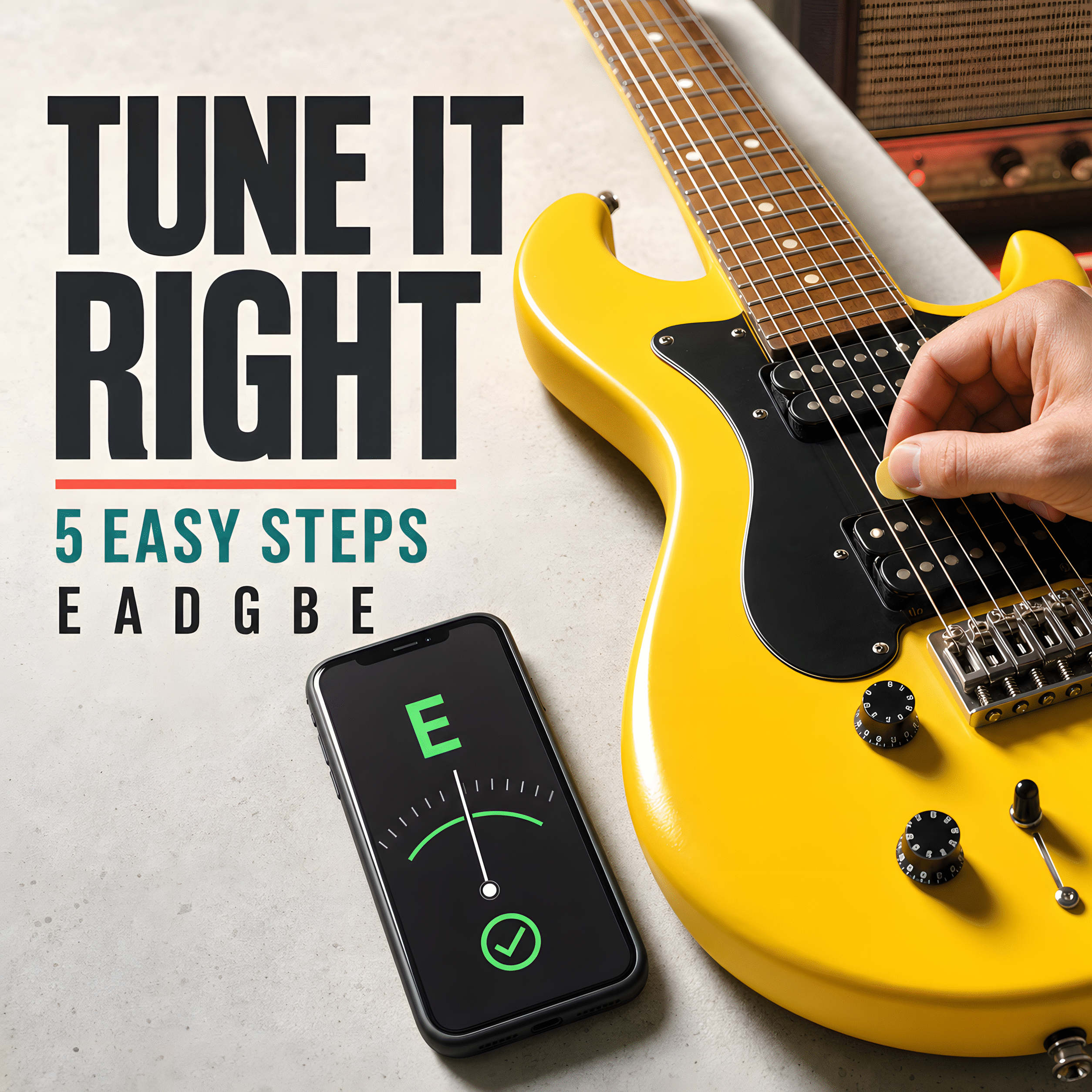
A landline dial tone hums two pitches at once, and one of them is exactly A 440. Old-timers really did tune to the phone. It sounds like a joke until the night your clip-on dies, your phone is at 2%, and the only working electronics in the cabin is screwed to the kitchen wall.
You need surprisingly little to get a guitar in tune. One trustworthy note. The rest is relationships between strings, and those never change.
Fair warning about the honest loophole first. If any browser is nearby, you already own a tuner — the mic tuner on this site hears your strings and needs no hardware, no app, no download. Everything below is for when even that's out of reach, or when you want the skill in your ears instead of on a screen.
Keep these handy for the verify step:
- Guitar standard tuning preset, which also plays reference tones for every string
- Drifting no matter what you do? That's a hardware problem, see guitar won't stay in tune
Step one, steal a reference note
Any of these gives you a true pitch to build from.
- A piano or keyboard. Play A2 (110 Hz), the second A below middle C. It matches your open 5th string directly. Even a toy keyboard with dead batteries replaced works.
- Another tuned instrument. Ask a bandmate to play A2 (110 Hz) so you can match your open 5th string directly.
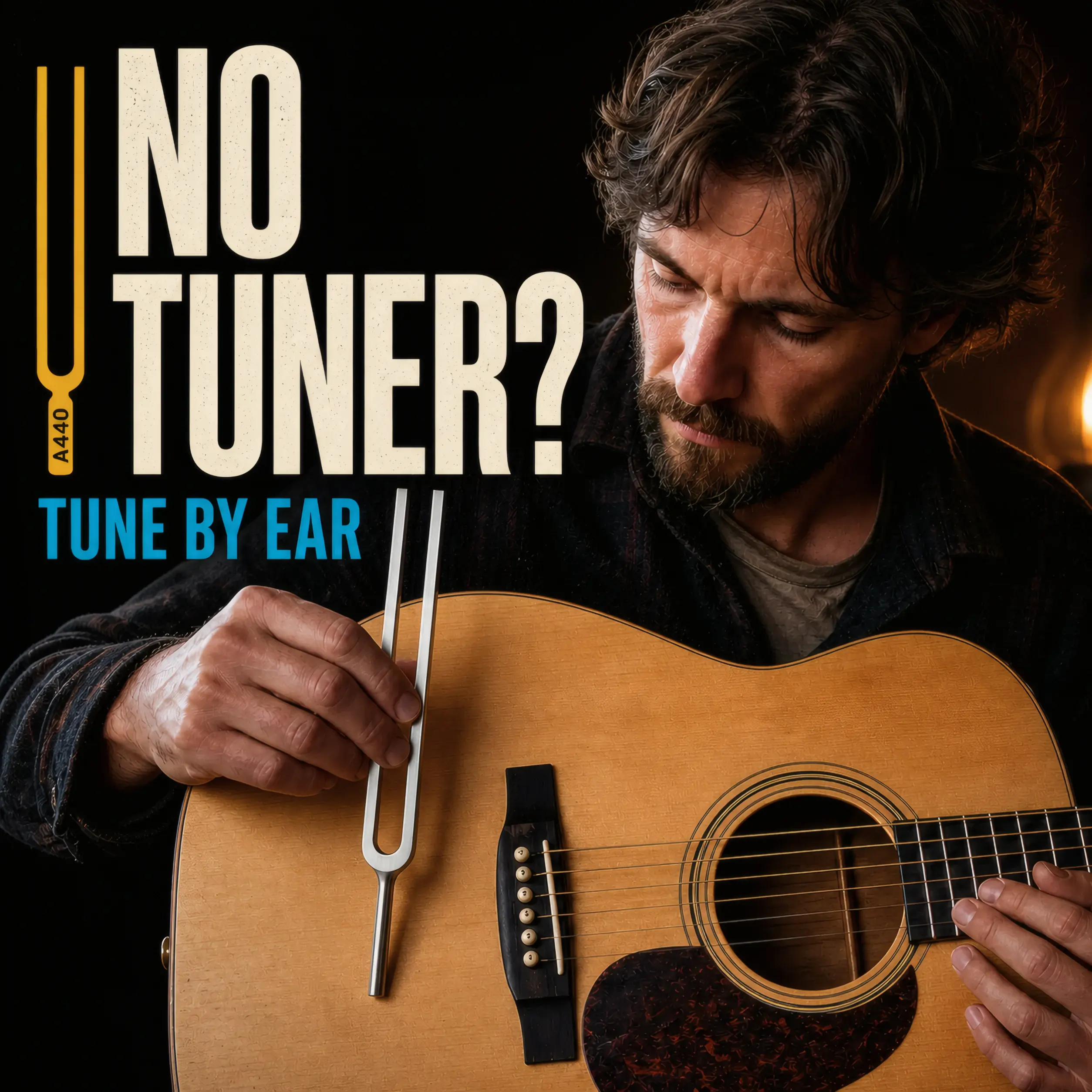
- A tuning fork. The classic A 440 fork is two octaves above your open A. Match it to the 5th-fret harmonic on the 5th string instead; the fork is silly-cheap and lives forever in a case pocket.
- A recording you know is at standard pitch, played from the original release. The opening chord of a song you've played along with before.
- That dial tone, if you can find one. North American tones include 440 Hz, which matches the 5th-fret harmonic on your A string, not the open string itself.
Your open 5th string (A) should be A2 at 110 Hz. If your reference is A2, compare it with the open string. If your reference is A 440, lightly touch the 5th string directly above the 5th-fret wire and pluck to sound its A4 harmonic, then compare that harmonic with the reference. Do not tighten the open string toward 440 Hz.
Play the reference, play the matching open note or harmonic, and listen for the slow wobble, the wah-wah-wah of two nearly-equal pitches beating against each other. Turn the peg until the wobble slows, then stops. When it stops, you match. And always approach from below — if you overshoot sharp, drop under the note and come back up, because strings tuned upward hold better.
No reference at all? Skip to the relative-tuning section. The guitar can at least agree with itself.
How to tune a guitar by ear with the 5th-fret method
One string is true. Now each string tunes the next.

The pattern is almost uniform. Fret any string at the 5th fret and you get the pitch of the next string up. Almost.
- Your A string is already true, so build upward from it first and save the low E for last.
- 5th string, fret 5 gives D. Tune the open 4th string to it.
- 4th string, fret 5 gives G. Tune the open 3rd string to it.
- 3rd string, fret 4 gives B. Tune the open 2nd string to it. Fourth fret this time. This is the step everyone flubs the first week.
- 2nd string, fret 5 gives E. Tune the open 1st string to it.
- For the low E, reverse the trick. Fret the 6th string at fret 5 and turn its peg until that fretted note matches your open A string.
Play the fretted note first, let it ring, then the open string, and listen for that same beating wobble slowing to nothing. Light fretting pressure matters here — squeeze too hard and you bend the reference note sharp, then tune a perfectly good string to your mistake.
Why the one odd fret? String pairs in standard tuning are a perfect fourth apart except G to B, which is a major third. One interval is smaller, so the fret moves down one.
Tune a guitar by ear using harmonics
Prettier, hands-free, and easier to hear in a noisy room, once you can sound a harmonic cleanly. Touch the string directly over the fretwire (not behind it), pluck, lift the finger. A chime rings out.
| Touch here | Matches |
|---|---|
| 6th string, 5th fret | 5th string, 7th fret |
| 5th string, 5th fret | 4th string, 7th fret |
| 4th string, 5th fret | 3rd string, 7th fret |
| 6th string, 7th fret | open 2nd string (B) |
| 5th string, 7th fret | open 1st string (E) |
Sound the pair, let both chimes ring together, and tune until the beating stops. Because the notes sustain without your fretting hand, both hands are free to work the peg, which is why stage players in loud rooms love this method.
Two honest caveats. Harmonics take practice before they ring reliably, so beginners sometimes fight the technique instead of the tuning. And the 7th-fret harmonic sits a hair sharp of where a tuner would put the fretted note, physics being stubborn about pure fifths. For a campfire it will never matter. Before a recording session, let the mic tuner have the final word.
No reference anywhere? Tune the guitar to itself
Pick whichever string sounds least wrong, call it correct, and run the 5th-fret method from there. The guitar ends up in tune with itself, every chord agreeing internally, even if the whole instrument sits a quarter-step from true pitch.
For solo practice on the porch this is completely fine. It falls apart the moment you play with a piano, a track, or another guitarist tuned to 440. I've watched two perfectly self-consistent guitars turn a duet into seasickness, each one convinced it was right..
Singers notice too, sooner than you'd think. A song you always sing in E feels strangely hard when "E" is actually E-and-three-quarters.
Check your work before you play
Thirty seconds of verification catches the string that lied.
- Play the open 6th and open 1st together. Both are E, two octaves apart, and octaves are brutally honest — any clash means one of them drifted.
- Strum an E minor gently, then G, then D. A chord that sounds sour under a soft strum points at its own worst string.
- Recheck the whole set once. Tightening one string subtly slackens the others through neck flex, so the first string you tuned has moved a little by the time you finish the sixth.
Chords still sound off when every open string checks out? That's intonation, a setup issue no amount of open-string tuning fixes.
Hearing the beats disappear is the whole skill, and it's far easier demonstrated than described — this harmonics walkthrough lets you listen along.
Guitar tuning by ear is a skill worth keeping
Every method above trains the same muscle, hearing when two pitches disagree. Students who tune by ear for a month start noticing a flat B string mid-song, before any tuner could be reached for. That awareness is the real prize, and it's also why I still make electric players do this even though their pedalboard has a tuner in it. Speaking of which, electric guitars bring their own wrinkles, amp off or amp on, and the electric guitar tuning guide handles those.
Then verify anyway, whenever a mic tuner is in reach. Ears get you close and proud. The needle gets you exact.
FAQ: tuning a guitar without a tuner
Is tuning by ear accurate enough to play with other people?
Close enough to play, usually not exact enough to record. A practiced ear lands within a few cents of true, and a beginner's ear within maybe ten. Match everyone to the same reference pitch and small errors stop mattering, since the band drifts together.
Why does the B string use the 4th fret instead of the 5th?
The gap between the G and B strings is a major third, while every other adjacent pair is a perfect fourth. Smaller interval, lower fret. It's the only exception in standard tuning, and forgetting it is the single most common by-ear mistake.
What can I use as a reference pitch?
A piano, another tuned instrument, a tuning fork, a landline dial tone (its upper pitch is A 440), or the reference tones built into the standard tuning page, which play each string's note out loud for you to match.
Can I tune a guitar with no reference note at all?
Yes, to itself. Run the 5th-fret method from any string and every chord will agree internally. The guitar just won't match other instruments or recordings until you anchor it to a true reference.
Does this work for bass?
The 5th-fret method transfers directly, and with no B string there's no 4th-fret exception — every pair on a standard bass is a perfect fourth. Details and bass-specific checks live in how to tune a bass.
Anchor it when you can
Tune by ear tonight, enjoy it, and when a browser is nearby let the standard tuning preset grade your work. The gap between your ear and the needle shrinks every week you practice this, which is the most satisfying progress bar in guitar.