Most songs you love are built from three or four chords played in a loop. That loop is a chord progression, and understanding how guitar chord progressions work is the fastest way to stop memorizing songs one at a time and start recognizing, transposing, and writing them.
This guide gives you the chords that belong to every major key, the five progressions behind thousands of songs, a key-by-key chart you can steal from, and exercises to make all of it automatic.
The tool that makes everything portable is the Roman numeral system. Instead of memorizing C–G–Am–F, you learn I–V–vi–IV. The numerals describe what each chord does in the key, not which frets your fingers are on. Learn one progression as numerals and you own it in all twelve keys.
Quick CTA:
- Browse the chord library: every shape used below
- Open the online metronome: progressions live or die by timing
Diatonic chords in major keys
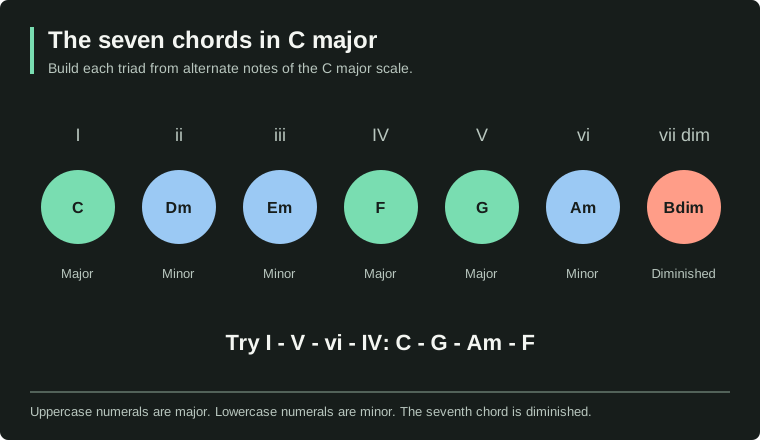
Every major key contains exactly seven chords, built by stacking notes from that key's scale. These are the diatonic chords, and they follow the same quality pattern in every key:
- I: major (home base, the "tonic")
- ii: minor
- iii: minor
- IV: major
- V: major (the chord that pulls hardest back home)
- vi: minor (the "relative minor," the melancholy cousin of I)
- vii°: diminished (tense, rarely played as written)
In C major, that gives you:
C – Dm – Em – F – G – Am – Bdim
That's it. Every classic progression is just a selection from those seven chords, in some order. Here's the full pattern across the five keys guitarists use most; memorize the C and G rows first, because their chords are all open-position friendly:
| Key | I | ii | iii | IV | V | vi | vii° |
|---|---|---|---|---|---|---|---|
| C | C | Dm | Em | F | G | Am | Bdim |
| G | G | Am | Bm | C | D | Em | F#dim |
| D | D | Em | F#m | G | A | Bm | C#dim |
| A | A | Bm | C#m | D | E | F#m | G#dim |
| E | E | F#m | G#m | A | B | C#m | D#dim |
Two practical notes before you move on.
First, the vii° chord is awkward to finger and harsh on its own. Real songs usually swap it for a V7 (G7 in the key of C), which contains almost the same notes and resolves just as well. Don't stress over diminished shapes yet.
Second, uppercase numerals mean major chords, lowercase mean minor. When you see vi it's a minor chord; when you see V it's major. That one convention lets you read any progression chart on the internet.
If you want to see where all these chords live on the neck, the chord library has fingerings for every shape in this table.
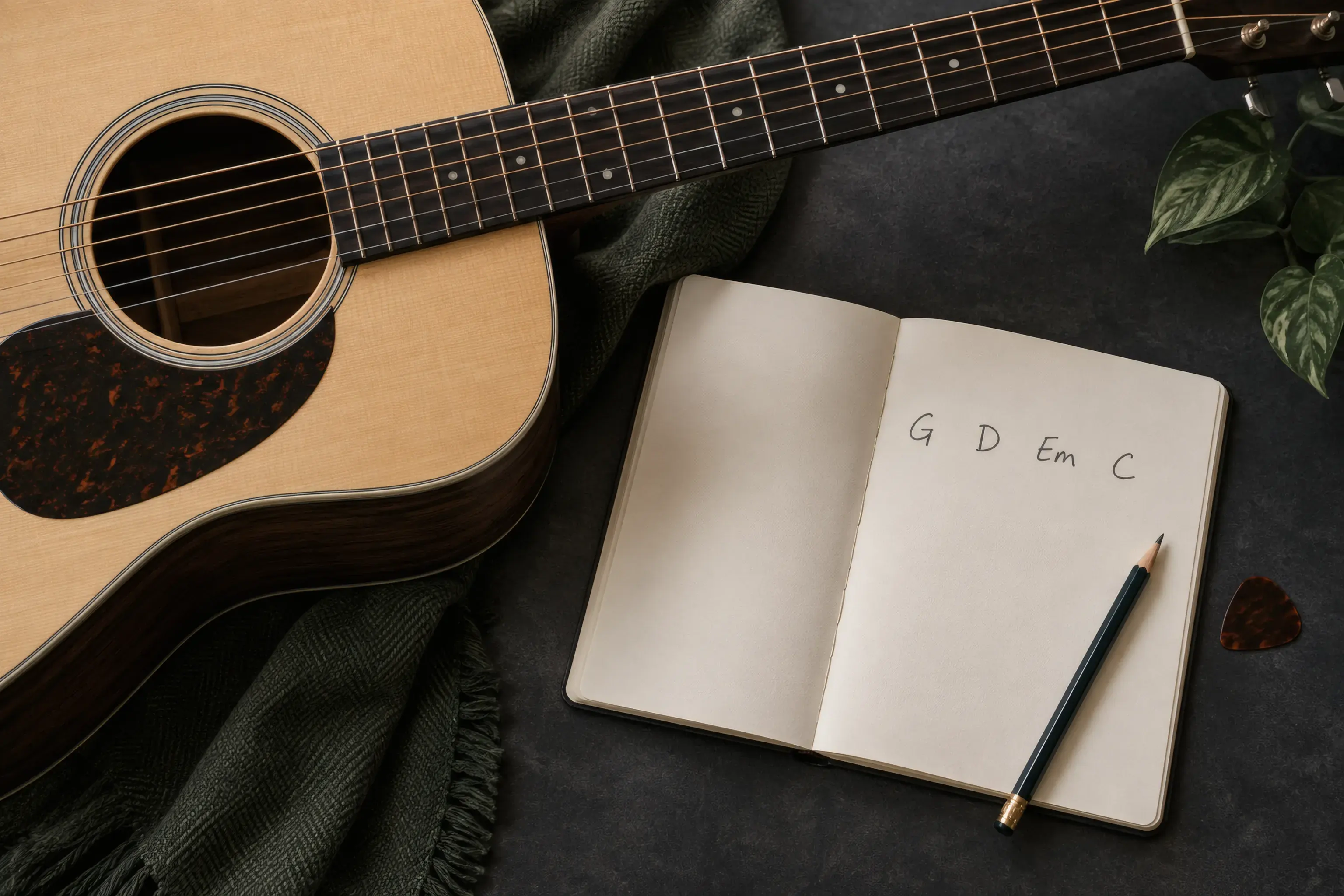
Most common guitar chord progressions
Five sequences cover an absurd share of popular music. Learn these as numerals first, then as real chords in one key.
I–V–vi–IV (the pop four chords)
In C: C – G – Am – F
This is the most recorded progression of the last fifty years. "Let It Be," "With or Without You" (in D: D–A–Bm–G), "Someone Like You," "No Woman No Cry", all of it. The vi chord (Am in C) is what keeps it from sounding like a nursery rhyme: it adds a minor sigh in the middle of three major chords.
People call these "the four chords," and the progression is often labeled uplifting or anthemic. Treat those mood labels as shorthand, not law. The same four chords sound wistful at 70 BPM and triumphant at 130.
I–IV–V (blues and rock)
In C: C – F – G
The oldest progression in the book. The entire 12-bar blues is built from these three chords, and so is most early rock and roll. "La Bamba," "Twist and Shout," "Wild Thing"; if you can change between three chords cleanly, you can play all of them.
In the blues, all three chords are often played as dominant 7ths (C7–F7–G7), which is what gives blues its gritty, unresolved sound.
ii–V–I (jazz)
In C: Dm – G – C
Jazz players think in this progression the way rock players think in power chords. It's the smoothest possible resolution: the ii sets up the V, the V resolves to the I. Played with 7th chords (Dm7 – G7 – Cmaj7), it's instantly recognizable as "that jazz sound."
You'll also hear it ending pop and country songs, often as a tag at the end of a verse.
vi–IV–I–V (the emotional rotation)
In C: Am – F – C – G
Same four chords as I–V–vi–IV, rotated to start on the minor. Starting on Am instead of C changes everything: the ear hears Am as home, and the whole loop leans melancholy. "Zombie" by The Cranberries and the verse of "Africa" by Toto live here. This rotation is common enough in emotional pop ballads that it's picked up the nickname "the sensitive female chord progression."
This is the clearest proof that order matters more than content. Four identical chords, two completely different feelings.
I–vi–IV–V (doo-wop)
In C: C – Am – F – G
The 1950s in four chords. "Stand By Me," "Earth Angel," "Blue Moon," and about half of everything ever slow-danced to. The move from I down to vi (C to Am) is one of the sweetest sounds in Western music, two chords that share two of their three notes.
It still shows up constantly in modern pop, usually slowed down and arpeggiated instead of strummed.
Progressions in different keys
Here's where the Roman numerals pay rent. Take I–V–vi–IV:
- In C: C – G – Am – F (all open chords)
- In G: G – D – Em – C (all open chords)
Same progression, same function, different set of shapes. And it keeps going:
| Key | I | V | vi | IV | Progression |
|---|---|---|---|---|---|
| C | C | G | Am | F | C – G – Am – F |
| G | G | D | Em | C | G – D – Em – C |
| D | D | A | Bm | G | D – A – Bm – G |
| A | A | E | F#m | D | A – E – F#m – D |
| E | E | B | C#m | A | E – B – C#m – A |
Notice how quickly the barre chords creep in. C and G are all open-position. D brings one barre chord (Bm). A brings one (F#m). E brings two (B and C#m).
That's not an accident; it's why C and G are the beginner keys and why so many songs get transposed into them. If a song is in a key with nasty chords, you have two fixes: move the shapes with a capo, or learn the barre chords. More on both below.
Why change keys at all? Usually the singer. If C–G–Am–F sits too low for the vocal, the whole progression slides up to D or E and the guitar follows. The numerals never change, which is exactly why musicians call out "one-five-six-four" at jam sessions instead of chord names.
How to use progressions (strumming, arpeggios, rhythm, transposing)
Knowing the chords is a third of the job. The other two-thirds are how you play them and where you put them.
Strumming patterns
A progression without a strumming pattern is a list, not music. Start I–V–vi–IV in C with the campfire pattern, one pattern per chord:
D . D U . U D U
(D = downstroke, U = upstroke, . = hand swings through without touching the strings)
Four bars of that is a verse. The full breakdown of that pattern, plus four more worth learning and the practice method that makes them stick, is in guitar strumming patterns, worth reading before you drill anything below.

Arpeggios
Slow songs and verses often skip strumming entirely and pick the chords one note at a time. Here's a simple pattern over a C chord (one bar, eighth notes):
e|-------0-------0-|
B|-----1---1---1---|
G|---0-------0-----|
D|-----------------|
A|-3---------------|
E|-----------------|
(Strings labeled on the left, high e on top. Count 1 & 2 & 3 & 4 & while picking strings A, G, B, e, B, G, B, e, one note per count. Use your thumb for A, index for G, middle for B, and ring finger for high e.)
Move the same picking motion through G, Am, and F and you have the "Let It Be" texture. Arpeggios also make chord changes sound smoother, because only one string rings at a time; sloppy switches hide better.
Rhythm variations
Three cheap ways to make one progression sound like three different songs:
- Change chords early. Switch on the "&" of beat 4 instead of beat 1. That tiny push is half of what makes pop rhythm guitar feel urgent.
- Vary the bar length. Hold one chord for two bars, then split the next bar between two chords. Instant dynamics.
- Mute between hits. Lift the fretting hand slightly after each strum for a choppy, percussive reggae-ish feel.
If your changes fall apart when the pattern gets busy, that's a timing problem, not a chord-knowledge problem. Metronome practice for chord changes covers the drills for switching exactly on the beat; do those before you speed anything up.
Transposing: capo or barre chords
Say a song is in E (E–B–C#m–A) and the C#m barre chord is beyond you today. Put a capo at the 4th fret and play the C shapes (C–G–Am–F) and out comes E–B–C#m–A. The guitar capo chart maps every capo position to the sounding key, so you can transpose any progression in about ten seconds.
The other path is learning the barre chords themselves. It's slower, but it's the skill that makes every key playable without hardware. The E- and A-shape barre chords cover every row of the table above; barre chords walks through both shapes and how to build the hand strength for them.
One more use worth mentioning: once you know which key a progression is in, you know which scale to solo over it. I–IV–V in A means the A major scale fits everywhere. The scale finder will show you that scale across the whole neck.
Practice exercises
Three exercises, in order. Do each one for a week before moving on.
1. Play I–V–vi–IV in three keys
Set the metronome to 72 BPM, one strumming pattern per chord, four beats each. Run the progression in C, then G, then D, without stopping. The D key version adds the Bm barre chord; that's the point.
Eight clean bars in each key before you bump the tempo 5 BPM. Record thirty seconds on your phone once per session. You will not believe how the changes sound until you hear the playback.
2. Write a four-bar melody over I–IV–V
Make a four-bar loop in 4/4: A | D | E | A, one chord held for four beats in each bar. Hum or play a melody that lasts the same four bars, then repeat it with the loop. For a first version, hold one note per bar: A | F# | G# | A. Each is a chord tone of the chord beneath it. Then experiment with passing notes from the A major scale in the scale finder, listening to how they resolve; scale membership alone does not make every note equally settled over every chord.
Record the chord loop on your phone first so both hands are free. Ten minutes of this teaches more about how melody and harmony fit than a month of theory reading.
3. Convert a song you know into Roman numerals
Pick a song you can already play. Write the chord sequence down, figure out the key (hint: it's usually the first or last chord), and translate each chord into a numeral using the diatonic table above.
Then play it in a different key using only the numerals. This exercise feels academic for about one day, and then something clicks: you start hearing the numerals inside songs on the radio. That is the actual skill this whole guide is pointing at.
Audio and backing tracks
Listen for the function, not the frets. Play I–V–vi–IV in C, then in G, back to back at the same tempo with the same pattern. Record both on your phone and compare. Your goal: hear that the emotional arc is identical (home, tension, sigh, lift) even though every chord is different. Once you can hear that, transposition stops being math and becomes instinct.
Solo over a I–IV–V loop in A. Loop A–D–E at 90 BPM (one chord per bar, or record twelve bars on your phone and loop the recording). Improvise with the A major pentatonic scale; the scale finder has the shape at the 5th fret. Listening goal: land your phrases on a chord tone when the chord changes. On A, that's A, C#, or E. When a note you land on clicks with the chord underneath, you'll feel it, and that feeling is the entire point of learning progressions in the first place.
FAQ
What's the difference between I–V–vi–IV and vi–IV–I–V?
Same four chords, different starting point, different home. In C, I–V–vi–IV starts on C, so your ear treats C as home and the loop feels resolved and bright. vi–IV–I–V starts on Am, so Am becomes home and the same chords turn moody. Songwriters exploit this constantly: verses in one rotation, chorus in the other. "Same chords, different song section" is a real studio trick.
Do progressions work in minor keys?
Yes, with a twist. Minor keys have their own diatonic set: in A minor the chords are Am, Bdim, C, Dm, Em, F, G, the same seven chords as C major, re-centered on Am. Progressions like i–VI–III–VII (Am–F–C–G) and i–iv–v (Am–Dm–Em) are minor-key staples. The twist: minor keys often borrow a major V chord (E instead of Em in A minor) because it pulls harder back to the tonic. That's where the harmonic minor scale comes from, and it's why so many minor-key songs have one surprising major chord in them.
How do I know which progression to use?
Steal first, decide later. Find a song that has the feel you want, work out its numerals (exercise 3 above), and start there. If you want loose guidance: I–V–vi–IV and I–vi–IV–V lean familiar and warm, vi-first rotations lean darker, I–IV–V leans rootsy and direct. But "sad" and "happy" progressions are subjective; tempo, rhythm, and how hard you hit the strings change the mood as much as the chord choices do. The honest answer is that you know which progression to use after you've played a hundred of them. This guide is the shortcut to the first twenty.
Put the numerals under your fingers
Pick one progression (I–V–vi–IV in C is the right choice), set the metronome to 72, and play until the changes stop needing thought. When a shape slows you down, the chord library has every fingering in this guide. The numerals do the rest.