If you can name the guitar fretboard notes under your fingers, everything else on the instrument gets easier: transposing songs, building chords, improvising over changes. This guide gives you the full note map, per-string charts you can read on your phone, and three five-minute drills that make it stick.
No quiz required, no course to buy. The charts below carry the whole lesson.
Quick CTA:
- Open the online guitar tuner: make sure you're in standard tuning before drilling notes
- Explore scales on the neck: see the notes you're learning inside real scale shapes
Why fretboard notes matter
Players get by for years on shapes alone. Shapes work until the day you need to move a song down for a singer, find a chord voicing above the 5th fret, or hit the right note over a bridge you don't know.
Three things unlock the moment you can name notes on the neck:
- Transposition. A capo or a singer's request becomes simple addition. "This song is in G, move it to Bb" means every root shifts up three frets. If you don't know where G is, you're stuck.
- Chord building. The E- and A-shape barre chords take their names from the root on the low E or A string. An E-shape major barre at the 8th fret is C major because the 8th fret of the low E string is C. Root-note knowledge lets you move those shapes into any key.
- Improvisation. Scales are just letter names laid over frets. Knowing where A, C, and E live lets you see an A minor chord inside the A minor pentatonic and land on chord tones instead of guessing.
You don't need all 72 frets at once. You need two strings and one trick, and this post gives you both.
Open String Notes
Standard tuning, low to high:
E – A – D – G – B – E
The 6th string (thickest, closest to your chin) is low E. The 1st string (thinnest) is high E, same note name, two octaves higher. That pairing is the first freebie on the fretboard: anything true on the low E string is true on the high E string. Learn one, know two.
Mnemonics help the sequence stick. Pick one and say it until you don't need it:
- Eddie Ate Dynamite, Good Bye Eddie
- Elephants And Dogs Grow Big Ears
- Every Amateur Does Get Better Eventually
Check yourself right now: play each open string and say its name out loud. If any string has drifted from its letter, the guitar tuner will set it straight in thirty seconds; drilling notes on an out-of-tune guitar trains your ear wrong.
Natural Notes on the E and A Strings
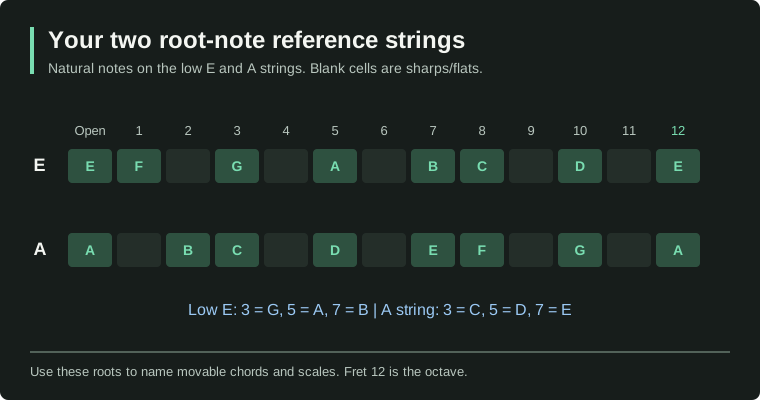
Here's the whole method in one line: memorize the natural notes (no sharps or flats) on the low E and A strings, frets 0–12. The sharp and flat notes just fill the gaps between them.
Natural notes land on these frets because E–F and B–C are only one fret apart (a half step), while every other natural pair is two frets apart (a whole step). That single fact (the E–F and B–C half steps) is why the spacing below looks uneven. It's not random.
Low E string (6th string)
| Fret | 0 | 1 | 3 | 5 | 7 | 8 | 10 | 12 |
|---|---|---|---|---|---|---|---|---|
| Note | E | F | G | A | B | C | D | E |
A string (5th string)
| Fret | 0 | 2 | 3 | 5 | 7 | 8 | 10 | 12 |
|---|---|---|---|---|---|---|---|---|
| Note | A | B | C | D | E | F | G | A |
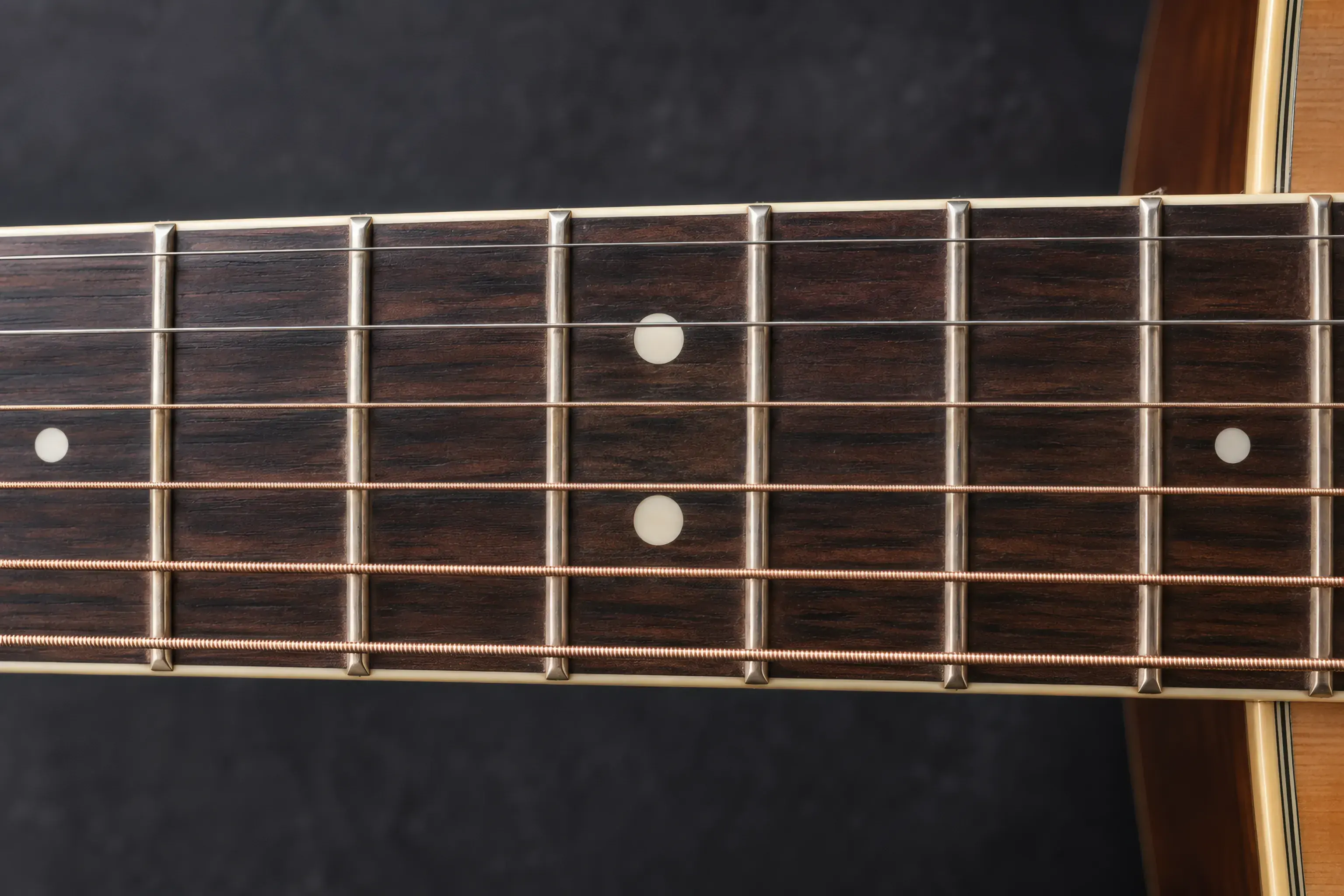
Notice the symmetry: the A string's natural notes sit at almost the same frets as the E string's, shifted by one letter. Frets 3, 5, 7, 8, 10, and 12 carry naturals on both strings. Most guitars even put inlay dots at 3, 5, 7, and 12; the dots are your landmarks, and now they have names.
For the gaps, add a sharp to the note below: 1st fret on the A string is A#, 4th fret is C#, 6th fret is D#. (Flats name the same frets going down: A# and Bb are the same fret.)
Full E string, every fret
| Fret | 0 | 1 | 2 | 3 | 4 | 5 | 6 | 7 | 8 | 9 | 10 | 11 | 12 |
|---|---|---|---|---|---|---|---|---|---|---|---|---|---|
| Note | E | F | F# | G | G# | A | A# | B | C | C# | D | D# | E |
Full A string, every fret
| Fret | 0 | 1 | 2 | 3 | 4 | 5 | 6 | 7 | 8 | 9 | 10 | 11 | 12 |
|---|---|---|---|---|---|---|---|---|---|---|---|---|---|
| Note | A | A# | B | C | C# | D | D# | E | F | F# | G | G# | A |
The 12th fret repeats the open string, one octave up. Past the 12th fret, the whole map starts over: 13th fret equals 1st fret, and so on.
Octave Shapes
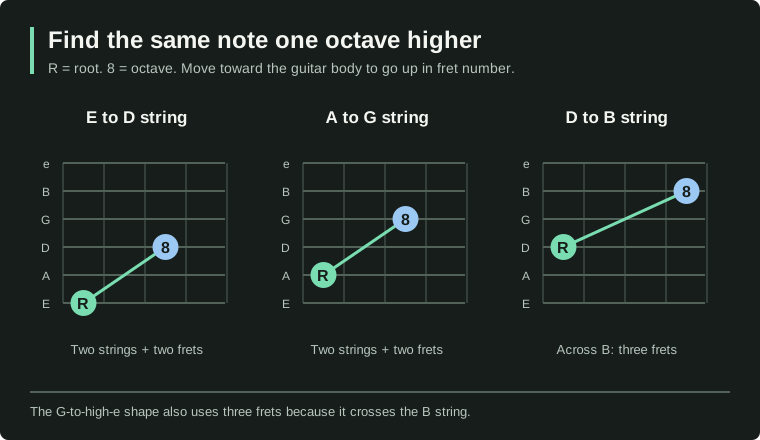
Two memorized strings cover the whole neck, thanks to octave shapes. An octave is the same note name higher up, and on guitar the same note sits in predictable spots. These shapes are movable; they work from any root.
6th-string root → 4th string, two frets up
Find any note on the low E string. Its octave lives on the D string, two frets higher, two strings down.
e|-------------------|
B|-------------------|
G|-------------------|
D|---------7---------| octave A
A|-------------------|
E|---5---------------| root A
Root A at the 5th fret of the low E, octave A at the 7th fret of the D string. Slide the pair anywhere and the note names change but the shape doesn't.
5th-string root → 3rd string, two frets up
Same idea from the A string: the octave is on the G string, two frets up.
e|-------------------|
B|-------------------|
G|---------5---------| octave C
D|-------------------|
A|---3---------------| root C
E|-------------------|
The G–B string exception
If you extend the pattern past the D string, add one extra fret. The B string is tuned a half step lower than the "two frets up" rule expects, so:
- 4th-string root → octave on the 2nd string, three frets up
- 3rd-string root → octave on the 1st string, three frets up
That's the only wrinkle in the system, and it's the reason some chord shapes look "off by one" on the top two strings.
Finding Any Note on the Fretboard
Now the payoff. The method, start to finish:
- Locate the note on the low E or A string (that's why you memorized them).
- Jump to its octave with the shapes above.
- From there, nearby strings are one quick count away; remember, neighboring strings are five frets apart, except G to B, which is four.
Worked example: find every C below the 12th fret.
- Low E string, 8th fret: straight from the E-string chart.
- A string, 3rd fret: straight from the A-string chart.
- D string, 10th fret: octave of the low E C: 8 + 2 = 10.
- G string, 5th fret: octave of the A-string C: 3 + 2 = 5.
- B string, 1st fret: octave of the D-string C with the exception: 10 + 3 = 13 is past 12, so count up from open B instead: B → C is one fret.
- High E string, 8th fret: same as the low E string, always.
Six C notes, and you can name all of them in about ten seconds once the E and A strings are automatic. Run the same exercise for F or G and you'll notice the frets cluster; that's the geometry of the neck showing itself.
Want to see what those six notes are good for? Drop any of them into the scale finder and it will show you the full C major or C pentatonic layout around that position. And the chord library will show you how many ways a C chord uses these same C roots.
Practice Exercises
Five minutes a day beats an hour on Sunday. Rotate these three.
1. Say and play the E string
Set a metronome to 60 BPM. Play the low E string at fret 0, say "E," move up one fret per click, and name every note through the 12th fret: E, F, F#, G, G#, A, A#, B, C, C#, D, D#, E. Then come back down. When the E string is easy, do the A string. Saying the names out loud is not optional; it forces recall instead of pattern-matching.
2. Find five G notes anywhere
Pick a note; G is a good start. Set a timer for two minutes and find five different G notes on the neck, in any octave, without looking at the charts. Check yourself against the method: G lives at the 3rd fret of the low E string, so its octave is the 5th fret of the D string; the A string gives you the 10th fret, whose octave is the 12th fret of the G string. When two minutes feels generous, drop it to one. Then switch the target note daily.
3. Octave drill in four positions
Pick a root, say D. Play it on the A string (5th fret), then its octave on the G string (7th fret). Now move the root to the low E string (10th fret) and play the octave on the D string (12th fret). That's four D notes in two shapes. Do the same circuit for E, F, and G. This drill builds the fretboard as pairs of connected notes instead of isolated dots, which is exactly how you'll use it in real playing.
Diagrams and Audio
Here's the full reference chart for E standard tuning, frets 0–12. Save this page; this table alone is worth the visit.
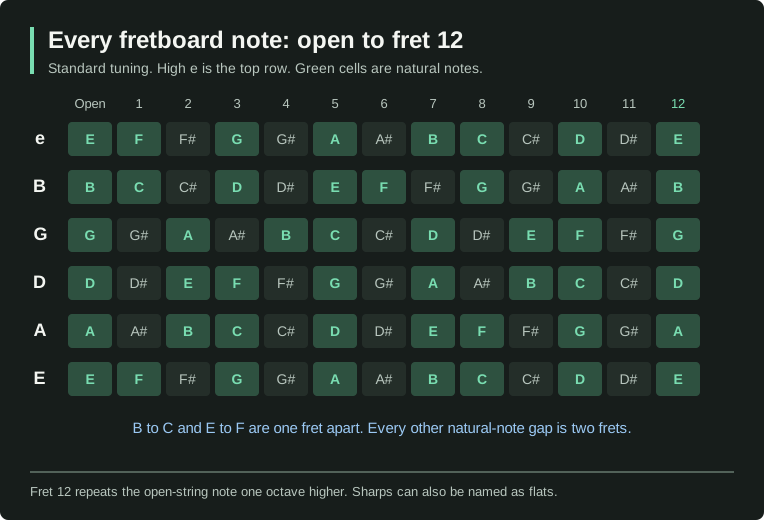
And the same chart as accessible per-string tables, in case the image doesn't load or you're on a screen reader:
D string (4th)
| Fret | 0 | 1 | 2 | 3 | 4 | 5 | 6 | 7 | 8 | 9 | 10 | 11 | 12 |
|---|---|---|---|---|---|---|---|---|---|---|---|---|---|
| Note | D | D# | E | F | F# | G | G# | A | A# | B | C | C# | D |
G string (3rd)
| Fret | 0 | 1 | 2 | 3 | 4 | 5 | 6 | 7 | 8 | 9 | 10 | 11 | 12 |
|---|---|---|---|---|---|---|---|---|---|---|---|---|---|
| Note | G | G# | A | A# | B | C | C# | D | D# | E | F | F# | G |
B string (2nd)
| Fret | 0 | 1 | 2 | 3 | 4 | 5 | 6 | 7 | 8 | 9 | 10 | 11 | 12 |
|---|---|---|---|---|---|---|---|---|---|---|---|---|---|
| Note | B | C | C# | D | D# | E | F | F# | G | G# | A | A# | B |
High E string (1st)
| Fret | 0 | 1 | 2 | 3 | 4 | 5 | 6 | 7 | 8 | 9 | 10 | 11 | 12 |
|---|---|---|---|---|---|---|---|---|---|---|---|---|---|
| Note | E | F | F# | G | G# | A | A# | B | C | C# | D | D# | E |
For self-testing, use call-and-response: cover the chart with your hand, point at a random fret on your guitar, name the note, then check. Ten reps, twice a day. A friend calling out fret and string numbers works even better.
FAQ
Do I need to memorize all notes at once?
No, and please don't try. Memorize the low E string first, then the A string; that's two strings, mostly natural notes, and it takes most students a week or two of short daily drills. Everything else comes from octave shapes and counting, which you'll absorb by using the exercises above. Total memorization of all six strings is the finish line, not the starting line.
How long does it take to learn the fretboard?
With five minutes a day: the E and A strings in one to two weeks, comfortable octave shapes in about a month, and instant recall of any note anywhere in two to three months. The timeline depends almost entirely on consistency, not talent. Daily five-minute sessions beat weekly hour-long ones every time, because this is habit formation, not homework.
What's the fastest way to memorize notes?
Say-and-play with a metronome, out loud, one string at a time, then the "find five of one note" drill. The out-loud part is the multiplier; silently staring at charts builds recognition, and you need recall. Add real songs as soon as possible: name the root of every chord you play for a week and the fretboard stops being a study topic and starts being the instrument.
Keep going
Tune up, run the say-and-play drill on the low E string, then find five G notes before you close the case.
- Open the online guitar tuner
- See your notes inside real scales
- Ready to use root notes for chords? Learn barre chords