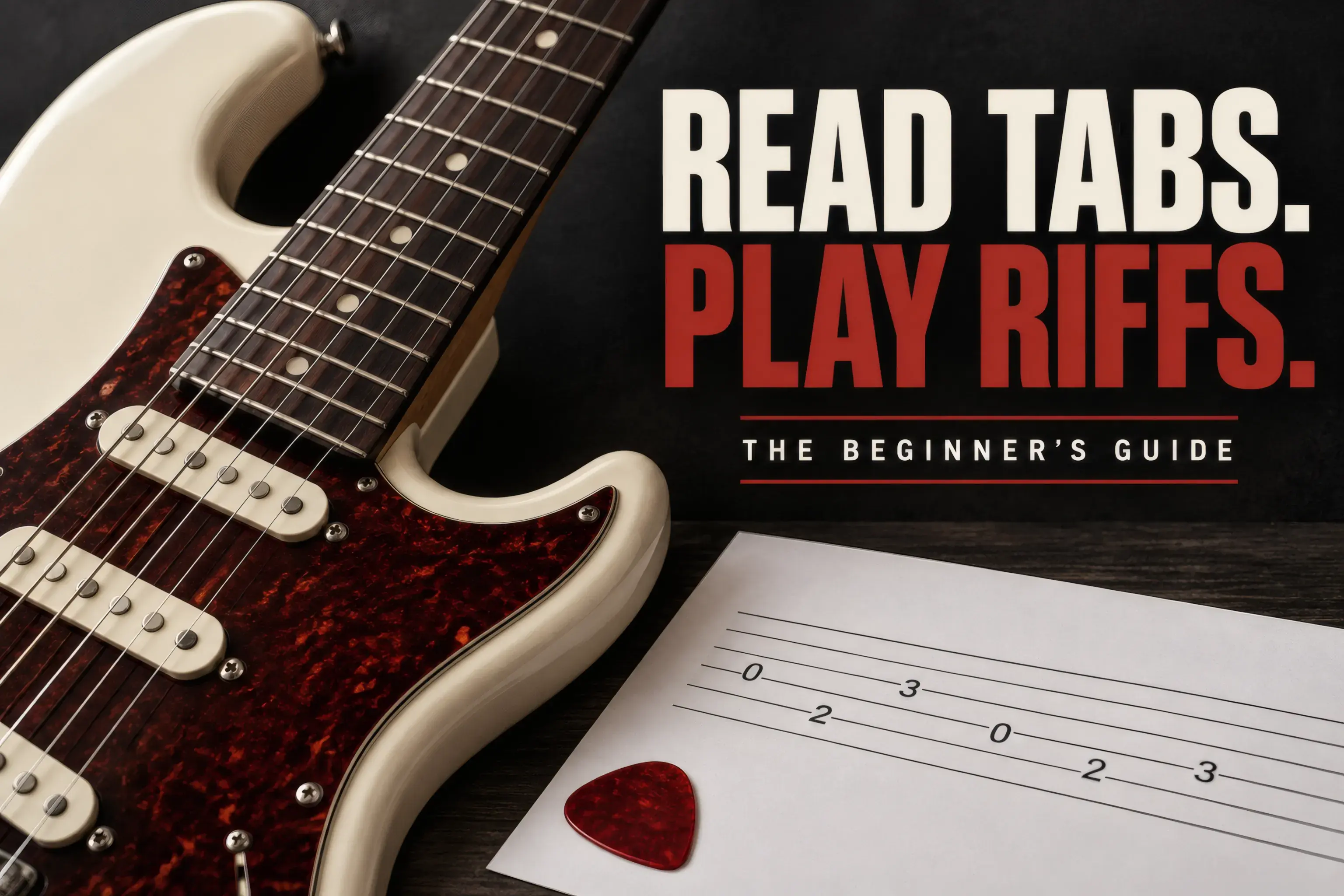
If you can count frets, you can read guitar tabs. Tablature is a visual map of your strings and frets (six lines, some numbers, a handful of symbols), and most beginners can decode their first riff in under five minutes. This guide teaches you every part of a guitar tab, from the string lines to the bend symbols, with verified example tabs you can play right now.
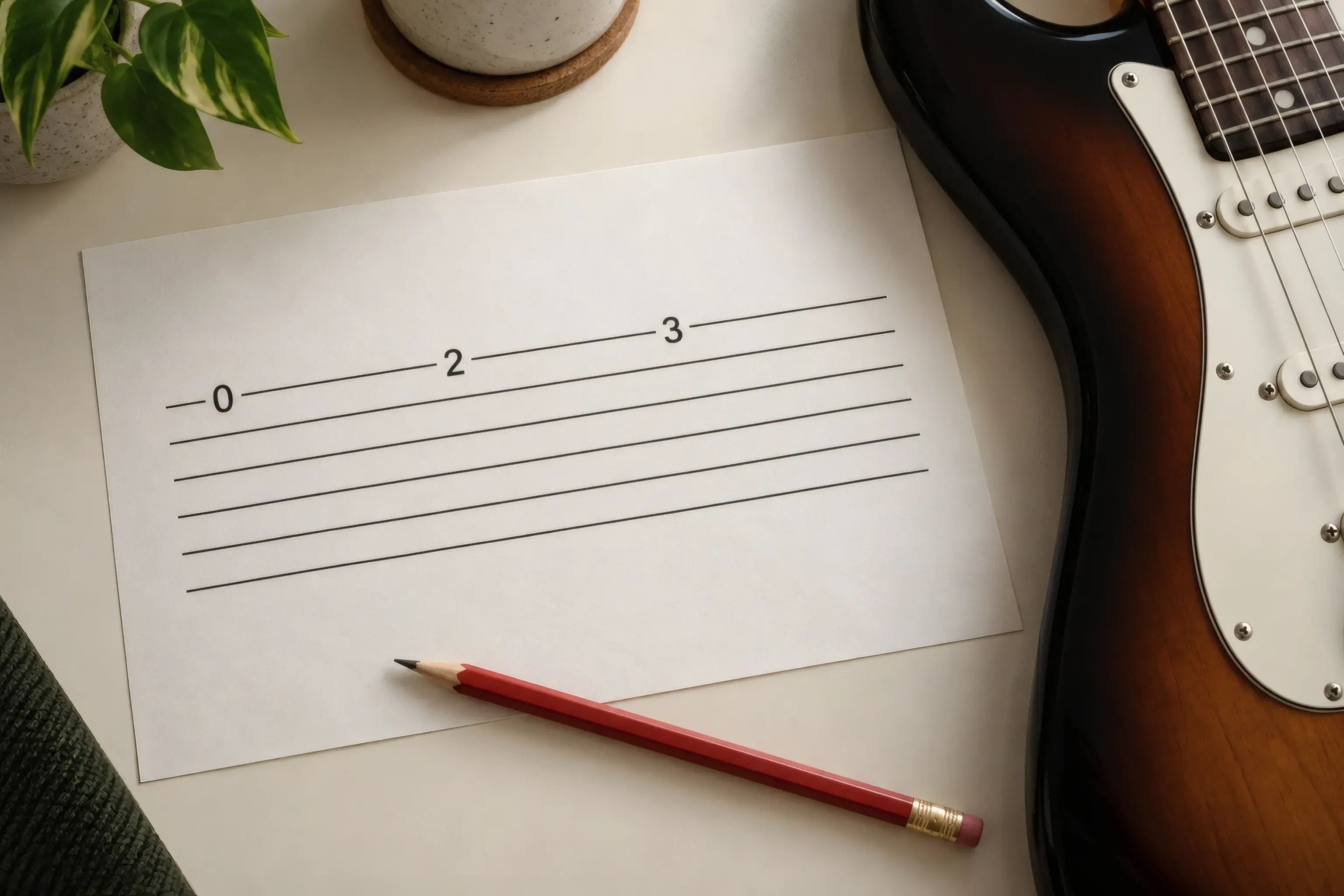
Here is your first tab. Decode it in 30 seconds: the top line is your thinnest string (high e), 0 means play it open, and 3 means press the 3rd fret and play again.
e|--0---3--|
B|---------|
G|---------|
D|---------|
A|---------|
E|---------|
That is the whole system in miniature. Everything else in this guide is detail.
Quick CTA:
- Open the online guitar tuner: tabs assume your guitar is in tune
- Open the metronome: you will want it for the rhythm section
Tab basics: six lines, six strings
A tab staff has one line per string. The catch that trips every beginner: the top line is the high e string (the thinnest one, closest to the floor when you hold the guitar), and the bottom line is the low E string (the thickest, closest to your chin).
It feels upside down at first because it is. The tab shows the guitar as if you looked down at the fretboard while playing, which is exactly how you see your own hands.
e|------------------------| ← thinnest string (high e)
B|------------------------|
G|------------------------|
D|------------------------|
A|------------------------|
E|------------------------| ← thickest string (low E)
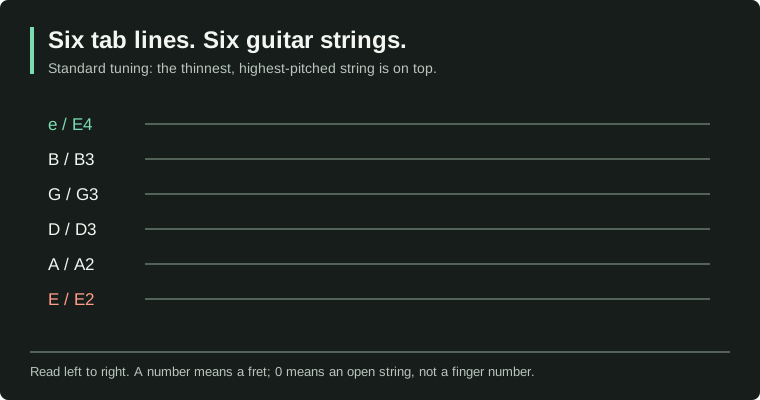
A few labels you will see at the top of a tab, before the first note:
- Tuning. Standard tuning (E A D G B E) is assumed unless the tab says otherwise. If it says "Drop D" or "Open G," retune first; our alternate guitar tunings guide walks through the common ones.
- Capo. "Capo 2" means clamp a capo on the 2nd fret, then read the numbers as if the capo were the nut. A "3" with capo 2 is really the 5th fret from the nut, but you just count from the capo.
- Tempo and time signature. Better tabs include a BPM and something like 4/4. Treat these as the target, not a rule for day one.
Numbers mean frets, not fingers
This is the second classic mix-up. A "3" on the A string line means press the A string at the 3rd fret; it says nothing about which finger to use. Fingering is your choice, and the FAQ below covers how to choose.
Reading simple tabs
You now know everything needed for your first real melodies. Three rules cover most of it.
1. Read left to right, like a sentence
The leftmost note sounds first. Play this one string at a time:
e|----------------------|
B|----------------------|
G|----------------------|
D|----------------------|
A|-----------0---2------|
E|--0---3---------------|
That is: low E open, low E 3rd fret, A open, A 2nd fret. Four notes, one after another. Say the string names out loud as you play; it wires the staff to your hands faster than silent reading.
2. 0 means open string
A zero is not "skip this string." It means pick the string with no fret pressed. Open strings appear constantly in beginner tabs, so get comfortable with them.
3. Stacked numbers are played together
When numbers line up vertically, you play them at the same moment; that is a chord. This is a C major chord:
e|--0--|
B|--1--|
G|--0--|
D|--2--|
A|--3--|
E|-----|
No number on the bottom line means do not play the low E string. Strum from the A string down and let all five notes ring together. If it sounds clean, you just read and played your first chord from a tab. When you are ready to put chords like this in order, our guide to guitar chord progressions is the natural next step, and the chord library has diagrams for any shape a tab throws at you.
Common first-week mistakes
Every teacher sees the same three. Catch them now and save yourself a month.
- Reading the staff upside down. If a riff sounds wrong but the numbers look right, you are probably playing the top line as the low E. Check the string labels every time until it is automatic.
- Confusing 10 with 1 and 0. Two-digit fret numbers are one number, not two notes. "10" on the A string is the 10th fret, not the 1st fret then open.
- Pressing on top of the fret wire. The number names the fret space, and your finger goes just behind the wire toward the headstock side. Pressing on the wire itself buzzes or mutes the note.
Common guitar tab symbols
Single numbers only get you so far. Tabs use small letters and marks to show how a note is played, not just which note. Here is each symbol you will actually meet, with a one-line original example and what to do with your hands.
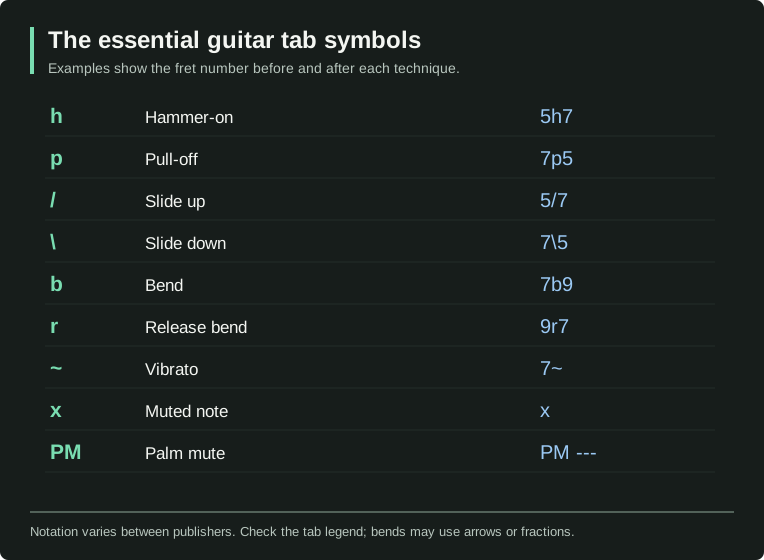
h = hammer-on
e|--0h3--|
Pick the open string, then slap a fretting finger down on the 3rd fret without picking again. Two notes, one pick stroke. It should sound smooth and connected, with the second note almost as loud as the first.
p = pull-off
e|--3p0--|
The reverse of a hammer-on. Press the 3rd fret, pick the note, then pull your finger off sideways (a tiny plucking motion) so the open string rings. If the second note is silent, you lifted straight up instead of pulling.
/ = slide up
e|--3/5--|
Pick the 3rd fret note, keep pressure on the string, and glide your finger up to the 5th fret. You should hear the pitch sweep upward with no gap.
\ = slide down
e|--5\3--|
Same idea, moving down toward the headstock. Slides show up everywhere in lead playing, and if the sound grabs you, slide guitar for beginners takes the technique much further with an actual slide.
b = bend
e|--7b9--|
Fret the 7th fret, pick, then push the string across the fretboard until the pitch rises to match the 9th fret note. That is a full-step bend. The second number is the target pitch, not a second note to fret. Check your bend by playing the 9th fret normally first and matching it.
r = release
e|--7b9r7--|
Bend up to the 9th-fret pitch, then ease the string back down to where you started. Bend and release is usually written as one phrase like this.
~ = vibrato
e|--5~---|
Hold the note and wobble the pitch slightly by rocking your fretting hand. Small and steady beats wide and wild. It should sound like the note is shimmering, not like a siren.
x = muted note
e|--x---x---3--|
Rest your fretting fingers lightly across the strings (touching, not pressing) and pick. You get a percussive click instead of a note. Mixed with real notes, x's are the backbone of funk and rock rhythm parts.
PM = palm mute
e|------------------|
B|------------------|
G|------------------|
D|------------------|
A|------------------|
E|--0---0---0---0---|
   PM--------------
The "PM" with a dotted line under the notes means rest the edge of your picking palm lightly on the strings near the bridge while you play them. The notes turn short and chunky: the classic chug of rock and metal. Too much pressure kills the note entirely; you want a thud with a pitch inside it.
A note on symbol variants
Tab is folk notation, not a strict standard, so spelling varies between sources. A bend may appear as 7b9, 7b, or with a curved arrow. Hammer-ons and pull-offs are sometimes joined by an arc instead of the h and p letters. Vibrato shows up as ~ or v. The symbols in this guide are the most common spellings; when a tab uses a different one, the shape of the move is the same.
Rhythm in tabs
Here is the honest truth most guides skip: plain text tabs usually do not encode rhythm. The numbers tell you what to play, not when. Some tabs hint at timing with wider gaps for longer waits:
e|--0----------3----3----0--|
B|--------------------------|
G|--------------------------|
D|--------------------------|
A|--------------------------|
E|--------------------------|
That spacing is a rough suggestion, nothing more. It cannot tell you whether a note lasts one beat or three.
Better tabs solve this two ways:
- Hybrid tabs add stems and beams above the tab staff, like standard notation. A filled head with one flag is an eighth note; no flag is a quarter. Two eighth notes beamed together split one beat evenly; count them 1 &. If your tab has stems, learn to read them; it is the single most useful rhythm skill for a tab reader.
- Tab plus standard notation. Printed books put the rhythm staff on top and the tab below. The top staff gives you exact timing; the tab gives you positions.
When your tab has no rhythm information (and most free online tabs do not), you supply it:
- Listen to the recording. Tap along and count the beats. Where does each note land?
- Count out loud. Fit the notes to a count: 1 & 2 & 3 & 4 &. Write the counts above the tab in pencil if it helps.
- Verify with a metronome. Set the online metronome to 60 BPM and check that your counted version lands on the clicks. If it does, you have decoded the rhythm yourself, a skill worth more than any single tab.
First riffs to practice
Time to use all of it. These two riffs are the classic first reads for a reason: few notes, big payoff. Play them slowly first, then at full speed.
Riff 1: the "Smoke on the Water" intro riff
The famous one. It lives on the D and G strings, and you play both strings at the same fret together (this two-string move is a power chord). The classic version runs three short phrases:
e|-------------------------------------------------|
B|-------------------------------------------------|
G|--0---3---5---0---3---6---5---0---3---5---3---0--|
D|--0---3---5---0---3---6---5---0---3---5---3---0--|
A|-------------------------------------------------|
E|-------------------------------------------------|
For each 0, play the D and G strings open with no fretting fingers touching them. For frets 3, 5, and 6, use a small index-finger barre across D and G and move it to the written fret, keeping the other strings muted. Release the barre completely for each return to 0. If the two-string version is too much today, play just the G-string line: no finger for 0, index for 3, ring for 5, and pinky for 6.
Riff 2: the "Seven Nation Army" riff
This one sits entirely on the A string, so the fretting hand barely moves. Seven notes:
e|----------------------------|
B|----------------------------|
G|----------------------------|
D|----------------------------|
A|--7---7---10--7---5---3---2-|
E|----------------------------|
The notes are E, E, G, E, D, C, B. After fret 10, return to fret 7, then continue to 5, 3, and 2, picking each written note separately. Release fretting pressure while repositioning; no slide is marked in this tab. Try a light palm mute once the plain version is clean.
One-bar exercises for each symbol family
These are original drills I wrote for this lesson, one per symbol group. Loop each bar four times before moving on.
Hammer-ons and pull-offs:
G|--0h2p0---0h4p0--|
Slides:
G|--3/5---5\3------|
Bend, release, vibrato:
B|--5b7r5~---------|
Mutes and palm muting:
E|--0---0---x---x--|
   PM---PM
Practice exercises
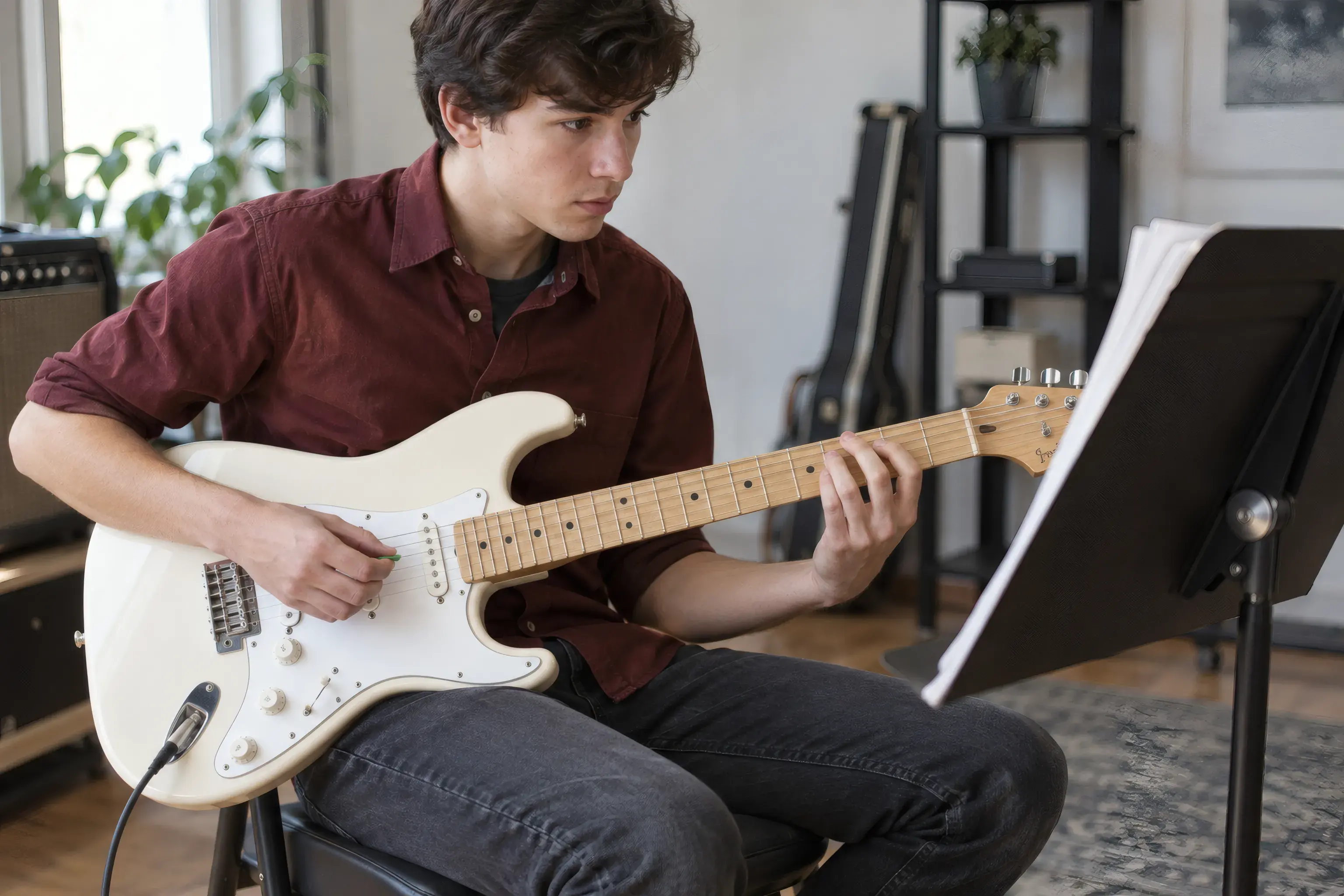
Three short daily drills turn tab reading from decoding into reading. Ten minutes total.
Exercise 1: name the open strings
Play each open string from low E to high e, saying the string name out loud as it rings:
e|-------------------0--|
B|----------------0-----|
G|-------------0--------|
D|----------0-----------|
A|-------0--------------|
E|--0-------------------|
Then go back down, high e to low E. This feels trivial. Do it anyway for a week; the goal is for your eyes to land on the right line of a tab without counting from the top.
Exercise 2: the G-string hammer/pull drill
One smooth loop, all on the G string. Pick only the first note of each pair; let the hammer and pull do the rest:
G|--0h2p0---2h4p2---4h5p4---5h7p5--|
Keep every note the same length and volume. Start at 60 BPM on the metronome, one pair per beat, and add 5 BPM only when all four pairs sound equally clean.
Exercise 3: read and play a 4-bar melody
Here is an original melody in E minor that uses nothing but open strings and the first four frets. Four quarter notes per bar: count 1 2 3 4 as you play:
e|-----------------|-----------------|-----------------|-----------------|
B|-----------------|-----------------|-----------------|-----------------|
G|-----------------|-----------------|--------0---2----|--4---2---0------|
D|-----------------|--0--------------|--0---2----------|-----------2-----|
A|--------0---2----|------2---0------|-----------------|-----------------|
E|--0---3----------|--------------3--|-----------------|-----------------|
Bar 1 climbs (E, G, A, B), bar 2 answers it coming down, bar 3 climbs again on higher strings, and bar 4 walks home to E. Play it at 60 BPM until you can do two clean passes, then try 80. Record yourself on your phone; hearing your own timing from the outside teaches more in one listen than ten playthroughs.
Audio and interactive elements
Reading a tab is half the job; hearing it is the other half. Here is how to get the ear training with what exists today, plus what is coming.
- For each riff and exercise: play it at half speed first, then full speed. Record both on your phone and compare; the slow take should sound identical to the fast one, just slower.
- For the symbol drills: record yourself doing the hammer-on exercise and listen specifically for the second note of each pair. If it is quieter than the picked note, hammer harder.
A click-to-play tab player for this lesson is planned, so each example will eventually play itself when tapped. Until it ships, the static tabs above plus your own recordings carry the full lesson, and honestly, learning to hear your own playing against the page is the skill that transfers to every tab you will ever meet.
FAQ
Do tabs show rhythm?
Plain text tabs usually do not. They show which notes to play and in what order, but not how long each note lasts. Some tabs add stems and beams for exact rhythm, and note spacing gives a rough hint, but for most tabs you figure out timing by listening to the song and counting with a metronome.
How do I know which finger to use for each fret?
Tabs do not say; the numbers are frets, not fingers. The default rule: in the first four frets, assign one finger per fret (index = 1, middle = 2, ring = 3, pinky = 4). Higher up the neck, use whatever keeps your hand from jumping around. If a stretch hurts, there is almost always an easier fingering; try shifting the whole hand instead of reaching.
Are tabs better than chord charts?
They do different jobs. A chord chart tells you which chord to strum and when to change: perfect for singing and strumming whole songs. A tab tells you exact notes, frets, and techniques: perfect for riffs, solos, and fingerpicking. Learn both; most guitarists end up reading chord charts for rhythm parts and tabs for anything note-by-note.
Play something today
You have the six lines, the numbers, the symbols, and two riffs. Open the guitar tuner, get every string centered, set the metronome to 60, and read the "Seven Nation Army" riff off the screen, slowly, out loud, one note per click. That is tab reading. Everything from here is just more songs.