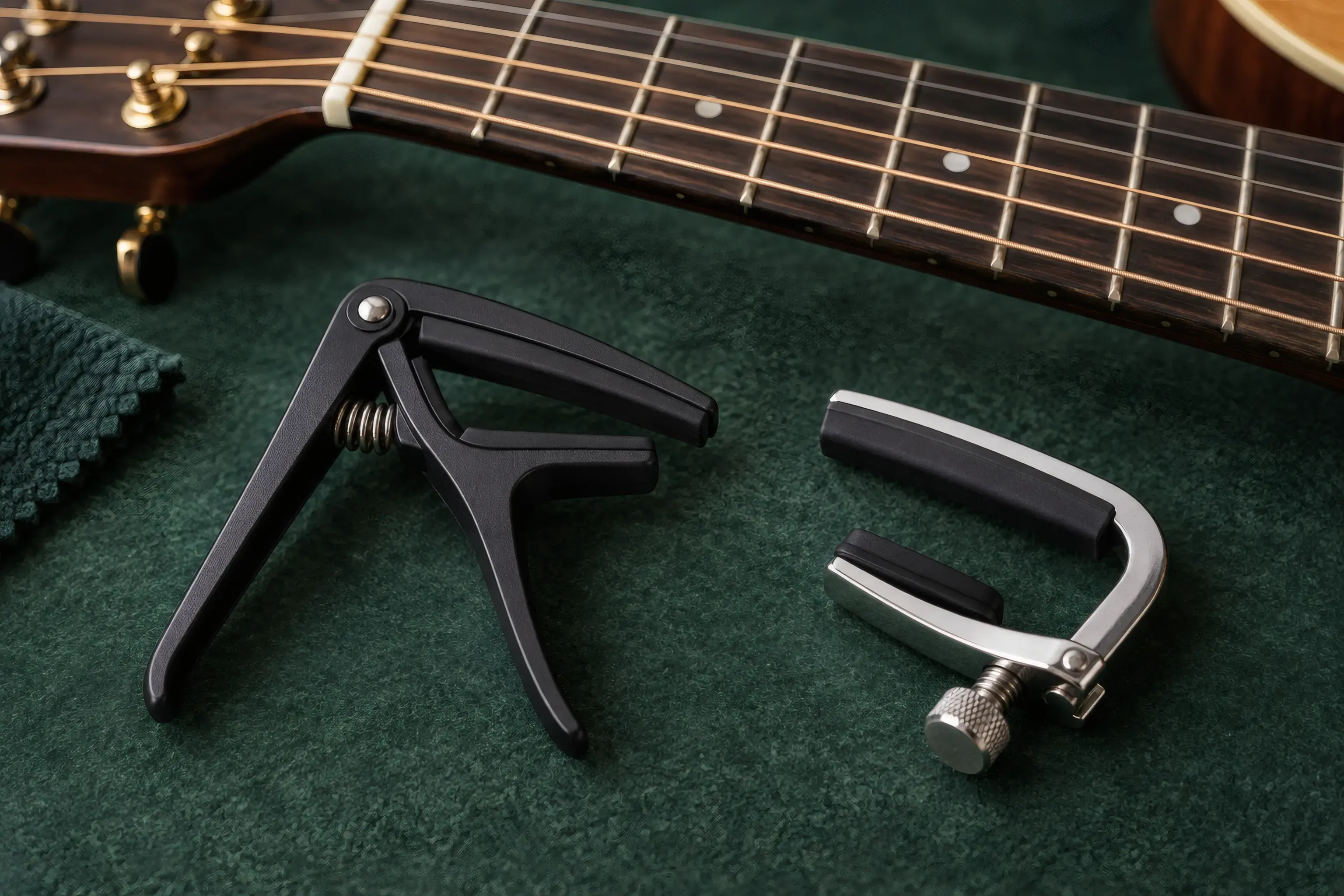
A capo clamps across your fretboard and raises the pitch of every string by one half-step per fret, so your familiar open chord shapes instantly sound in a new key. This page gives you a complete guitar capo chart for all 12 keys, plus the placement and tuning habits that make a capo sound clean instead of buzzy.
Quick-use guide:
- Find the key the song is in (or the key you want to sing in).
- Look it up in the chart below and pick the chord shape family you like best.
- Place the capo on the fret listed and play your open shapes as usual.
Quick CTA:
- Open the online guitar tuner: check tuning before and after clamping
- Browse the chord library: look up any open shape in the chart
How a capo works
A capo is a moveable nut. Clamp it at the 2nd fret and every open string now sounds two half-steps higher, exactly as if your guitar had been shortened. Each fret equals one semitone:
- Capo 1 = up one half-step (C shapes sound as C#/Db)
- Capo 2 = up two half-steps (C shapes sound as D)
- Capo 3 = up three half-steps (C shapes sound as Eb)
And so on. Your chord shapes don't change. A G shape is still fingered like a G; it just sounds higher. Guitarists still call out the shape names ("play G, then C") even when the sounding chords are A and D.
Why bother? Three real reasons:
- Easier chords. A song in Ab is all barre chords. With a capo at the 1st fret you can play it with G family shapes (G, C, D, Em) that beginners learn in week one.
- Vocal range. The singer needs it a step higher? Move the capo up two frets instead of relearning the song.
- Open-string resonance. Open chords ring with drones and sustain that barre chords can't match. A capo keeps that sound in any key.
How to read a guitar capo chart
A capo chart is a lookup table. One axis lists the chord shapes you finger, the other lists the capo fret, and each cell tells you the key that actually comes out of the guitar.
Worked example: you need to play in Bb and you love G-family shapes (G, C, D, Em). G is three semitones below Bb, so you need three half-steps of lift: capo at the 3rd fret. Now your G shape sounds Bb, your C shape sounds Eb, your D shape sounds F. The chart below just does that math for every combination.
Full capo chart (all 12 keys)
Rows are the open chord families you finger (C, G, D, A, E). Columns are capo positions 0–7. The cell is the key that sounds.
| Shapes played | Capo 0 | Capo 1 | Capo 2 | Capo 3 | Capo 4 | Capo 5 | Capo 6 | Capo 7 |
|---|---|---|---|---|---|---|---|---|
| C family | C | C#/Db | D | Eb | E | F | F#/Gb | G |
| G family | G | Ab/G# | A | Bb | B | C | C#/Db | D |
| D family | D | Eb | E | F | F#/Gb | G | Ab/G# | A |
| A family | A | Bb | B | C | C#/Db | D | Eb | E |
| E family | E | F | F#/Gb | G | Ab/G# | A | Bb | B |
Read it backwards to plan a song: find your target key in the grid, then slide up that column to see which shapes and capo fret produce it.
For most keys there are two or three comfortable options. Here are the easiest: the ones using the friendliest open shapes at the lowest sensible capo position:
| Target key | Easiest option | Alternative |
|---|---|---|
| C | C shapes, open | G shapes, capo 5 |
| Db / C# | C shapes, capo 1 | G shapes, capo 6 |
| D | D shapes, open | C shapes, capo 2 |
| Eb | D shapes, capo 1 | C shapes, capo 3 |
| E | E shapes, open | D shapes, capo 2 |
| F | E shapes, capo 1 | D shapes, capo 3 |
| F# / Gb | E shapes, capo 2 | D shapes, capo 4 |
| G | G shapes, open | E shapes, capo 3 |
| Ab / G# | G shapes, capo 1 | E shapes, capo 4 |
| A | A shapes, open | G shapes, capo 2 |
| Bb | G shapes, capo 3 | A shapes, capo 1 |
| B | A shapes, capo 2 | G shapes, capo 4 |
Notice the pattern: you rarely need to capo past the 5th fret. Anything higher and the guitar starts sounding thin and the frets get crowded; pick a different shape family instead.
Practical examples
Song in Eb. The chart row says: D shapes at capo 1, or C shapes at capo 3. If the song leans on D, A, and Bm-type shapes, capo 1 keeps everything familiar. If you'd rather have C, F, and G shapes under your fingers, capo 3. Same sounding chords (Eb, Ab, Bb) either way.
Song in F#. Use E shapes at capo 2: your E, A, and B shapes now sound F#, B, and C#. Or use D shapes at capo 4 if the song has lots of G-type and D-type movement. Capo 2 usually wins because the frets stay roomy.
Song in Ab. Barre chords for days, unless you capo 1 and play G shapes. G, C, D, and Em shapes come out as Ab, Db, Eb, and Fm. This is the classic reason the capo exists.
Song in B. A shapes at capo 2 gives you A, D, E shapes sounding B, E, F#. Much friendlier than barreing everything.
Once you've picked shapes, you can build the actual progression with the chord library. Try C–G–Am–F, then use the chart above to see which key those shapes produce at your chosen capo fret.
Capo placement tips
Placement is 90% of capo problems. Three habits fix almost everything:
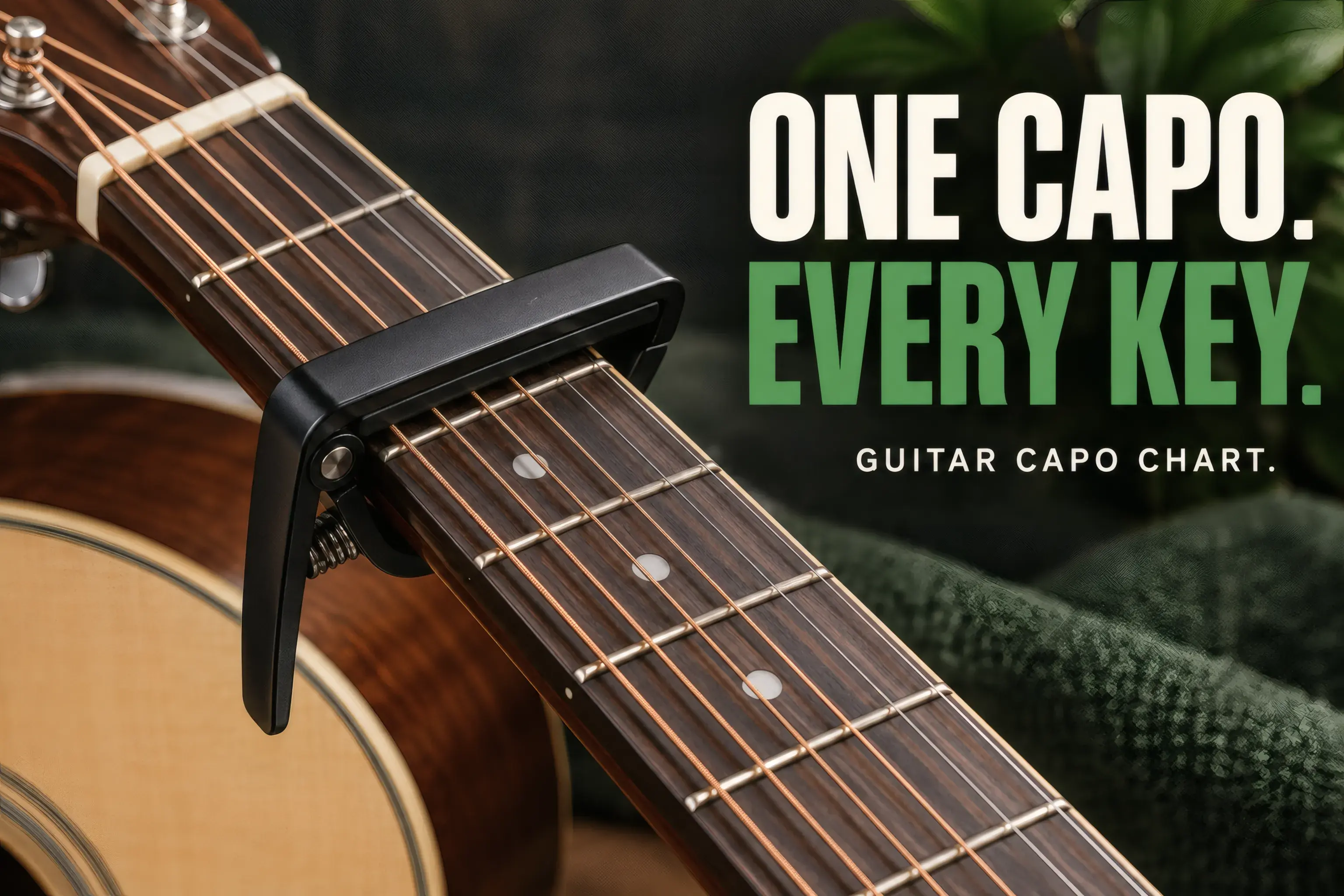
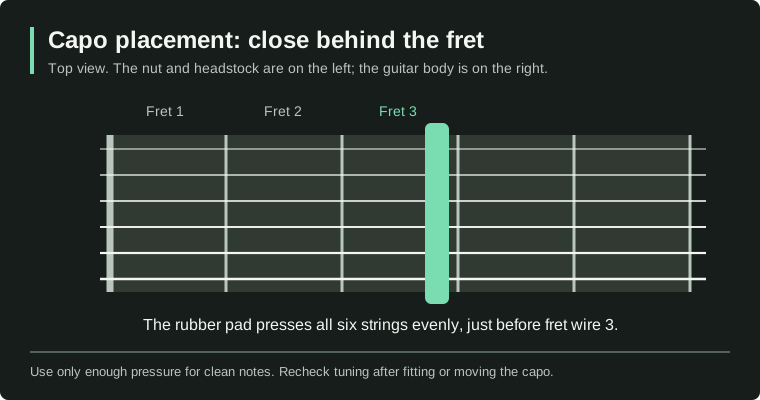
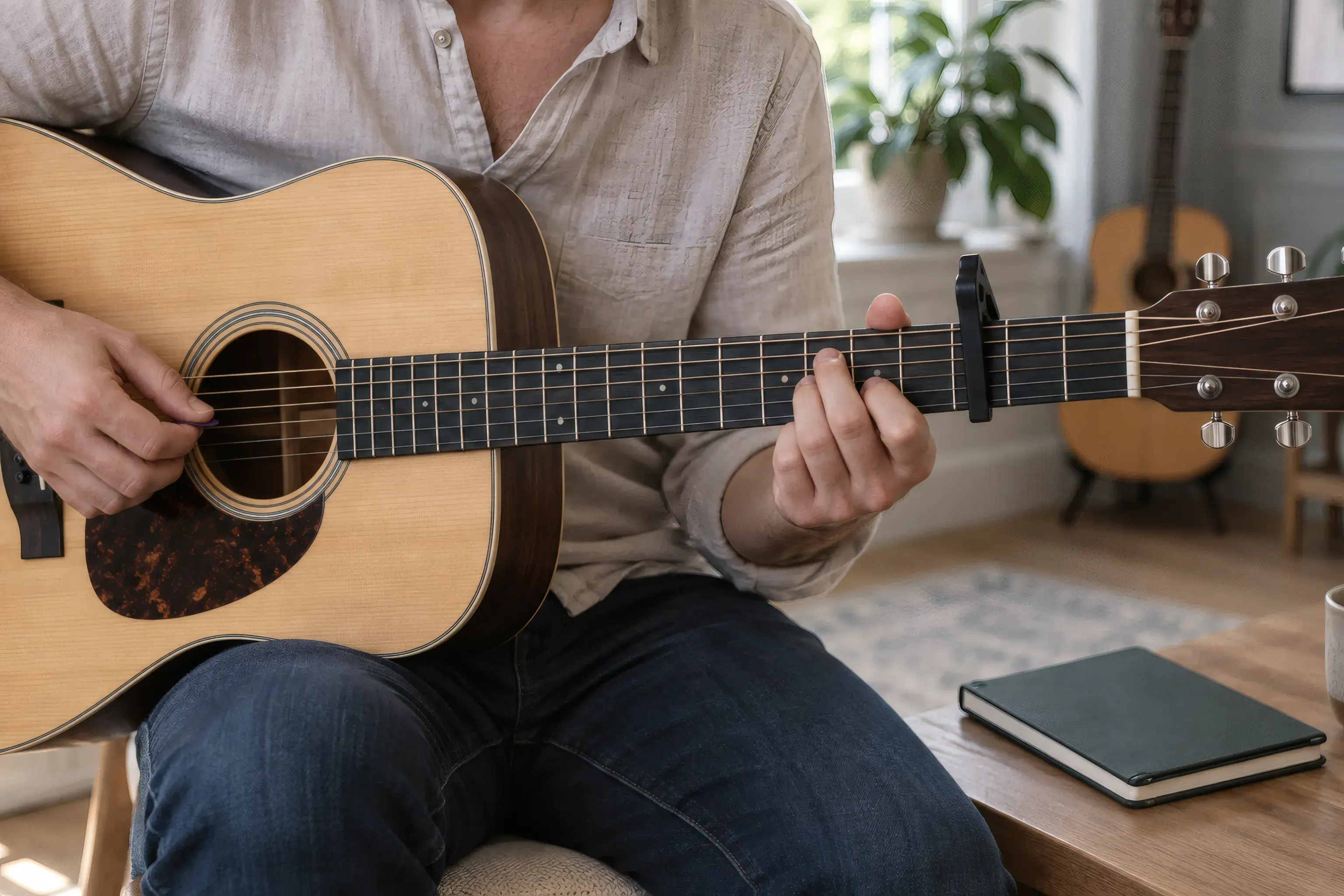
- Just behind the fret, not on it. The capo should sit close to the fret wire on the nut/headstock side, the same spot your finger wants for a clean note. Keep the pad in the space before the intended fret wire, not beyond it toward the body. Placing it on the wire or too far behind it can cause buzzing or uneven contact.
- Even pressure across all six strings. When you clamp, look at the capo from the side. If it's tighter on the treble strings than the bass (or the reverse), something will go sharp or mute. Adjustable-tension capos let you dial this in; spring capos need a centered, square clamp.
- Retune check. Every capo pulls strings slightly sharp. More on that below.
Common capo mistakes
Capo too far from the fret. The strings buzz because they're not being pinned down near a hard point. Move the capo right up against the fret wire.
Uneven pressure. Usually a capo clamped at an angle. Loosen, square it up parallel to the fret, and reclamp.
Tuning drift. Clamping bends each string over the capo's edge and drags it sharp; the wound strings suffer most. The fix is simple: after you place the capo, re-check tuning with the online tuner and nudge anything that reads sharp. Ten seconds, and the difference is obvious.
If your guitar drifts out of tune constantly (capo or no capo), the capo isn't the culprit. Worn tuners, binding nuts, and old strings are the usual suspects, and why your guitar won't stay in tune covers the full checklist.
Forgetting the shapes changed name. This one is mental, not mechanical. With a capo at 3, your "G shape" is a Bb chord. When the bandleader calls Bb, that's you. Learn to think in shape names while listening in sounding names.
Diagrams and practice
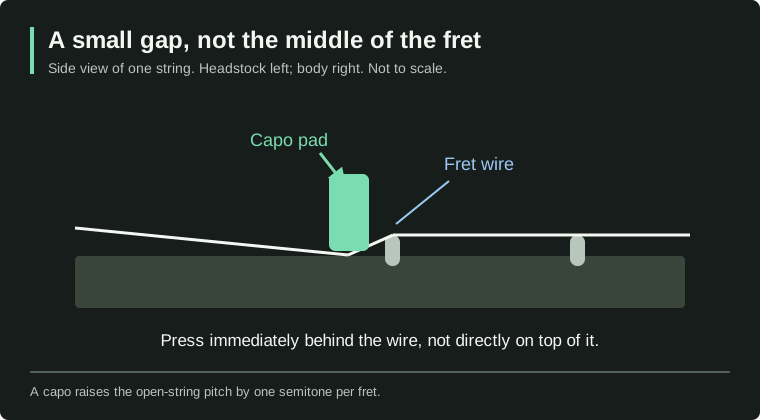
The two diagrams above show the golden rule: the capo pad presses the strings down immediately behind the fret wire, never in the middle of the fret space and never on top of the wire.
Exercise: one progression, three keys
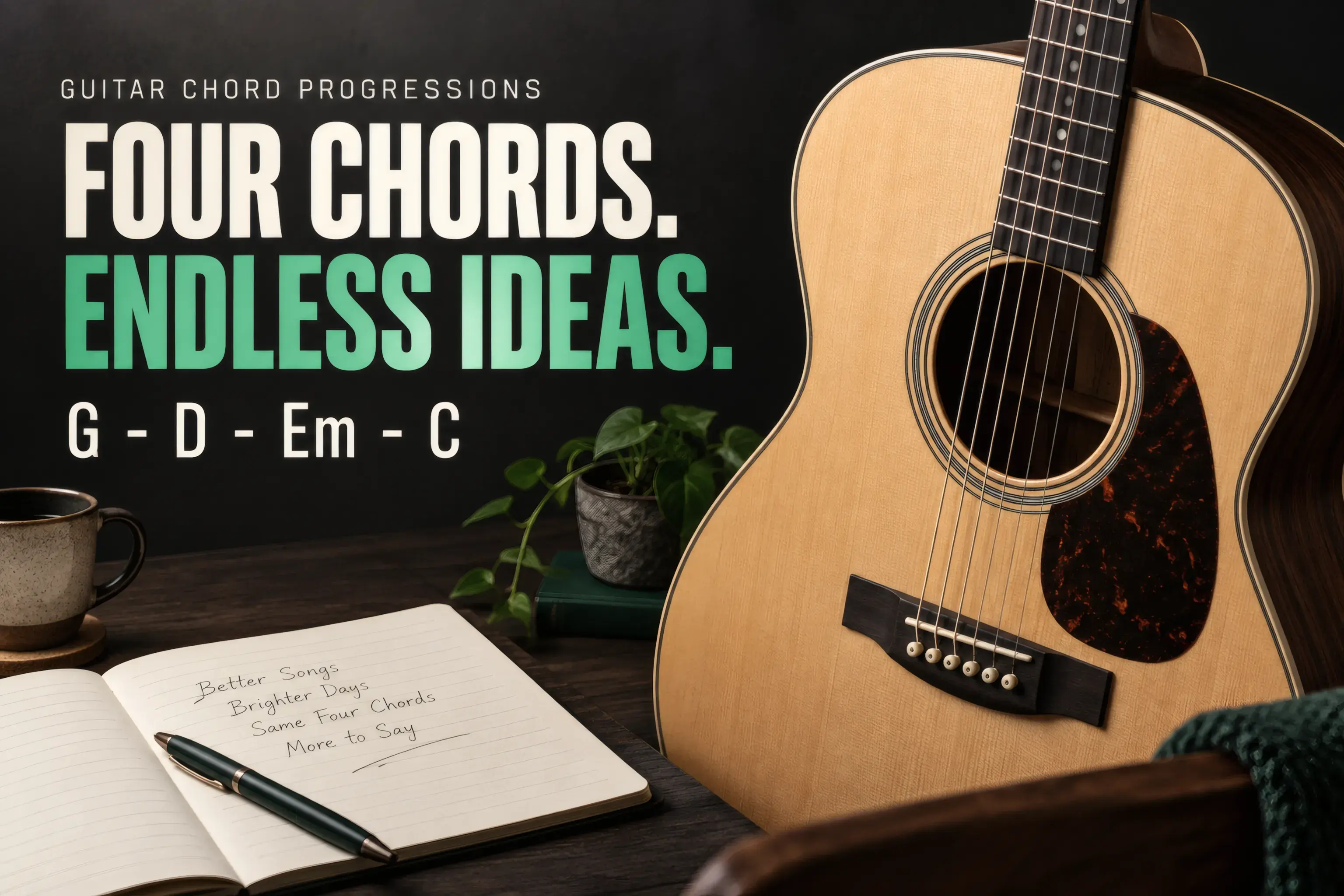
Take the most common progression in pop: I–V–vi–IV. In G, with G shapes, that's G – D – Em – C.
Now transpose it with the capo instead of new fingerings:
- Key of A, capo 2. Same G shapes. They now sound A – E – F#m – D. Play it until the new names feel natural.
- Key of Bb, capo 3. Same shapes again, sounding Bb – F – Gm – Eb. Notice the guitar getting brighter and tighter as you climb.
- Key of C, capo 5. Same shapes, sounding C – G – Am – F. Then take the capo off and play open C shapes: C – G – Am – F. Same key, two different positions, two different textures.
Run each key for eight bars at 70 BPM with the metronome, changing chords on beat 1. By the third key you'll feel why session players treat the capo as a transposition dial, not an accessory.
FAQ
Does a capo change the key or just the chords?
Both, really. The capo raises the sounding pitch of everything you play, so the song is genuinely in a new key; G shapes at capo 3 really do sound in Bb. What doesn't change is your fingerings. You're playing G-family shapes while the audience hears Bb. When guitarists say "we're in G, capo 3," they mean shapes in G, sound in Bb.
Can I use a capo on electric guitar?
Yes. Same rules, same chart. A couple of practical notes: electric string tension is lighter, so clamp gently to avoid pulling strings sharp, and a capo above the 5th fret can sound thin and choked through a clean amp. Acoustic-style spring capos work fine on most electrics with standard-radius fretboards.
Why does my guitar sound out of tune with a capo?
Check capo placement and pressure first: excess pressure can pull strings sharp, and uneven contact can cause buzzing. To check the guitar's intonation separately, remove the capo and tune the open strings. Compare each 12th-fret harmonic with the fretted note at that same fret using normal finger pressure; those two pitches should match. A persistent difference calls for a setup check. Reattach the capo and re-check tuning with the guitar tuner before playing.
Grab the capo and go
Find your key in the chart, clamp just behind the fret, and re-check tuning. The chord library has every open shape the chart references, and the online tuner keeps the whole thing honest. One clamp, any key.