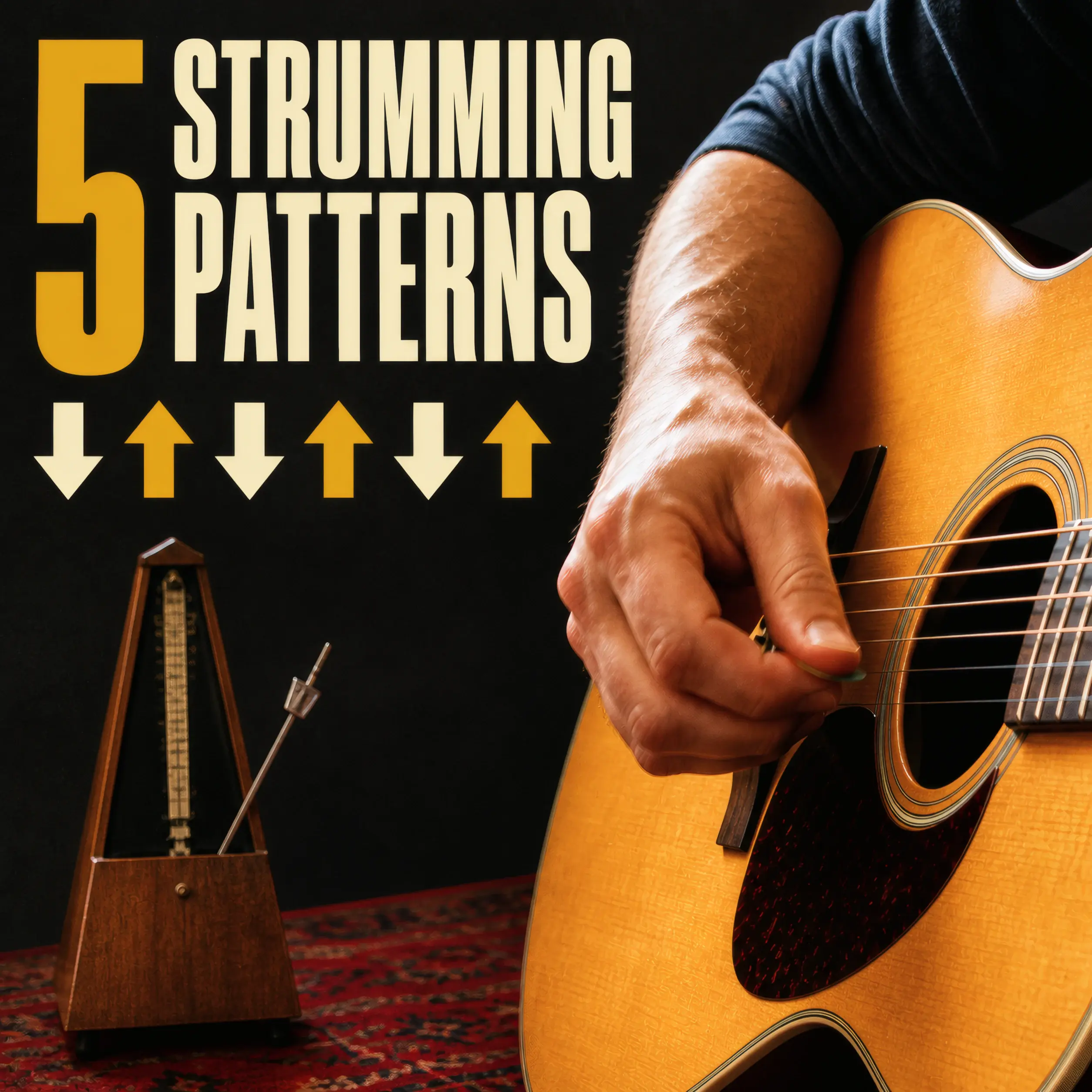
Watch a good rhythm player's elbow sometime. It barely moves. The forearm swings down-up, down-up like a pendulum that never stops, and the "pattern" is just which of those swings actually touch the strings.
That one idea unlocks all of this. Beginners think a pattern is a sequence of separate moves to memorize. It's a filter over a motion that never quits. Miss on purpose, keep swinging.
Two tabs to open before you start:
- Online metronome — everything below assumes a click
- Chord library, for when a progression needs a shape you don't know
Guitar strumming patterns for beginners (the five worth learning)
Every pattern below is written on the eighth-note grid, counted 1 & 2 & 3 & 4 &. D is a downstroke, U is an upstroke, a dot means the hand swings through without touching.

1. Four on the floor
D . D . D . D .
Downstroke on each number, nothing on the &s. Boring on purpose — this is where you learn to make eight strums in a row identical in volume. Try it under "You Are My Sunshine." If you can't keep this even at 70 BPM, no fancier pattern will save you.
2. Straight eighths
D U D U D U D U
Every swing touches. Down on the numbers, up on the &s. On the upstroke, catch only the top three or four strings, and on the downstroke favor the lower ones. That string targeting is what separates a strum from a rake, and almost nobody teaches it early enough. "Brown Eyed Girl" runs happily on this all day.
3. The campfire pattern
D . D U . U D U
When someone says "teach me the strumming pattern," this is the one they mean. Down, down-up, up-down-up. The slot after beat 2 is silent while your hand rises. So is beat 3 — that missed downstroke on 3 is the hard part and the entire character of the pattern.
Sits beautifully under "Leaving on a Jet Plane" and "Take Me Home, Country Roads."
4. The long pause
D U . . D U D U
Two hits, a hole in the middle of the bar, then a run of four. The hole is where students rush. I had one who came in early at bar three of every single progression, same spot for a month, until we muted the strings and he could finally hear his hand sprinting through the silence. The hand swings through beats 2-and-a-half like a metronome of its own. Try it with "With or Without You."
5. The backbeat push
D . D U D U D . (accents on beats 2 and 4)
Same notes as patterns you know, different weights. Hit beats 2 and 4 a little harder, like a snare drum. Backbeat accenting is most of what makes a strummed part feel like a groove instead of a typing exercise. "Stand By Me" is the eternal practice track for it.
Guitar practice with a metronome (the method that actually sticks)
Here's the sequence I use in lessons, and it works because the guitar is removed from the equation until the rhythm exists on its own.
- Set the metronome to 70 BPM, 4/4, accent on beat 1.
- Say the pattern out loud against the click. "Down, down up, up down up." Silly, effective.
- Lay your fretting hand flat across the strings and strum the pattern muted. Pure rhythm, zero chord anxiety.
- Eight clean bars muted, then add one chord. Eight more, then a two-chord change.
- Only raise the tempo 5 BPM after two consecutive clean passes.
A producer habit worth stealing — keep the click quiet. People crank the metronome to fight it. Turn it down until it's barely there and your ear leans in, which is the attention you actually want. When a take is rushing in the studio, the fix is almost never "listen harder to the loud click," it's relaxing the strumming hand.
Chord changes have their own set of drills, timing the switch on the & before the downbeat, and that's a separate page — metronome practice for chord changes covers it.
An easy strumming pattern in 3/4
Waltz-time songs count 1 & 2 & 3 &, six slots instead of eight.
D . D U D U
One anchor downstroke, then two gentle pairs. "Amazing Grace" and "Down in the Valley" both float on this, and 3/4 is weirdly good practice for 4/4 too, because the shorter bar exposes drift faster.
Watching a strumming hand at speed teaches things notation can't — note how the wrist stays loose and the motion never stops between hits.
Strumming styles — dynamics, the chuck, and not sounding robotic
Patterns get you through the door. Styles are what people actually hear.
- Dynamics. Play a verse quieter and a chorus louder with the identical pattern. Cheapest arrangement trick in existance.
- The chuck. On beats 2 and 4, land the strum with the edge of your palm touching the strings at the same instant. You get a percussive "tsk" instead of a chord. Ukulele players live on this, and it transfers straight to acoustic guitar.
- Pick choice matters more than beginners think. A thin, floppy pick (under 0.6 mm) glides through strings and forgives a stiff wrist. My pocket lives with a .53 in it for exactly this.
- Swap one downstroke for a bass-note-only hit. Instant folk texture.
And a grip note. If your forearm burns after two minutes, you're strumming from the elbow with a squeezed pick. Loosen the pick until it almost slips, shrink the motion, let the wrist do most of it.
When it falls apart
Speeding up. Drop 10 BPM, go back to muted strums, and record thirty seconds on your phone. Nobody believes they rush until the playback.
Losing your place mid-bar. Count out loud, accent beat 1 on the metronome, and stay on pattern 1 for a few days. There's no shame in the foundation.
Uneven volume between down and up strums. Aim the upstroke at fewer strings. Three is plenty.
One more, and it's sneaky. If the guitar sounds bad no matter how clean the rhythm gets, tune it. Strumming exposes tuning drift more than single notes do because every hit sounds five or six strings together. Thirty seconds with the guitar tuner before practice, every time.
FAQ: guitar strumming patterns
What strumming pattern should I learn first?
All downstrokes on the beat, then straight eighths, then the campfire pattern (D, D U, U D U). That order builds the constant hand motion first, and the campfire pattern alone covers a huge share of folk, country, and pop songs.
What BPM should I practice strumming at?
Start at 70 BPM. If you can't stay with the click for eight bars, drop to 60. Raise it 5 BPM only after two clean passes in a row. The slow tempos feel worse and teach more.
How long until strumming feels natural?
With five focused minutes a day, most students stop thinking about the campfire pattern within two or three weeks. Daily short sessions beat one long weekend session by a mile, because rhythm is habit formation more than knowledge.
Should I strum with a pick or my thumb?
Both are legitimate. A thin pick gives a brighter, more even attack and is easier for beginners to control at speed. Thumb strumming sounds warmer and works beautifully on the 3/4 pattern. Learn with a thin pick, add thumb later.
Do these patterns work on ukulele?
Yes, identically, minus the string-targeting advice since a uke only has four strings. The chuck on beats 2 and 4 is practically the national anthem of ukulele strumming. Tune first with the ukulele tuner and go.
Put a click under it
Open the online metronome at 70, mute the strings, and run the campfire pattern until it survives eight bars. Then one chord, then two. The chord library has shapes when you're ready for progressions, and your tuner should hear the guitar before any of it.