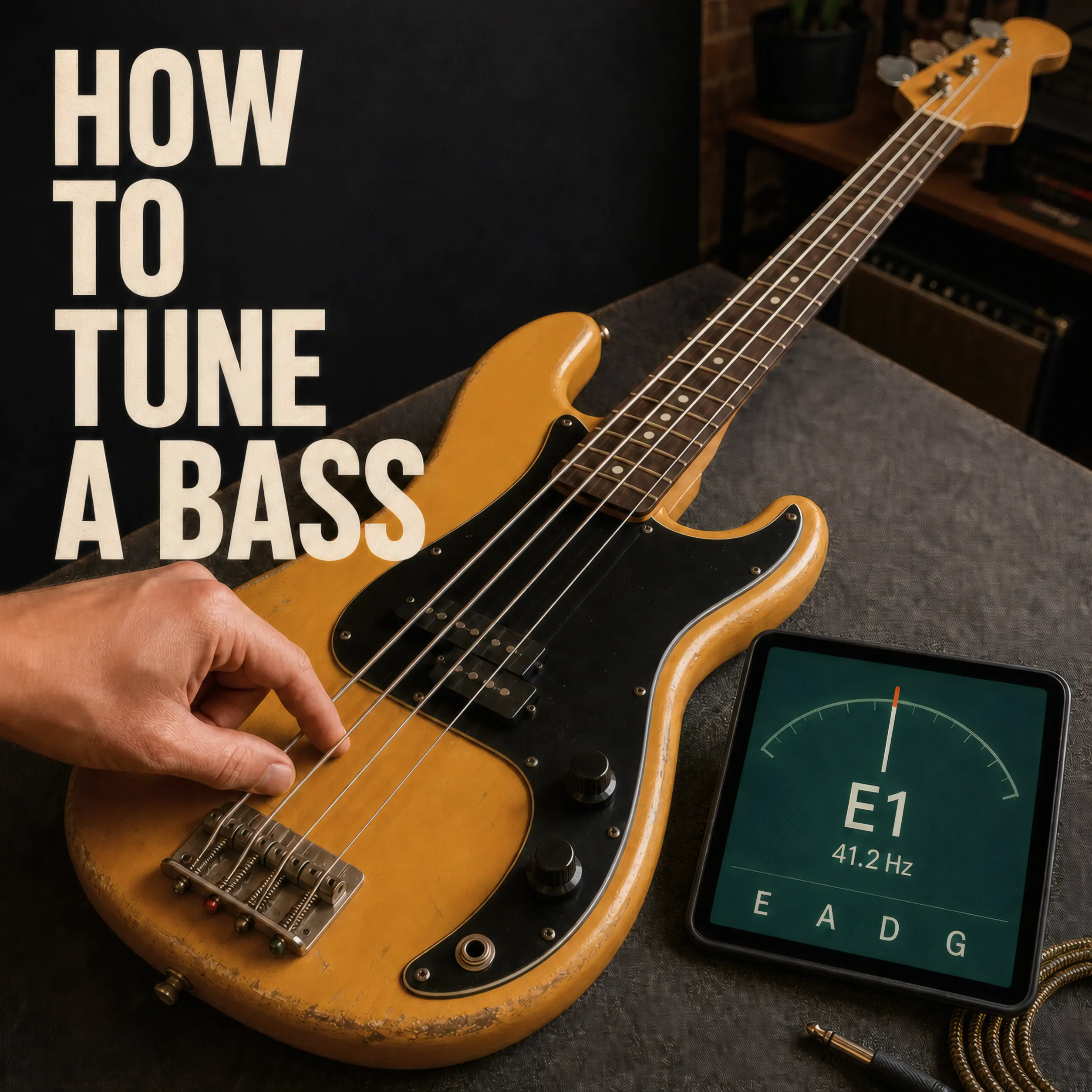
Low E on a bass vibrates at 41.2 Hz. That's low enough that cheap clip-on tuners guess at it, phone mics shrug at it, and half the "my bass won't tune" complaints I hear at rehearsals trace back to a tuner that literally couldn't hear the note.
So tuning a bass well is mostly about giving the tuner a signal it can read. The notes themselves are simple. Four strings, E A D G, and about two minutes of your time.
Fastest route:
- Open the online bass tuner, pick Standard (E A D G)
- Tap Start listening, allow the mic, and tune each string up to its note
Bass strings notes: what each string is tuned to
Thickest string closest to your chin, thinnest closest to the floor. Standard tuning on a 4-string runs low to high like this:
| String | Note | Frequency | Same note on guitar |
|---|---|---|---|
| 4th | E1 | 41.20 Hz | Low E, one octave down |
| 3rd | A1 | 55.00 Hz | A string, one octave down |
| 2nd | D2 | 73.42 Hz | D string, one octave down |
| 1st | G2 | 98.00 Hz | G string, one octave down |
Those are the same notes as a guitar's four lowest strings, dropped an octave. Every string is a fourth apart from its neighbor, which is why one fretboard pattern works everywhere on the neck.
Need a mnemonic? Every Apple Deserves Gratitude. Silly ones stick better, and honestly after a week you won't need it.

The octave numbers matter more on bass than anywhere else. Tune your E to E2 by mistake and you'll have a floppy guitar string's worth of tension pretending to be a bass. If a note sounds absurdly tight or loose on the way up, stop and check which octave the tuner thinks you're on.
How to tune a bass with an online tuner, step by step
You don't need hardware. A browser tuner with mic access reads a bass fine once you set it up to succeed.
- Open the bass tuner and choose Standard (E A D G). The preset shows each string's target so there's no guessing.
- Press Start listening and allow microphone access when the browser asks.
- Get the sound to the mic. Unplugged electric bass is quiet, so bring the phone close to the strings, or play through your amp at low volume near the laptop. Acoustic bass, aim the body at the mic.
- Pluck the open 4th string, medium strength, over the end of the fretboard. Let it ring. Don't keep re-plucking while the needle settles.
- Read the needle. Flat means tighten, sharp means loosen.
- Always finish tuning upward. If you overshoot sharp, drop below the note and come back up. Coming up to pitch takes slack out of the gears and the string settles where you leave it.
- Repeat for A1, D2, G2, then do one fast second pass. Tuning the other three strings changed the neck tension, and the first string you tuned has probably moved a hair.
Aim for the cents readout holding near 0 while the note rings, not just touching it for a moment.
One habit worth stealing. Pluck and then mute the other strings with your fretting hand while the tuner listens — open bass strings love to ring sympathetically, and two strings sounding at once is the main reason needles wander.
When the tuner says B but you played E
Classic bass problem. Low fundamentals are weak, so the mic sometimes latches onto an overtone instead. B is the loudest overtone of E, so the display swears you're playing B while your hands say otherwise.
The fix takes two seconds: play the 12th-fret harmonic instead of the open string. Touch the string lightly right over the 12th fret, pluck, lift your finger. Same pitch class, one octave up, much cleaner signal, and it rings long enough to tune calmly while you watch the display.
Fender's beginner walkthrough — useful for seeing the peg-turning direction and plucking technique on camera before you do it yourself.
How to tune a bass guitar by ear
Worth learning even with a tuner in your pocket. Ears catch drift mid-set that you'd never stop to check.
You need one trustworthy reference note. A keyboard, another tuned instrument, whatever's around. Tune your open A string to it. Then the bass tunes itself:
- Fret the 5th fret of the E string. That's an A. Tune it against your open A until they match.
- Fret the 5th fret of the A string (a D) and tune the open D string to it.
- Fret the 5th fret of the D string (a G) and tune the open G to it.
Matching two notes is easier than it sounds because out-of-tune unisons beat. You'll hear a slow wah-wah-wah pulse between the two pitches. As they get closer the pulse slows down, and when it stops completely you're there. Overshoot and it speeds back up.
Harmonics make the beats even easier to hear. The harmonic at the 5th fret of a lower string matches the harmonic at the 7th fret of the string above it, and harmonics keep ringing with both hands free to turn pegs. That's how I tune on loud stages, one palm resting on the body, feeling the beats as vibration when I can't hear them.. Genuinely works, feels like a magic trick the first time.
Then check the result against the bass tuner when it's quiet. By-ear gets you close; the tuner tightens the last few cents.
Bass tuning notes for 5-string and 6-string
Same logic, more range. Low to high:
| Bass | Notes | The new string(s) |
|---|---|---|
| 5-string | B0 E1 A1 D2 G2 | B0 at 30.87 Hz below everything |
| 5-string alt | E1 A1 D2 G2 C3 | high C, common in solo playing |
| 6-string | B0 E1 A1 D2 G2 C3 | both |
That B0 sits at the edge of what mics and small speakers reproduce, so use the 12th-fret-harmonic trick on it by default. Full setup notes for the low B, string tension included, are in the 5-string bass tuning guide.
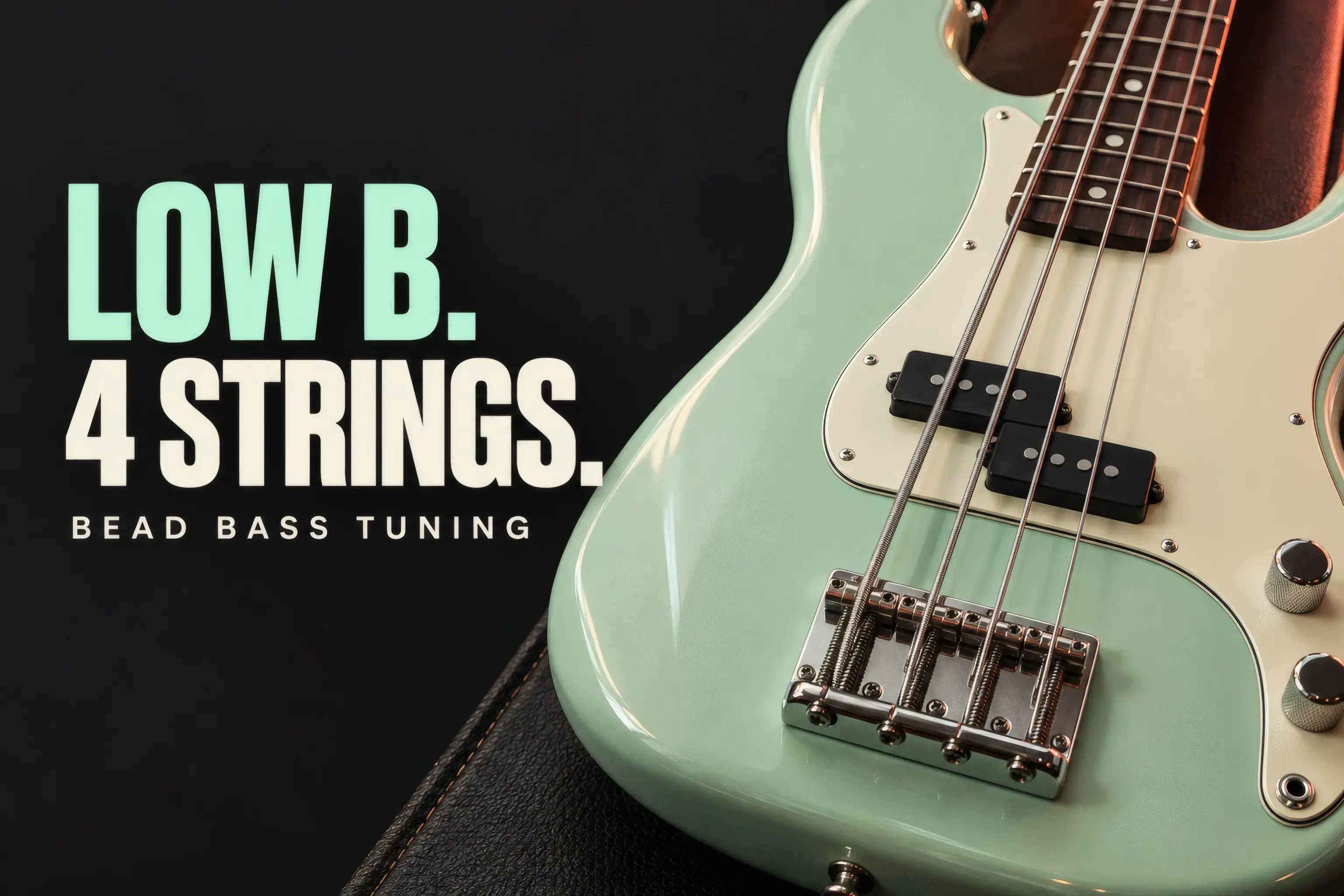
There's also a budget path to the 5-string's range — stringing a 4-string B E A D with the four thickest strings of a 5-string set. The BEAD tuning guide covers whether your nut can take it.
Drop D and lower bass tunings
Drop D is the gateway. Lower only the E string a whole step to D1 and the bottom two strings give you that heavier, wider sound half of rock lives on. The drop D bass tuner preset has the target notes ready.
Going lower than that, whole bands at a time do. Drop C, C standard, Eb standard and friends each deserve proper string-gauge thought rather than paragraph here, and each has its own preset with the exact notes in the bass tunings catalog.
Why a bass slips out of tune
Basses hold pitch better than guitars, heavier strings resist disturbance. When one does drift, the causes are boring and fixable.
- Fresh strings. They stretch for the first few sessions. Tune, gently pull each string away from the body, retune. Two or three rounds settles them.
- Old strings go the other way and just get stubborn. Roundwounds have usually died tonally long before this point anyway. (Flatwound players, carry on, yours outlive us all.)
- Messy winds around the tuning post slip under tension. Two to three neat wraps, winding downward.
- Temperature swings. Car trunk in winter, sunny stage in July. Let the bass acclimate ten minutes, then retune and it'll hold.
Retuning at every session is normal, here's how often the pros actually do it. Constant drift within one session is not normal, and usually means strings or winds.
FAQ: how to tune a bass
Can I use a guitar tuner to tune a bass?
A chromatic tuner, yes. It reads whatever pitch it hears, bass notes included, though weak low fundamentals may need the 12th-fret-harmonic trick for a clean reading. A tuner locked to guitar-only mode is the wrong tool, it'll try to drag every string toward E A D G B E. The online bass tuner has a dedicated bass mode tuned for low-frequency detection.
How do you tune a 4 string bass for beginners?
E A D G, thickest to thinnest, using the exact octaves E1 A1 D2 G2. Open the tuner preset, pluck one string at a time, and tighten up to the note until the needle centers and holds. First-timers overshoot by turning pegs too fast, quarter-turns at most once you're near the note.
Do I tune a bass the same as a guitar?
Same process and the same four note names as the guitar's low strings, one octave lower. No B string to worry about (the 5-string's low B excepted), so honestly bass is the easier instrument to tune.
Why does my bass sound in tune open but off higher up the neck?
Intonation. The saddle positions need adjusting so the 12th-fret note matches the open string. Tuning open strings more carefully won't cure it — the intonation guide explains the check, and the same logic applies to bass saddles.
What tuning should a beginner bassist use?
Standard E A D G, no contest. Nearly every lesson, tab, and beginner song assumes it. Explore drop D once standard feels automatic, it's a one-string change and everything you've learned still works.
Tune up and play something
Open the online bass tuner, run through E A D G with the steps above, then put two minutes on the metronome and let those fresh-tuned open strings groove. A bass in proper tune, through even a small amp, is one of the most satisfying sounds there is.