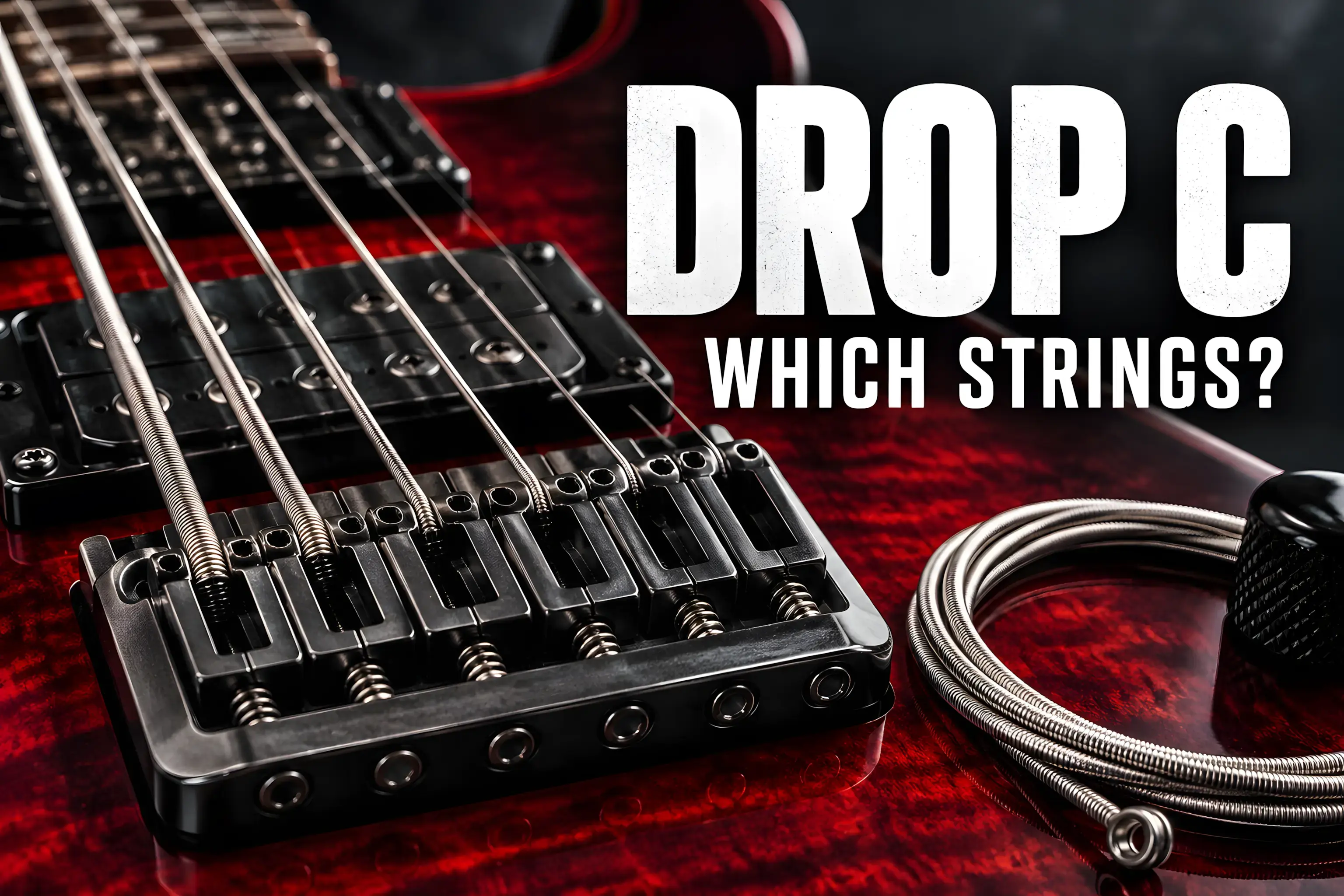
A stock .010-.046 set tuned down to C2 leaves the low string slack enough to slap the frets, and closing that gap is what the best strings for drop c are for. Below is a starting gauge for your scale length, backed by tension numbers I calculated, and then five sets checked against the makers' own pages.
Once the strings are on, check pitch with the Drop C guitar tuner. Drop C is C G C F A D, low to high (C standard is a different tuning, C F A# D# G C).
Best string gauge for Drop C, and where to start
- 25.5-inch scale (Strat and Tele styles, most superstrats). Start at .011-.054. If the low string still flaps under hard picking, go to .011-.056.
- 24.75-inch scale (Les Paul and SG styles). Start at .011-.056. Ernie Ball's own chart suggests .012-.056 for Gibson-scale guitars, which runs heavier (see below).
- 27-inch baritone. .010-.052. It looks too light on paper and isn't.
- If you bend a lot, look hard at the third string, and prefer a plain .018 or .019 over a .022 or .024.
Tension is what you feel, so I calculated it. A whole step down costs every string about a fifth of its tension, and the sixth string, dropped another step, loses more than a third. My yardstick is a .010-.046 set in E standard on 25.5 inches, about 17.5 lb on the low E and 104 lb for the set.
Every figure here is calculated from published unit weights, not measured. D'Addario's weight for each gauge goes into the formula behind the string tension calculator. Other makers' wound strings differ a little, so allow about five percent.
Drop C on a 25.5-inch scale.
| Feel | Gauges (set) | Low C (lb) | Whole set (lb) |
|---|---|---|---|
| Yardstick, E standard | .010-.046 (Regular Slinky) | 17.5 (E) | 104 |
| Floppy | .009-.042 (Super Slinky) | 9.3 | 65 |
| Floppy | .010-.046 (Regular Slinky) | 11.0 | 79 |
| Lighter | .011-.049 (NYXL 11-49) | 12.4 | 91 |
| Lighter | .010-.052 (Skinny Top Heavy Bottom) | 13.9 | 93 |
| Balanced | .011-.054 (Beefy Slinky) | 15.5 | 110 |
| Balanced, firmer low string | .011-.056 (NYXL 11-56) | 16.6 | 108 |
| Tight rhythm | .012-.056 (Not Even Slinky) | 16.6 | 125 |
| Very tight | .012-.060 (NYXL 12-60) | 19.2 | 124 |
Notice that the Beefy Slinky totals more than the 11-56 despite a lighter low string. Its plain .022 third carries about 22 lb at F3, and that one string moves the whole set.
Best guitar strings for Drop C, from the makers' own pages
Gauges and construction come from the manufacturers' pages, and the tensions are my arithmetic. I've left prices out because they move around, and I haven't strung every set listed.
Ernie Ball Beefy Slinky, .011-.054
Gauges are .011, .015, .022p, .030, .042 and .054 (p means plain, unwound), nickel-plated steel on a tin-plated hex core, per Ernie Ball's listing. Its gauge guide starts Drop C on 25.5-inch guitars here, with a .056 or even a .060 swapped in for the low string. The catch is the stiff .022 third, which makes bends work.
Ernie Ball Not Even Slinky, .012-.056
Gauges are .012, .016, .024p, .032, .044 and .056. Ernie Ball's guide sends Gibson-scale guitars here for Drop C and says a .060 low string adds more weight down low. Try it on a 24.75-inch neck that still feels slack. But the plain .024 third carries about 25 lb at that scale, and the set lands roughly 14 percent above my yardstick there.
D'Addario NYXL, .011-.056 or .012-.060
Uncoated, with a NY Steel core and nickel-plated steel wrap. D'Addario designed the 11-56 (.011, .014, .019, .032, .044, .056) to keep a comfortable tension a whole step down at D, so Drop C only lowers the low string. D'Addario's own tension chart for it, scaled to Drop C, comes out a touch lighter than my table, about 16 lb on low C and 106 lb for the set.
The 12-60 (.012, .016, .020, .034, .046, .060) is the set D'Addario lists for Drop C, optimized for C tuning. Its chart is for C standard, and moving five strings up a step puts the set near 122 lb by the same scaling.
Skip the NYXL 11-49 here. D'Addario's chart gives its low E 18.9 lb, roughly 12 lb once that string is at C.
Stringjoy 11-58 Drop C Gauge Signatures
Gauges are .011, .014, .018p, .032, .044 and .058, nickel wound. Stringjoy says it's the set it most often recommends for Drop C, aiming for balanced tension when you tune down. The light .018 third is about 15 lb on 25.5 inches against 22 for the Beefy's .022, and a .058 low C should land between 16.6 lb (.056) and 18.5 lb (.059) by D'Addario's neighbouring gauges. The catch is the top strings, the lightest of any pick here at roughly 14 to 16 lb, which a hard picker may feel give.
Beefy Slinky in coated and cobalt versions
Same gauges as the Beefy, different surface. Ernie Ball's Titanium RPS coated set treats the wound strings to repel moisture and oils, and the maker says the feel and sound match uncoated sets. Its Cobalt set aims at output and clarity, with what Ernie Ball calls crisp, clear highs. I found no unit weights for either, so expect numbers a few percent off my nickel table.
Drop C strings by scale length
Tension rises with the square of scale length, so the same notes want a heavier set on a short neck. Brackets show low C and whole-set pounds.
| Scale length | Start with | If still slack | If too stiff |
|---|---|---|---|
| 24.75 in (Les Paul style) | .011-.056 (15.6 / 102) | .011-.058 (16.8 / 101) | .011-.054 (14.6 / 104) |
| 25.5 in (Strat style) | .011-.054 (15.5 / 110) | .011-.056 (16.6 / 108) | .011-.052 (13.9 / 99) |
| 27 in (baritone) | .010-.052 (15.5 / 104) | .011-.054 (17.4 / 123) | .010-.046 (12.3 / 89) |
The baritone row uses 27 inches, the short end of baritone scales. Baritone sets are often built for B standard (D'Addario's 13-62 is charted from a low B), so a regular hybrid set fits Drop C pitches better.
What the best strings for Drop C tuning ask of your setup
A heavier low string and a lower pitch shift the balance your guitar was set up for. Strandberg's support notes cover the basics.
- Truss rod. More pull can add relief, which shows as higher action mid-neck. Turn the rod an eighth of a turn at time, then leave it until the strings settle. Slow is kinder to the neck, and if it won't turn without force, stop.
- Nut slots. Strandberg warns that heavier strings may not sit properly in the existing slots. The giveaway is a ping while you tune and a string that goes flat after a bend. Pencil graphite helps a slot that pinches a little. One that's too narrow needs a file, and a tech..
- Raise the bass side of the action a hair, since the low string swings wider in Drop C.
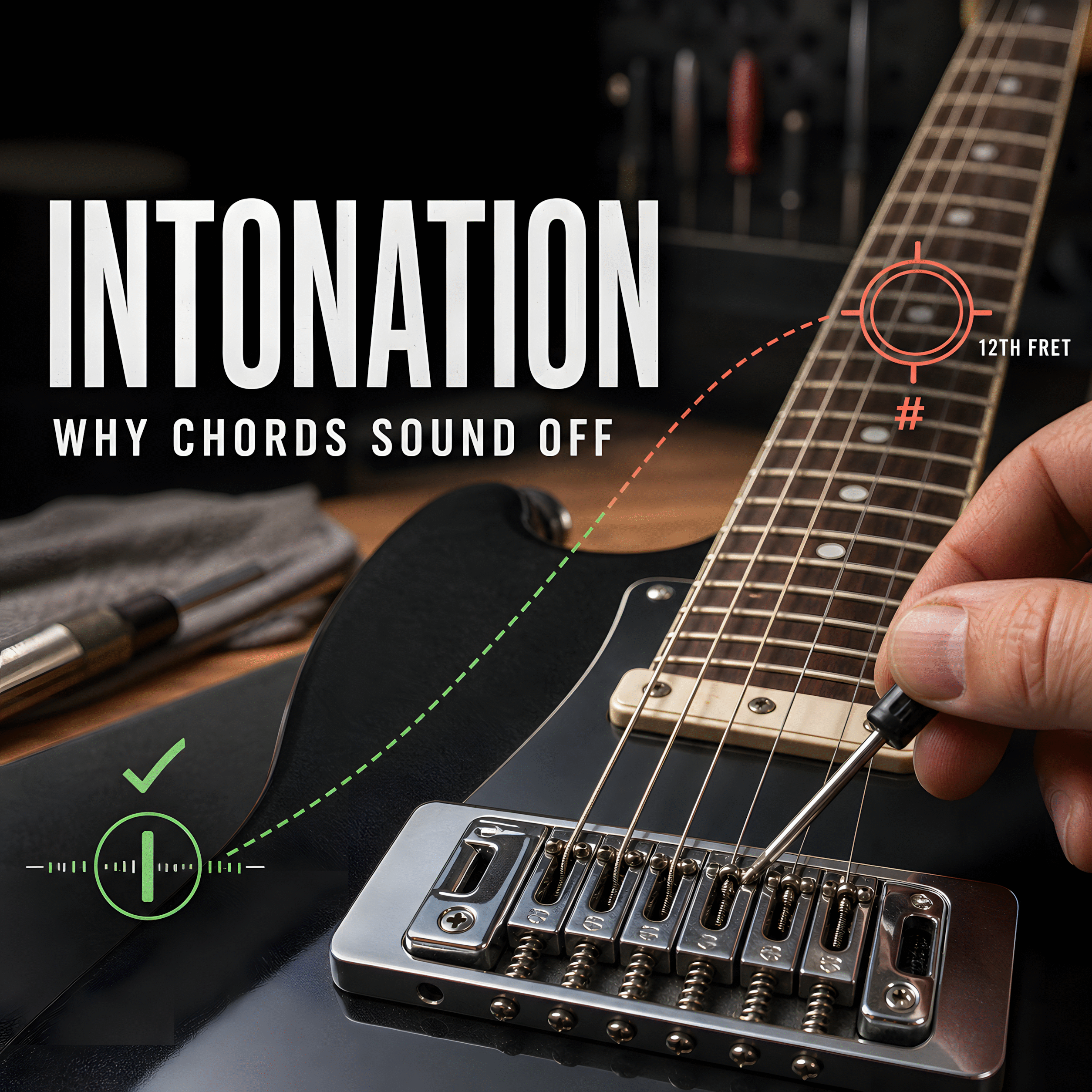
- Intonation. A thicker wound low string usually wants its saddle a little farther back. Check the 12th fret against the open string once the strings stop stretching, using the intonation guide.
- Pickup height comes last. If the low C sounds woolly, lower the bass side a touch. I could be wrong here, but in my experience that fixes more than it should.
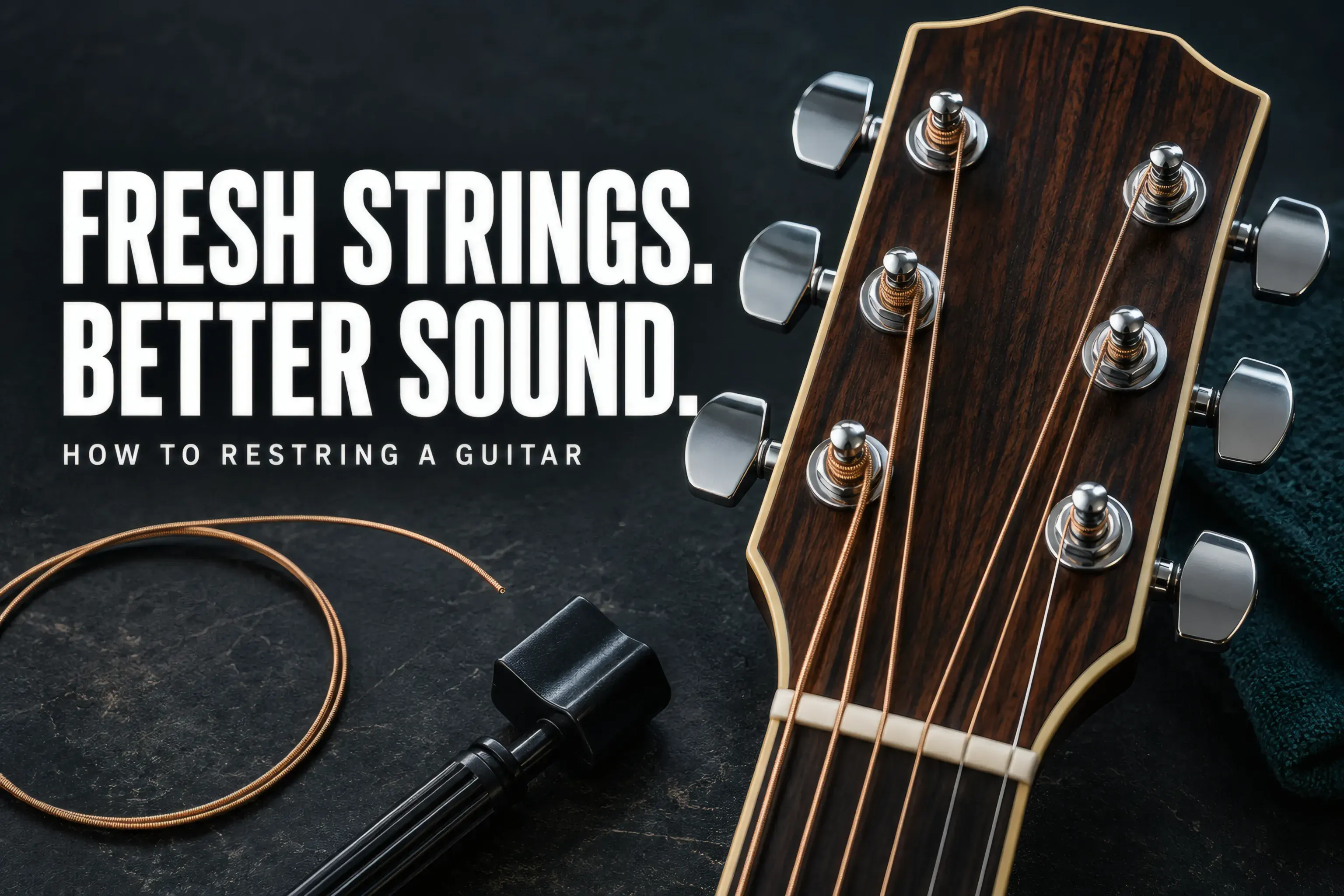
Stretch the new set gently and retune a few times (how to restring a guitar covers it). If pitch still wanders, nut friction is the usual suspect. See a tech if the nut slots need cutting or the truss rod resists, and again with a floating tremolo, whose springs must be rebalanced.
Mistakes that make Drop C strings feel wrong
- Staying on .009s. Low C lands near 9 lb on 25.5 inches, about half the yardstick, and goes sharp every time you dig in. (I've watched a bass player wince at that before the guitarist noticed.)
- One gauge for every guitar. The same .011-.054 set is 104 lb on a 24.75-inch neck and 123 lb on a 27-inch one.
- Ignoring nut friction. No gauge fixes a string that sticks in its slot.
- Choosing by the low string alone. A plain .024 G is what makes the tip of your ring finger ache after an hour of bending. My bias, which I can't fully defend, is that I'd take a slightly slack low C over a stiff third string.
For the tuning itself see the Drop C tuning guide, and for the Drop D comparison see Drop C vs Drop D.
FAQ about best strings for drop c
Can I use .010s in Drop C?
It will play. On 25.5 inches a .010-.046 set puts low C near 11 lb, about two thirds of a standard low E, so expect flop and buzz under hard picking. A .010-.052 hybrid reaches about 14 lb, the lightest I'd call workable.
Are heavier strings harder to play?
Slightly. Ernie Ball notes that heavier gauges need more finger pressure to fret and bend. An .011-.054 set in Drop C totals only about six percent above a .010-.046 in E standard, so most of the extra work lands on the third string.
Do I need a setup after changing gauges?
Often a light one. Check relief and intonation, and look at the nut slots. A tech can take it from there.
What low C string gauge matches standard tuning feel?
To match a standard .046 low E (17.5 lb), my numbers say about .057 on 25.5 inches, .059 on 24.75 and .054 on 27. Most players settle a little under that.
Verdict
I'd start almost everyone at .011-.054, then move to .012-.056 or D'Addario's 12-60 once you know you want a tighter, more metal rhythm feel and bend very little.
Fit the set, give it a day to settle, then tune with the Drop C guitar tuner and play steady chugs on the open sixth string against the metronome. And if the pitch jumps sharp every time you dig in, move up one gauge on the low string.