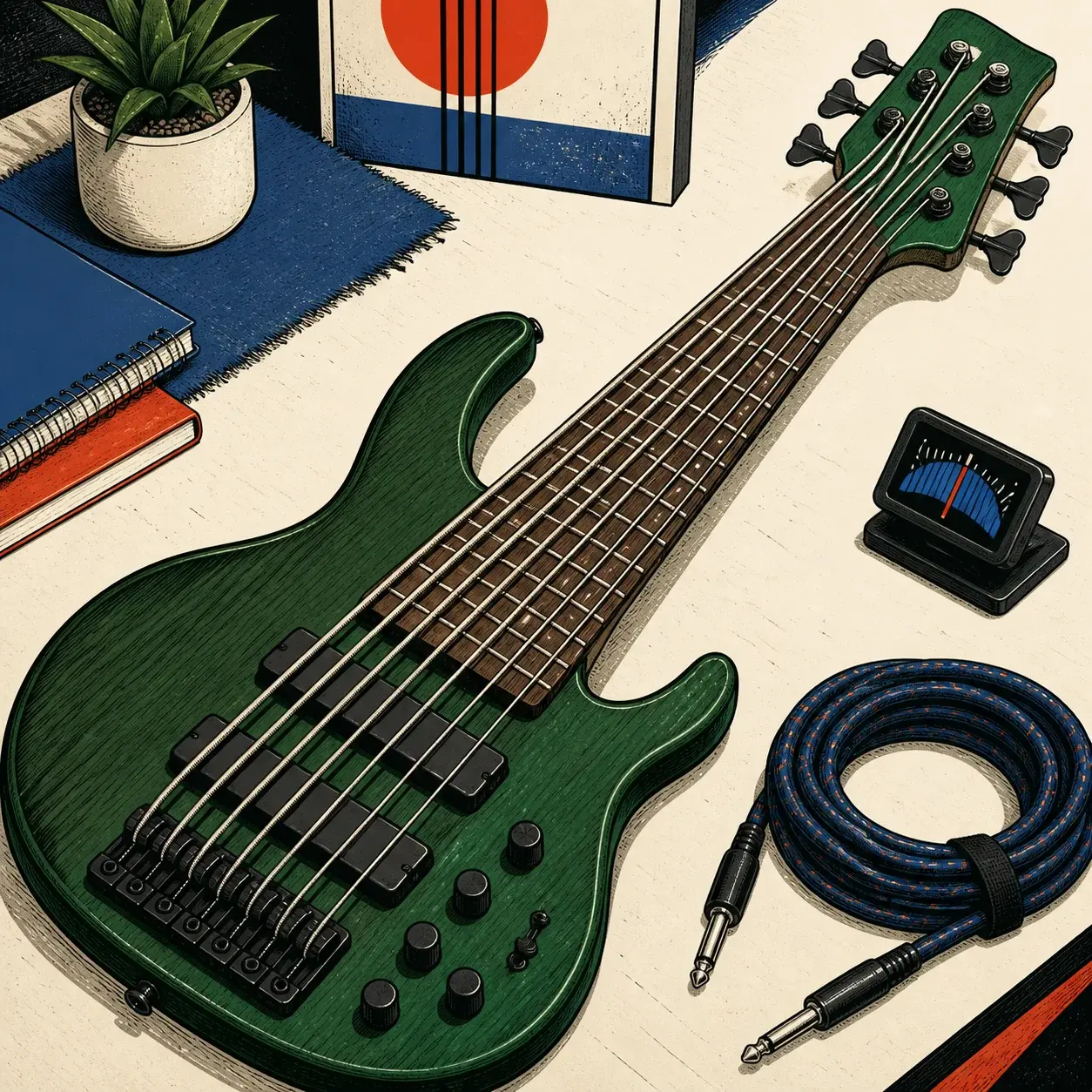
Standard U-Bass tuning is E A D G, from the thickest string to the thinnest. The exact targets are E1 A1 D2 G2, the same open pitches used by a full-size four-string electric bass.
The instrument may fit in a baritone-size case, but it does not use ordinary ukulele G C E A or baritone D G B E tuning. Its short scale and specialized strings are engineered to produce bass-register notes.
Tune now:
- Open the E1 A1 D2 G2 bass tuner
- For a five-string U-Bass, open the B0 E1 A1 D2 G2 tuner
U-Bass tuning notes and frequencies
These targets use A4 = 440 Hz.
| String | Note | Frequency | Same open pitch on electric bass |
|---|---|---|---|
| 4, thickest | E1 | 41.20 Hz | low E |
| 3 | A1 | 55.00 Hz | A |
| 2 | D2 | 73.42 Hz | D |
| 1, thinnest | G2 | 98.00 Hz | G |
Kala's U-Bass support page confirms E A D G for four-string models and B E A D G for its five-string models.
Octave numbers prevent the most common misunderstanding. E1 is not the E4 found on a standard ukulele, and G2 is two octaves below a high-G ukulele's G4. Use the bass standard preset, which already contains the correct octave targets; creating a second identical U-Bass preset would only duplicate the same tuner job.
How to tune a U-Bass
Tune in normal playing position with the volume control up and any onboard tuner turned on if the instrument has one. Soft, flexible strings respond differently from steel bass strings, so use a controlled pluck rather than repeatedly striking harder when the display hesitates.
1. Mute three strings and play E1
Pluck the thickest string with a moderate attack. Wait for the first wobble to settle, then adjust toward E1. A polyurethane string can briefly read sharp during the attack because it stretches sideways under the finger.
If a phone microphone does not hear 41.20 Hz clearly, connect the pickup to a small clean amp and place it near the microphone at modest volume. A clip-on tuner, onboard tuner, or pedal tuner can also avoid room noise.
2. Tune A1, D2, and G2
Work from the thickest string toward the floor: E1, A1, D2, G2. Rest a finger across the other strings so their sympathetic vibrations do not send the tuner to the wrong note.
3. Approach each note from below
If a string is sharp, loosen it below the target and then tune upward. That seats the string around the post and reduces slack in the tuning machine. Make small movements; a short scale can change pitch quickly at the peg even when the string feels soft under the hand.
4. Make another pass
New polyurethane and other synthetic strings may need repeated tuning while they stretch and settle. Tune all four, play for a few minutes, then check E A D G again. This can continue across several sessions after a new set is fitted.
Check U-Bass tuning at the fifth fret
Standard bass strings are a perfect fourth apart. The fifth fret of one string should match the next open string:
| Fretted note | Matching open string |
|---|---|
| E1 string, fret 5 = A1 | open A1 |
| A1 string, fret 5 = D2 | open D2 |
| D2 string, fret 5 = G2 | open G2 |
This is a useful string-order check, not a substitute for a tuner. Fretting stretches a soft string, and pressing harder than necessary can make the note sharp. On a fretless U-Bass, finger placement becomes part of the tuning result: center the pitch by ear or tuner instead of assuming a visual marker is exact.
You can also compare 12th-fret harmonics. They sound E2, A2, D3, and G3, one octave above the open strings, and may be easier for a microphone to detect. Return to the open-string preset for the final reading.
Why a U-Bass can confuse a tuner
A pitch detector chooses a fundamental from the vibration it receives. U-Bass strings can make that job harder in a few specific ways.
The attack bends sharp
Thick, flexible strings move a long distance when plucked. A hard attack increases their tension for an instant, so the pitch starts sharp and then falls. Tune the sustained portion with the same attack you use in a song. Do not tune the resting pitch flat to compensate for occasional overplaying.
An overtone looks stronger than the fundamental
The tuner may show E2 instead of E1 or B2 instead of E1. E2 is the first octave harmonic; B2 is another overtone in the E series. Pluck nearer the middle of the speaking length, reduce treble, mute every other string, and wait a moment.
The room masks the bass note
Laptop and phone microphones apply speech-oriented filtering, while fans, traffic, and HVAC noise live near the same low-frequency region. Move closer, use the instrument's pickup through a clean amp, or switch to a vibration-sensing/direct-input tuner.
The string is still stretching
Repeatedly falling flat after a string change is not always a faulty tuner. Kala describes its Road Toad strings as a proprietary polyurethane blend, and the manufacturer lists both EADG and BEADG sets. Flexible synthetic strings need time and multiple tuning passes to stabilize.
U-Bass, bass ukulele, and regular ukulele compared
| Instrument | Common standard tuning | Register | String behavior |
|---|---|---|---|
| 4-string U-Bass | E1 A1 D2 G2 | bass | specialized synthetic, flatwound, or roundwound set |
| 5-string U-Bass | B0 E1 A1 D2 G2 | extended bass | adds a low B string |
| standard ukulele | G4 C4 E4 A4 | treble | nylon or fluorocarbon, often re-entrant |
| baritone ukulele | D3 G3 B3 E4 | guitar-like middle register | nylon/fluorocarbon baritone set |
"Bass ukulele" is often used as a generic description, while U-BASS is Kala's product name. Other compact basses may use similar E A D G pitches but different scale lengths, bridges, pickups, and approved string sets. Confirm the manual for the actual instrument rather than assuming every short-scale bass accepts the same replacement string.
For an ordinary high-G instrument, use the standard ukulele tuner. For D3 G3 B3 E4, use the baritone ukulele tuner. Neither is an alternative tuning for a U-Bass.
Polyurethane, Nylgut, flatwound, and roundwound strings
U-Bass-compatible strings do not all share the same construction or setup requirements.
- Polyurethane strings feel thick, flexible, and rubber-like. They emphasize a round attack and strong low end.
- Dense synthetic/Nylgut strings aim for low bass frequencies with a different surface feel and response.
- Flatwound strings use a metal wrap and can feel closer to a conventional bass while retaining a smoother surface.
- Roundwound strings have a more pronounced texture and brighter upper harmonics.
Do not switch types based only on note names. Nut-slot width, bridge design, scale length, pickup type, and the string's intended model all matter. Kala's product notes warn that some rubber-string and roundwound conversions need a compatible nut or are not compatible with particular solid-body or pickup designs.
Use the maker's compatibility list. If a new string will not sit in the nut, do not force it. A technician can determine whether a reversible nut replacement or slot adjustment is appropriate.
Five-string U-Bass tuning
A standard five-string U-Bass adds B0 below E1:
B0 E1 A1 D2 G2
| String | Note | Frequency |
|---|---|---|
| 5 | B0 | 30.87 Hz |
| 4 | E1 | 41.20 Hz |
| 3 | A1 | 55.00 Hz |
| 2 | D2 | 73.42 Hz |
| 1 | G2 | 98.00 Hz |
Use the five-string bass preset. The extra B0 is particularly difficult for a phone microphone because its fundamental sits near 31 Hz. The 12th-fret harmonic at B1, about 61.74 Hz, provides a useful cross-check when the open note will not register.
Do not add a low-B string to four-string hardware. A five-string model needs the appropriate neck width, nut, bridge spacing, tuner, and pickup coverage.
Common U-Bass tuning problems
The open string is centered but fretted notes are sharp
Use less finger pressure first. Soft strings stretch easily when pushed hard toward the fingerboard. If the problem increases up the neck, check action and intonation with the intended strings installed.
One string jumps at the peg
The string may be binding in the nut or wound poorly around the post. Loosen it, inspect the path, and follow the instrument and string maker's installation method. Do not lubricate a polyurethane string with a product unless its manufacturer says it is compatible.
The tuner is steady through the pickup but erratic through the microphone
Trust the cleaner signal path. The pickup isolates the instrument from room reflections and low-frequency background noise. Confirm with a second pass rather than trying to make both devices animate identically.
The instrument sounds thin unplugged
A compact acoustic body cannot project 41 Hz like a large bass cabinet. Judge pitch with a tuner and judge amplified tone through suitable headphones, an amp, or a full-range system. Quiet acoustic output does not mean E1 is the wrong octave.
U-Bass tuning FAQ
Is U-Bass tuning the same as bass guitar tuning?
Yes. A standard four-string U-Bass uses E1 A1 D2 G2, the same open pitches as a standard four-string electric bass.
Is a U-Bass tuned like a ukulele?
No. Standard ukulele is G4 C4 E4 A4, while four-string U-Bass is E1 A1 D2 G2. The body shape is compact, but the instrument plays in the bass register.
Can I use a guitar or ukulele tuner?
Use chromatic mode or a preset that supports bass octaves. A mode locked to guitar E2 A2 D3 G3 B3 E4 or ukulele G4 C4 E4 A4 can reject the correct U-Bass targets. TuneMode's bass preset uses E1 A1 D2 G2.
How often should new U-Bass strings be tuned?
Check them before every session and again after a few minutes while they settle. Fresh synthetic strings can stretch across multiple sessions. Once stable, tune before playing and whenever temperature or playing feel changes.
Why does my U-Bass show the right note but sound out of tune?
Check the octave, fretting pressure, intonation, and whether another string is ringing. A display that says E without an octave may be following E2 rather than the open E1 fundamental.
Use the bass preset, not a duplicate tuner
Open the standard bass tuner and target E1 A1 D2 G2. The pitches are identical for a four-string U-Bass, so the same preset is the accurate choice. The difference is in how the compact instrument and its specialized strings produce those notes, which is why the tuning technique in this guide matters.