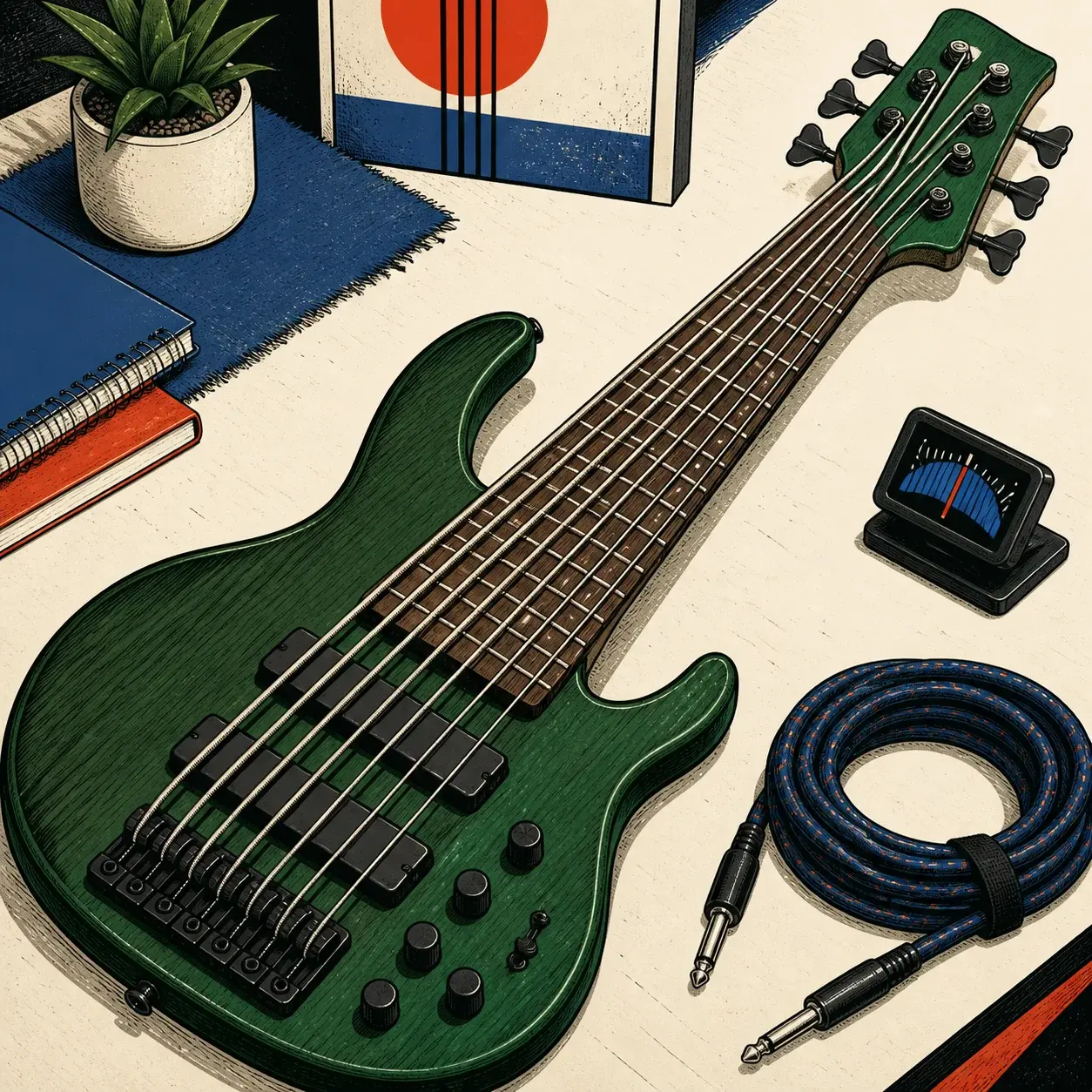
Standard 6-string bass tuning is B E A D G C, from the thickest string to the thinnest. With scientific pitch notation, those targets are B0 E1 A1 D2 G2 C3.
That layout takes a normal four-string bass, E A D G, and extends it in both directions. The low B adds five lower notes; the high C adds five higher notes. Every adjacent pair remains a perfect fourth, so interval shapes stay consistent across all six strings.
Tune now:
- Open the 6-string bass tuner
- Using five strings instead? Open the B E A D G tuner
6-string bass notes and frequencies
These frequencies use A4 = 440 Hz.
| String | Note | Frequency | Relationship |
|---|---|---|---|
| 6, thickest | B0 | 30.87 Hz | low extension below E1 |
| 5 | E1 | 41.20 Hz | standard four-string low E |
| 4 | A1 | 55.00 Hz | a fourth above E1 |
| 3 | D2 | 73.42 Hz | a fourth above A1 |
| 2 | G2 | 98.00 Hz | a fourth above D2 |
| 1, thinnest | C3 | 130.81 Hz | high extension above G2 |
The sequence is also confirmed in Fender's bass guitar owner manual, which lists B, E, A, D, G, C from low to high for a six-string bass.
Do not stop when the tuner displays the correct letter. A low B at B1 is an octave too high, while C2 is an octave below the intended high C3. The six-string preset shows the octave beside each note so you can catch that mistake.
How to tune a 6-string bass
Use a clean tone and tune with the bass in playing position. Gravity, neck support, and picking pressure can move a flexible low string enough to change the reading.
1. Start with the low B0
Mute five strings and pluck the low B with the same moderate attack you use while playing. Its first transient often contains stronger upper harmonics than the 30.87 Hz fundamental. Let the note settle for a moment before deciding whether it is sharp or flat.
If a phone or laptop microphone struggles with B0, put a clean bass amp near the microphone at low volume, use a clip-on tuner that senses vibration, or use a pedal tuner from the bass output. Another check is the 12th-fret harmonic: it sounds B1 at 61.74 Hz, exactly one octave above the open target.
2. Tune E1 A1 D2 G2
The middle four strings are ordinary four-string standard tuning. Work upward from E1 to G2, muting the string you just tuned so it does not ring into the next reading.
3. Finish with high C3
The thinnest string is C3, not B2 and not E3. On a standard fourths-tuned six-string bass, fret G2 at the fifth fret to produce C3. Compare that note with the open high C as a quick cross-check.
4. Make a second pass
Adding or correcting tension on six large strings changes the neck and bridge load slightly. Return to B0 and check all six again. Approach each target from below so the tuner gears and string windings settle in the direction used to hold pitch.
Tune a six-string bass by fifth-fret matching
When the open strings are close, the fifth fret of each lower string should match the next open string:
| Play this | Match this open string |
|---|---|
| B0 at fret 5 = E1 | open E1 |
| E1 at fret 5 = A1 | open A1 |
| A1 at fret 5 = D2 | open D2 |
| D2 at fret 5 = G2 | open G2 |
| G2 at fret 5 = C3 | open C3 |
This method exposes obvious string-order mistakes, but it does not replace a tuner for final setup. A fretted note can be sharp because of finger pressure, high action, or poor intonation even when both open strings are correct.
Use harmonics for a cleaner audible comparison when needed. The fifth-fret harmonic of a lower string is approximately the same pitch as the seventh-fret harmonic of the next higher string. For example, compare the fifth-fret harmonic on B0 with the seventh-fret harmonic on E1. Equal-tempered fourths and pure harmonics are not mathematically identical, so a chromatic tuner remains the reference.
Four-string vs five-string vs six-string bass tuning
| Instrument | Standard notes | Lowest note | Highest open note | What it adds |
|---|---|---|---|---|
| 4-string bass | E1 A1 D2 G2 | E1 | G2 | the standard core range |
| 5-string bass | B0 E1 A1 D2 G2 | B0 | G2 | one lower string |
| 6-string bass | B0 E1 A1 D2 G2 C3 | B0 | C3 | low B plus high C |
A six-string bass is not just a five-string with another low note. The usual added string is high C, not a still-lower F#. This keeps the range balanced and gives more room for chords, upper-register melodies, and positions that avoid long shifts.
All three standard bass layouts use fourths between neighboring strings. That means a scale fragment learned across E A D G transfers directly across B E A D G C. What changes is muting: two extra strings can ring sympathetically, so both hands need to silence strings that are not being played.
A 6-string bass is not always a Bass VI
The phrase "six-string bass" can describe two different instrument families.
- Extended-range bass: normally B0 E1 A1 D2 G2 C3, with bass-style fourths across every pair.
- Bass VI: normally E1 A1 D2 G2 B2 E3, using guitar string relationships one octave below standard guitar.
Fender's Bass VI history describes the latter as E A D G B E, one octave below guitar. Its chord shapes, scale length, string spacing, and playing role differ from a B E A D G C extended-range bass.
Before using any preset, look at the instrument's manual or the labels on its existing strings. If the two thinnest strings are B and E, use a Bass VI or guitar-style chromatic setup. If they are G and C above a low B, use TuneMode's B E A D G C preset.
String gauges and scale length
There is no universal gauge set for B0 E1 A1 D2 G2 C3. Scale length, core construction, taper position, action, and the player's attack all affect tension and clarity.
Typical commercial sets often place the low B somewhere around .125 to .135 inch and the high C around .028 to .035 inch. Treat those numbers as a shopping range, not a setup prescription. A 35-inch low-B scale may feel different from a 33-inch multi-scale section even with the same printed gauge.
Check three physical details before installing a new set:
- Winding length: the silk or taper should not sit on the speaking side of the nut or saddle.
- Bridge fit: the low B must pass through the bridge or anchor without forcing it.
- Nut slots: each string should sit at the correct depth without binding or floating above a slot that is too narrow.
Do not force a .130 low B into a slot cut for a smaller string. Binding causes tuning jumps and can split the nut. A technician can widen the slot while preserving its bottom shape and break angle.
Setup checks after changing six-string bass strings
Keep the intended tuning and string set installed before judging the setup. Then inspect adjustments in this order:
- Neck relief: six strings create substantial combined tension. Measure rather than turning the truss rod by feel.
- Action: set a playable height after relief is stable. Raising every saddle is not the right fix for a single poorly seated string.
- Nut and saddle contact: the string should leave each contact point cleanly, without a rounded section blurring the speaking length.
- Intonation: compare the open or 12th-fret harmonic with the fretted 12th-fret note after relief and action are set.
- Pickup height: a wide six-string neck can reveal uneven output across the outer B and C strings.
If the low B is in tune open but sharp at the 12th fret, lengthen its speaking length by moving the saddle away from the neck. If it is flat, shorten it. Stop when the saddle reaches the end of its travel; changing string construction or having a technician inspect the instrument is better than forcing the hardware.
Common six-string bass tuning problems
The tuner keeps reading F# or B1 on the low B
Those are strong overtones of B0. Reduce treble, use the neck pickup, pluck near the middle of the speaking length, and wait through the attack. A vibration-sensing or direct-input tuner is usually more reliable than a distant phone microphone at 30.87 Hz.
The low B sounds dull even at the correct pitch
Check whether the taper or silk crosses the nut or saddle, whether the string is twisted, and whether the witness points are clean. Also compare through headphones or a system that can reproduce 31 Hz; a small laptop speaker cannot tell you much about the fundamental.
The high C breaks or feels much tighter than the others
Confirm that it is a C3 string for the bass's scale length and that you are not aiming for C4. Inspect the tuning post and bridge for a sharp edge. Do not keep tightening against an obviously excessive feel just because the display has not reached the target.
Open strings tune correctly but fretted notes disagree
Check neck relief, action, finger pressure, and intonation in that order. Very high action makes a fretted note stretch sharp, and the flexible low B can move sharp under an aggressive left hand.
6-string bass tuning FAQ
What is standard tuning for a 6-string bass?
Standard extended-range six-string bass tuning is B0 E1 A1 D2 G2 C3 from thickest to thinnest. It adds low B below and high C above the four-string E A D G range.
Is a 6-string bass tuned like a guitar?
Usually not. An extended-range six-string bass uses B E A D G C in fourths. A Bass VI uses E A D G B E one octave below guitar. Identify the instrument family before choosing a preset.
What frequency is the low B on a 6-string bass?
B0 is approximately 30.87 Hz at A4 = 440 Hz. Its 12th-fret harmonic is B1 at about 61.74 Hz, which some tuners detect more easily.
What is the highest string on a 6-string bass?
In B E A D G C standard tuning, the thinnest string is C3 at about 130.81 Hz. It is a fourth above G2.
Can I turn a five-string bass into a six-string?
Not by adding a string to normal hardware. A six-string needs a neck, nut, bridge, pickups, and tuners designed for six courses. Use a purpose-built instrument rather than modifying a five-string without a qualified builder.
Lock in B0 through C3
Open the 6-string bass tuner, mute five strings at a time, and work from B0 to C3. Finish by matching every fifth-fret note to the next open string. That two-part check catches both a drifting peg and an incorrect string order before rehearsal does.