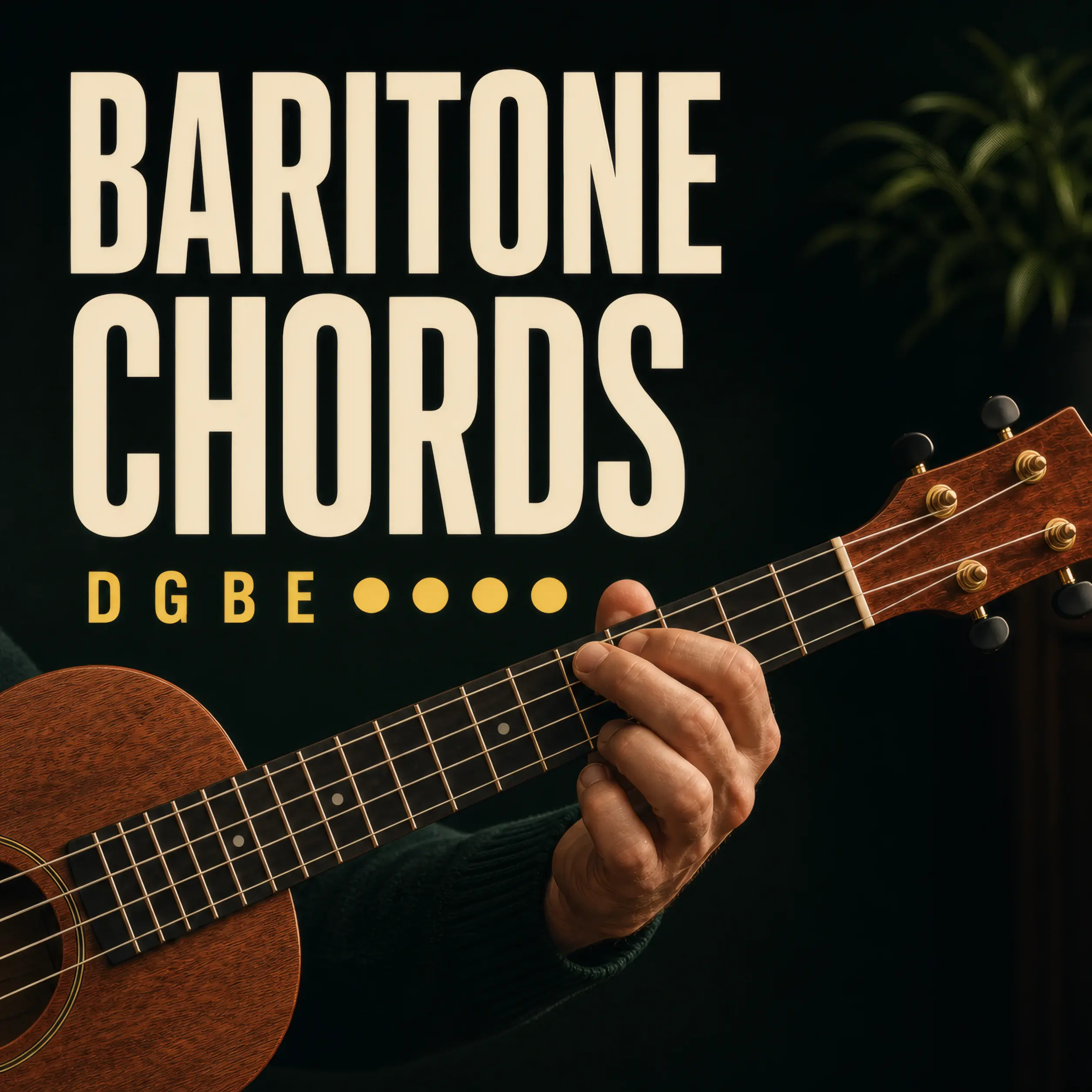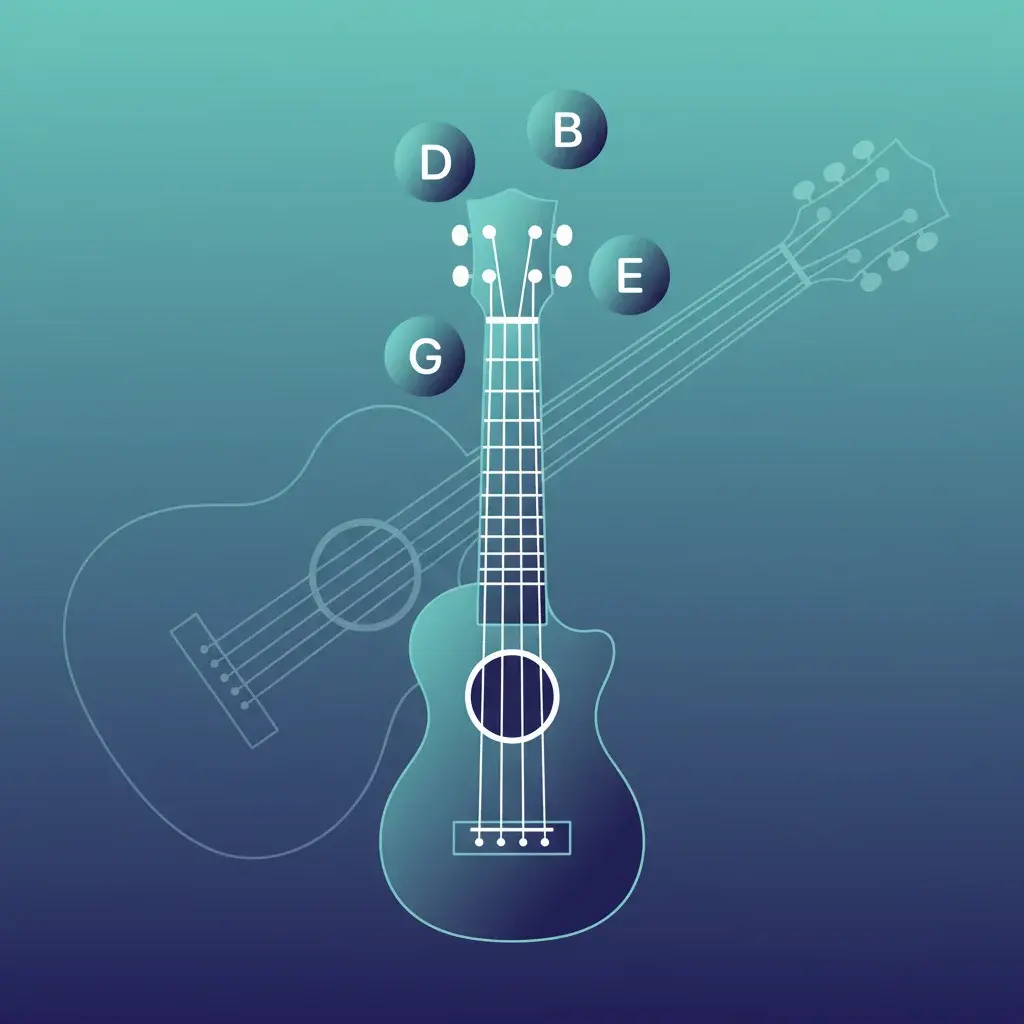
Easy baritone ukulele songs are mostly guitar songs wearing smaller clothes. Your strings are D G B E, matching the top four strings of a guitar. Familiar shapes such as G and Em work here too, just without the guitar's two bass strings.
The problem is that many ukulele charts online are for smaller instruments tuned G C E A. Copy the fingering onto a D G B E baritone and you'll get a different chord. You won't know until it sounds wrong.
Everything here is written for D G B E and sorted by how many chords a song needs. Two come first. When you can switch between them smoothly without looking at your hand, try the next tier.
Quick start
- Tune to D G B E with the baritone ukulele tuner
- Pick a strum from the beginner patterns below, then head to the song tables
Easy baritone ukulele chords to learn first
You only need the nine shapes below for these arrangements. Read the fret numbers from the thickest string to the thinnest. For G, 0 0 0 3 means leaving D, G, and B open and fretting the E string at fret 3.
| Chord | Frets (D G B E) | Notes you're sounding |
|---|---|---|
| G | 0 0 0 3 | D G B G |
| C | 2 0 1 0 | E G C E |
| D | 0 2 3 2 | D A D F# |
| Em | 2 0 0 0 | E G B E |
| Am | 2 2 1 0 | E A C E |
| A | 2 2 2 0 | E A C# E |
| E | 2 1 0 0 | E G# B E |
| F | 3 2 1 1 | F A C F |
| G7 | 0 0 0 1 | D G B F |
If you play guitar, nothing here is new. The first four are your guitar chords with the two bass strings dropped. If a chart doesn't mention its tuning, check before using it; it may be written for G C E A. The baritone ukulele chord guide has more shapes and explains why the same fingering produces different chords in the two tunings.
F is the awkward one, a mini-barre across the top two strings. Fifteen of the nineteen songs below never ask for it, and in my experience it gets a worse reputation than it deserves.
Two-chord baritone ukulele songs for beginners
Two chords, one change per bar, no hurry. Strum letters (A to D) are explained further down. The difficulty ratings are my judgment: level 1 is two slow chords, while level 4 means a longer loop and quicker changes.
| Song and artist | Chords | Strum | Level | Practice tip |
|---|---|---|---|---|
| Hush, Little Baby (traditional) | C, G7 | A | 1 | The slowest pick here. Count four beats aloud, then change on the next beat one. |
| Skip to My Lou (traditional) | C, G7 | B | 1 | For G7, fret the E string at 1 and leave the other three open. |
| A Horse with No Name, America | Em, D | A | 1 | Hold each chord for four beats. Plain D stands in for the record's fancier shape. |
| Jambalaya (On the Bayou), Hank Williams | C, G7 | B | 2 | Quicker changes than the first three. Begin at half speed and let C ring. |
America's song alternates Em and a fancier D (a D6/9, per Guitar Noise's lesson) one chord per bar. Plain D is a fair stand-in. I'd start a brand-new player here, and not on a nursery song, because you get a real record to play along with.
Three-chord baritone ukulele songs
I've used published sheet music or standard charts for the keys. Where a recording uses more complicated chords, these arrangements use simpler shapes.
| Song and artist | Chords | Strum | Level | Practice tip |
|---|---|---|---|---|
| Ring of Fire, Johnny Cash | G, C, D | C | 2 | Drill C to D by itself for a minute. That's the change that falls apart. |
| Love Me Do, The Beatles | G, C, D | A | 2 | G and C do most of the work. D waits for the middle section. |
| Blowin' in the Wind, Bob Dylan | G, C, D | C | 2 | The record is in D, so this is a transposed easy version. |
| Three Little Birds, Bob Marley | A, D, E | B | 2 | Light touch, loose wrist. The record is in A, same as this chart. |
| Riptide, Vance Joy | Am, G, C | C | 2 | Repeat one bar of Am, one of G, and two of C. |
| You Are My Sunshine, Jimmie Davis | C, F, G7 | A | 3 | Work on the F shape, 3 2 1 1, by itself before putting it into the song. |
| Lean on Me, Bill Withers | C, F, G | A | 3 | Use the same F drill. No capo is needed for the recording's key of C. |
| Twist and Shout, The Beatles | D, G, A | B | 3 | Begin at half speed to catch the quick changes. D matches the Beatles recording. |
Musicnotes lists Ring of Fire in G major. You can use the G, C, and D shapes above without a capo to match that key.
Four-chord baritone ukulele songs
With a capo, you keep the same chord shapes but raise their pitch to match the recording. Leave it off if that key is too high to sing comfortably; you'll be playing in a lower key instead.
| Song and artist | Chords | Strum | Level | Practice tip |
|---|---|---|---|---|
| Knockin' on Heaven's Door, Bob Dylan | G, D, Am, C | A | 2 | Think of two short loops. G D Am, then G D C. The record is in G. |
| No Woman, No Cry, Bob Marley | C, G, Am, F | A | 3 | Repeat the four-chord loop with a slow, steady strum. |
| Let It Be, The Beatles | C, G, Am, F | A | 3 | Use the same loop in this arrangement. C matches the original key without a capo. |
| Stand by Me, Ben E. King | G, Em, C, D (capo 2) | C | 3 | Capo 2 puts it in A, the key of the record. |
| Take Me Home, Country Roads, John Denver | G, Em, D, C (capo 2) | B | 3 | Capo 2 again for the record's key of A. Take the Em to D change slowly. |
| Wagon Wheel, Old Crow Medicine Show | G, D, Em, C (capo 2) | C | 3 | Capo 2 lands in A like the record. Same four shapes as I'm Yours, different order. |
| I'm Yours, Jason Mraz | G, D, Em, C (capo 4) | B | 4 | Capo 4 matches the record in B. Fast changes, so build speed over weeks. |
Musicnotes gives Let It Be in C major as its original published key. For the capo songs, I checked that each shape plus the capo lands on the recording's key (G Em C D with a capo at 2 sounds A F#m D E, for example).
Best first baritone ukulele song
A Horse with No Name. Hold each of its two chords for a full bar. Once you've learned the change, there's nothing else to look up mid-song.
Set the metronome to 60 BPM, deliberately slower than the record. Strum pattern A, four downstrokes per bar. Hold each shape for four slow beats, then move. Once you can keep going for two minutes without stopping, raise the tempo by 5 BPM.
(If a ring on your fretting hand clicks against the neck during C or Em, take it off for practice.)
Baritone ukulele strumming patterns for beginners
Count every pattern as 1 & 2 & 3 & 4 &: eight slots in a bar. At a dash, keep your hand moving but pass over the strings without touching them.
| Letter | Name | Pattern |
|---|---|---|
| A | Down on beats | D – D – D – D – |
| B | Down-up | D U D U D U D U |
| C | Folk strum | D – D U D – D U |
| D | Island strum | D – D U – U D U |
Spend the first week on pattern A. Pattern C is the one most of the songs above want, and the island strum can wait. The ukulele strumming patterns guide breaks each one down slot by slot (it was written for G C E A, but strums don't care what the strings are tuned to).
A four-week practice plan
- Week 1. Chords only. Spend five minutes a day on G, C, D, and Em before trying a song.
- Week 2. Changes. Loop G to C, then C to D, with the metronome at 60.
- Week 3. Choose a song from the two-chord table and play it from start to finish at half speed.
- Week 4. Add your voice while keeping the strum going. Don't worry if the first attempts sound rough.
FAQ about easy baritone ukulele songs
Can I use guitar chords on baritone ukulele?
Yes, for shapes played on guitar strings 4 through 1. Those strings are D G B E, just like your baritone, so G, C, D, and Em transfer directly. Guitar shapes that rely on the low E or A string need adapting, and you'll lose those bass notes.
Is baritone ukulele easier than standard ukulele?
For a guitarist, baritone often feels easier because the tuning and shapes are familiar. A complete beginner still has four strings and chord changes to learn, with a longer fretboard and a deeper tone than a standard uke. Neither is automatically the easier choice.
What key should beginners learn first?
Try G first. The open D, G, and B strings are already notes of a G chord. Add fret 3 on the E string and you're there. G, C, D, and Em also give you a useful set of changes without large stretches.
Why do some songs say capo?
A capo raises the pitch while you keep the easy shapes. Use it at the listed fret to match the recording's key. Without it, you can sing and play the arrangement in a lower key, but it won't match the recording.
Tune up, then play one song
To get started, use the baritone ukulele tuner to tune D G B E. Loop Em and D at 60 BPM on the metronome for ten minutes rather than searching for another song. When that change feels easy, move on to the next shapes in the chord guide.