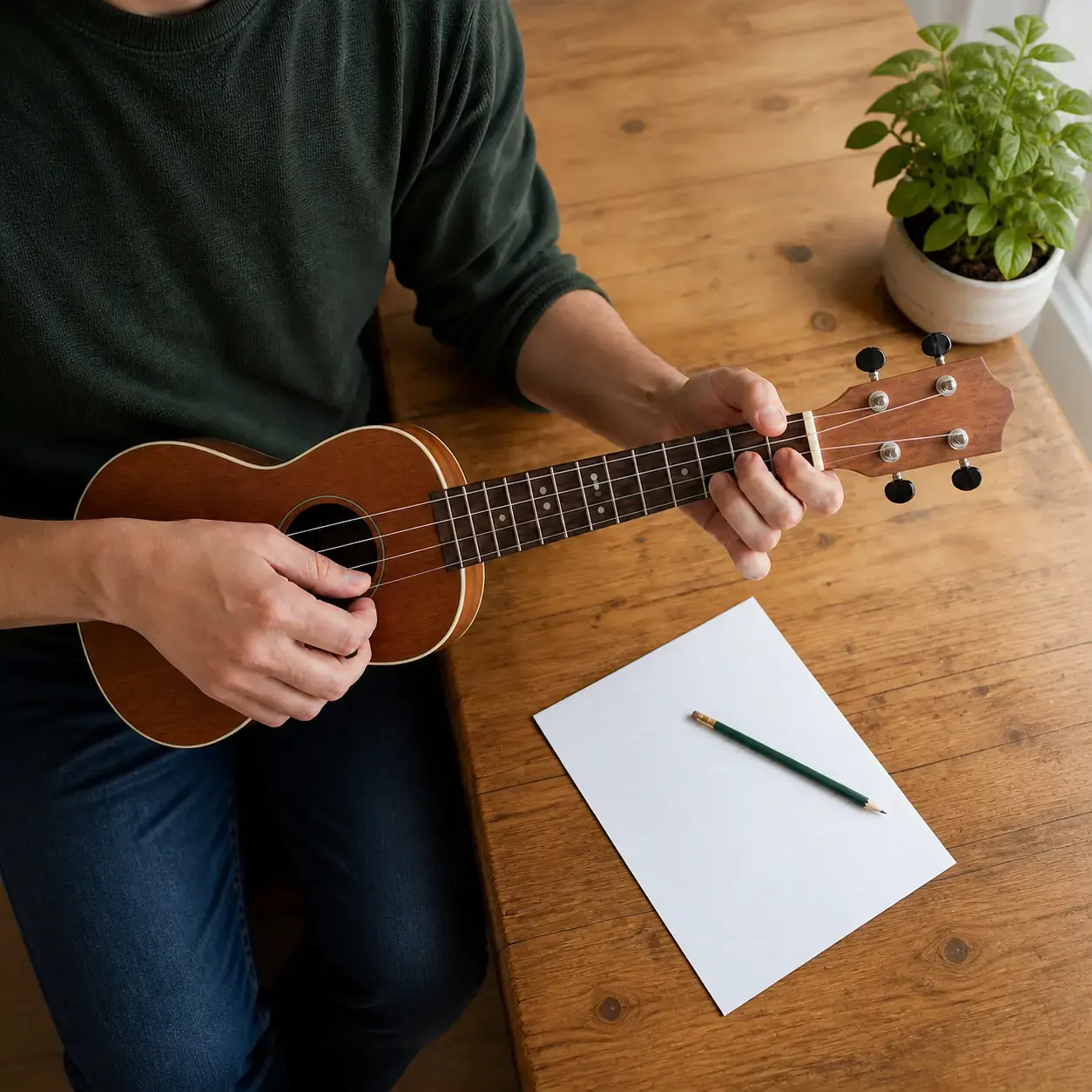
Strumming is the whole engine of the ukulele. Chords tell you which notes to play, but the strumming pattern decides how the song feels: relaxed and swaying, bouncy and bright, or driving and urgent. This guide gives you four ukulele strumming patterns that cover most of what beginners and intermediate players actually play, each written out on the count grid, plus the hand technique that makes them sound easy instead of choppy.
Everything below assumes your uke is in standard tuning (G C E A). Take thirty seconds to check it first; strumming hides tuning drift better than picking does, but a drifting C string will sour every pattern on this page.
Quick CTA:
- Tune up with the online ukulele tuner
- Open the metronome: every exercise here assumes a click
- Review the basic shapes in ukulele chords for beginners
Strumming notation basics
Every pattern in this guide sits on an eighth-note grid in 4/4 time. You count it as 1 & 2 & 3 & 4 &: eight slots per bar, said out loud as "one and two and three and four and."
Three symbols cover everything:
- D: a downstroke, strumming from the G string toward the A string (ceiling toward floor).
- U: an upstroke, A string toward G string (floor toward ceiling).
- –: a rest. Your hand still moves through the slot, it just doesn't touch the strings.
That last one matters more than beginners expect. Your strumming hand should swing down and up at a constant rate, one motion per slot, whether or not it hits the strings. The pattern isn't a list of separate moves; it's a filter over a hand that never stops. The rests are where the groove lives.
Two more marks you'll see in the wild: a bold stroke means an accent (hit it a little harder), and some teachers write a dot instead of a dash for rests. Same idea, different ink.
Essential beginner patterns
Learn these two before anything fancier. They're slow to master only if you skip the counting part.
Pattern 1: D – D U D – D U
Count: 1 & 2 & 3 & 4 & Play: D – D U D – D U
Play a downstroke on every numbered beat, adding upstrokes on the "and" of 2 and 4. Your hand still swings up after beats 1 and 3, but misses the strings. This steady pattern is a useful starting point for folk, pop, and campfire songs before you try skipping a numbered beat.
Pattern 2: D – – U – U – U
Count: 1 & 2 & 3 & 4 & Play: D – – U – U – U
One downstroke on beat 1, then three upstrokes floating on the "and" counts. This teaches the two skills beginners skip: playing upstrokes alone, and trusting rests. It feels empty for the first day and then suddenly sounds like a waltz-adjacent folk groove. Great under slow ballads.
How to practice them (slow, then tempo)
Don't chase speed. Here's the sequence:
- Set the metronome to 60 BPM in 4/4.
- Count "1 & 2 & 3 & 4 &" against the click first, then say "down, down-up, down, down-up" for Pattern 1 while keeping those slots in mind.
- Strum it on a C chord for eight bars without stopping. If it falls apart, drop to 50 BPM; slower is not failure, it's the point.
- Once eight bars survive at 60, nudge up 5 BPM at a time. Stop around 90 BPM; that's plenty for most songs.
- Only then try a second chord.
Muted practice helps too: rest your fretting hand lightly across all four strings so they thunk instead of ring, and strum the pattern. Pure rhythm, no chord anxiety. The same slow-then-tempo discipline shows up in our metronome practice for chord changes post, and it applies one-for-one here.
Intermediate patterns
These two are the sound people picture when they hear "ukulele." They're not harder to memorize; they're harder to keep relaxed.
The island strum: D – D U – U D U
Count: 1 & 2 & 3 & 4 & Play: D – D U – U D U
Written in beat chunks, that's D – DU – UDU: a down on 1, a down-up pair on beat 2, and an up-down-up across beats 3 and 4. This is the pattern. Luaus, beach videos, every uke tutorial ever: this is the sway. The missed downstroke on beat 3 is the engine: your hand keeps swinging down through that slot and just skips the strings, which is what makes the upstroke on the "and" of 3 feel like it's lifting.
Keep it light. The island strum played heavy sounds like marching. Played with a loose wrist and small motion, it swings.
A syncopated variation: D U – U – U D U
Count: 1 & 2 & 3 & 4 & Play: D U – U – U D U
A downstroke anchor on 1, upstrokes on the "and" of 1, 2, and 3, then a down-up pair on 4 and its "and" to close the bar. Compared to the island strum, you also skip the downstroke on beat 2. Keep swinging through both missed downstrokes; try it at 70 BPM before you push it faster.
A quick sanity check for both grids: count the slots. Each line has exactly eight positions matching 1 & 2 & 3 & 4 &, and every downstroke lands where your hand would naturally be moving down. If a written pattern ever asks for an upstroke on a numbered beat, something's off.
Techniques for better strumming
Patterns are the easy half. Sound lives in the hand.
Wrist, not arm
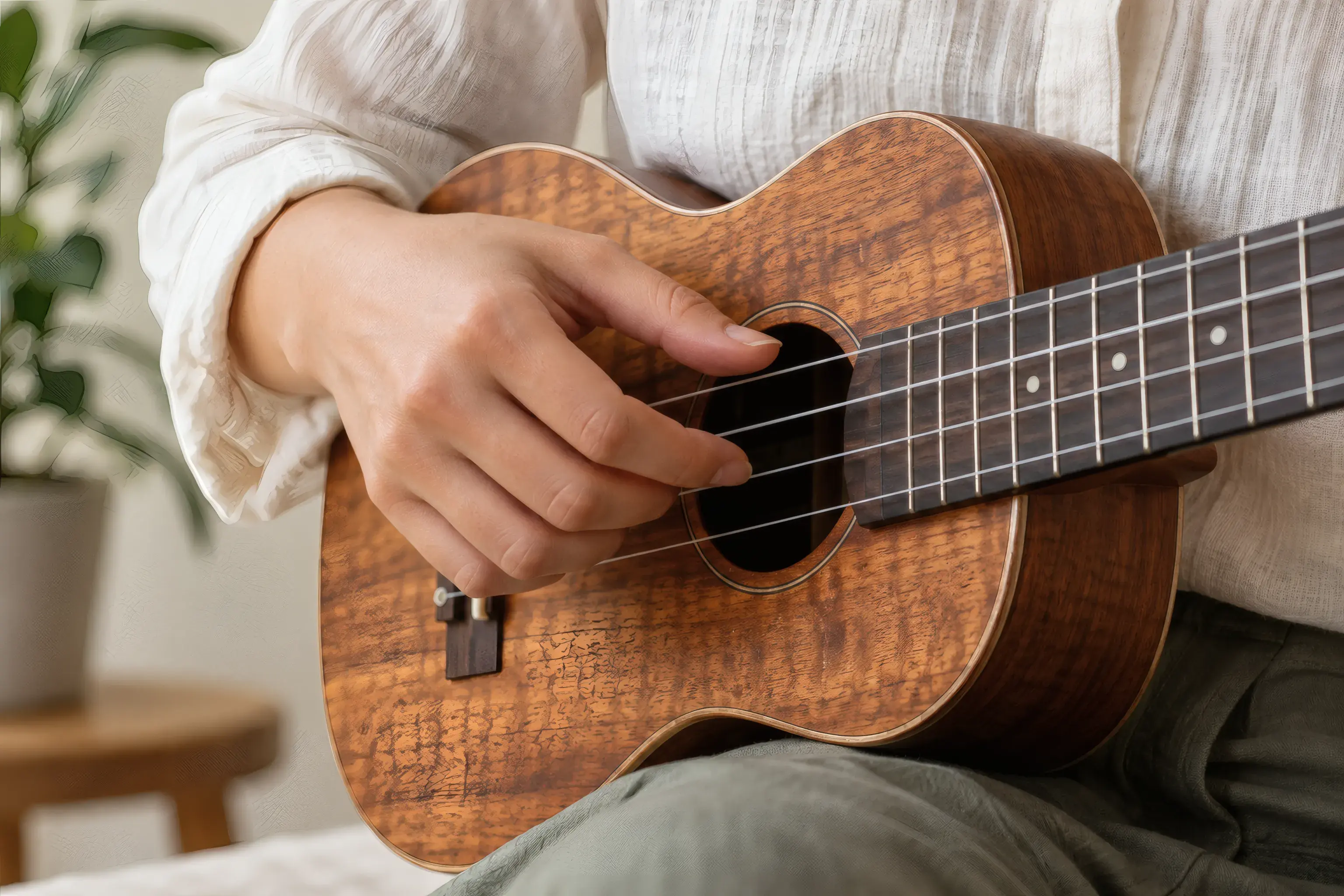
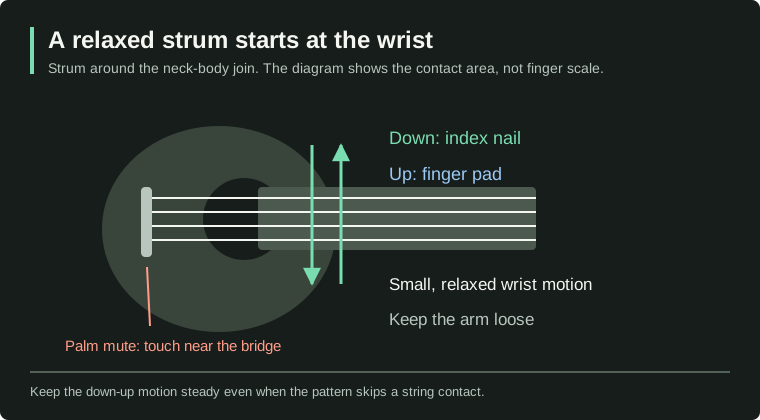
On guitar you can get away with strumming from the elbow. On ukulele it sounds clunky; the instrument is small, the strings are light, and big arm swings overshoot them. Keep your forearm nearly still and rotate from the wrist, like you're flicking water off your fingertips. The whole motion should fit in a few inches.
Index finger or thumb
Both are standard, and they sound different:
- Index finger: strum down with the nail side, up with the fleshy pad. Brighter and more rhythmic. This is the default for most players.
- Thumb: the pad brushes down across the strings. Warm, soft, rounded. Lovely for ballads and Pattern 2 above.
Learn index first, then add the thumb as a color. Some players pinch thumb and index together for a hybrid; fine, but get each one clean on its own first.
Relax the grip on everything
Two grips matter. The hand holding the uke's neck shouldn't be squeezing; a ukulele is light and stays put with a gentle cradle. And your strumming hand should be loose enough that the fingers wiggle. Tension anywhere shows up as choppy, rushed rhythm. If your forearm burns after two minutes, you're muscling it; shrink the motion.
Palm muting (the chuck)
On beats 2 and 4, land the strum while the edge of your palm touches the strings right at the bridge. Instead of a chord you get a percussive "chk." This is the single most ukulele sound there is, and it turns the island strum from nice into irresistible. Start by adding it to just beat 2, then both.
Dynamics
Play the verse quiet and the chorus louder with the identical pattern. That's it: the cheapest arrangement trick in music. Strum closer to the bridge for a tighter, punchier sound; drift up over the fretboard end for something rounder.
Practice exercises
Three short drills. Five to ten minutes total, daily, beats an hour on Sunday.
Exercise 1: one chord, one pattern
Metronome at 60 BPM. C chord. Run Pattern 1 for eight bars, Pattern 2 for eight bars, island for eight, syncopated variation for eight, no stops between them. When it's clean at 60, repeat at 70, 80, 90. That's the whole workout.
Exercise 2: C–G–Am–F progression
Now make it music. Use these standard ukulele voicings:
| Chord | G string | C string | E string | A string |
|---|---|---|---|---|
| C | open | open | open | 3rd fret |
| G | open | 2nd fret | 3rd fret | 2nd fret |
| Am | 2nd fret | open | open | open |
| F | 2nd fret | open | 1st fret | open |
One bar per chord, island strum throughout: C, G, Am, F, repeat. Keep the current chord fretted through the last upstroke (the "and" of 4), then move to the next shape for beat 1. Slow the metronome until you can make that change without losing the upstroke. For an easier practice variation, replace the final U with a rest and change during that slot; that is a different pattern, not the full island strum. If the shapes are still new, ukulele chords for beginners walks through each fingering.
Exercise 3: switch patterns every 4 bars
Stay on the same C–G–Am–F loop, but change the pattern every four bars: four bars of Pattern 1, four of island, four of the syncopated variation, four of Pattern 2 without stopping. This is the real intermediate skill. Songs don't stay on one feel, and this drill trains the switch without a tempo wobble. If you stumble, go back to 60 BPM and mute the strings until the pattern changes feel automatic.
Audio and backing tracks
Reading a grid is one thing; hearing the swing is another. While the demonstration clips for this page are in production, here's how to give yourself the same experience right now:
- Hear each pattern on one chord. Record thirty seconds of yourself playing each pattern over a C chord at 60 BPM, then again at 90 BPM, with your phone. Compare the two takes; the slow one should feel identical in shape, just wider. This is the single fastest way to hear your own rushing.
- Build your own backing loop. Play the C–G–Am–F progression (a I–V–vi–IV in C) into your phone's recorder, one bar per chord, four minutes straight at 75 BPM. Now you have a practice loop. Play the island strum over it, then the syncopated variation.
FAQ
Why does my strumming sound choppy?
Almost always one of three things: you're strumming from the elbow with a big motion, you're gripping the neck or tensing the strumming hand, or you're stopping your hand at the rests. Fix the third one first: keep the hand swinging down-up through every slot even when it doesn't touch the strings. Then shrink the motion to the wrist and loosen up. If it still sounds sour, check your tuning with the ukulele tuner; drift exposes itself fast once the rhythm gets clean.
How do I count while strumming?
Say 1 & 2 & 3 & 4 & out loud, quietly, against the metronome, while your hand plays the pattern. It feels silly for about two days. If speaking is too much, tap your foot on the numbers (1, 2, 3, 4) and let the "ands" fall between taps. Within a week the counting goes internal and the foot keeps time on its own.
Can I use these patterns on any song?
Any song in 4/4, yes, which is most popular music. Start with the pattern that matches the song's energy: Pattern 1 for steady folk and pop, island strum for anything sunny or swaying, the syncopated variation for more offbeat emphasis. Songs in 3/4 (waltzes) need a different grid, and a few songs have signature patterns worth learning note-for-note, but these four will carry you through a remarkably large songbook.
Put a click under it
Open the metronome at 60 BPM, tune up with the ukulele tuner, and run Pattern 1 on a C chord until it survives eight bars. Then Pattern 2, then the island strum, then the C–G–Am–F loop. Four patterns and one progression is a real repertoire; everything after this is style.