Scales are the shortest path from "I can play a few songs" to "I understand my bass." They build finger strength, teach you where the notes live on the neck, and give you the raw material for bass lines and fills. This guide covers the three bass scales every beginner needs (major, natural minor, and pentatonic) with tabs for a standard 4-string bass in standard tuning (E A D G).
Quick CTA:
- Open the online bass tuner: tune up before you practice
- Open the metronome: every exercise below assumes a click
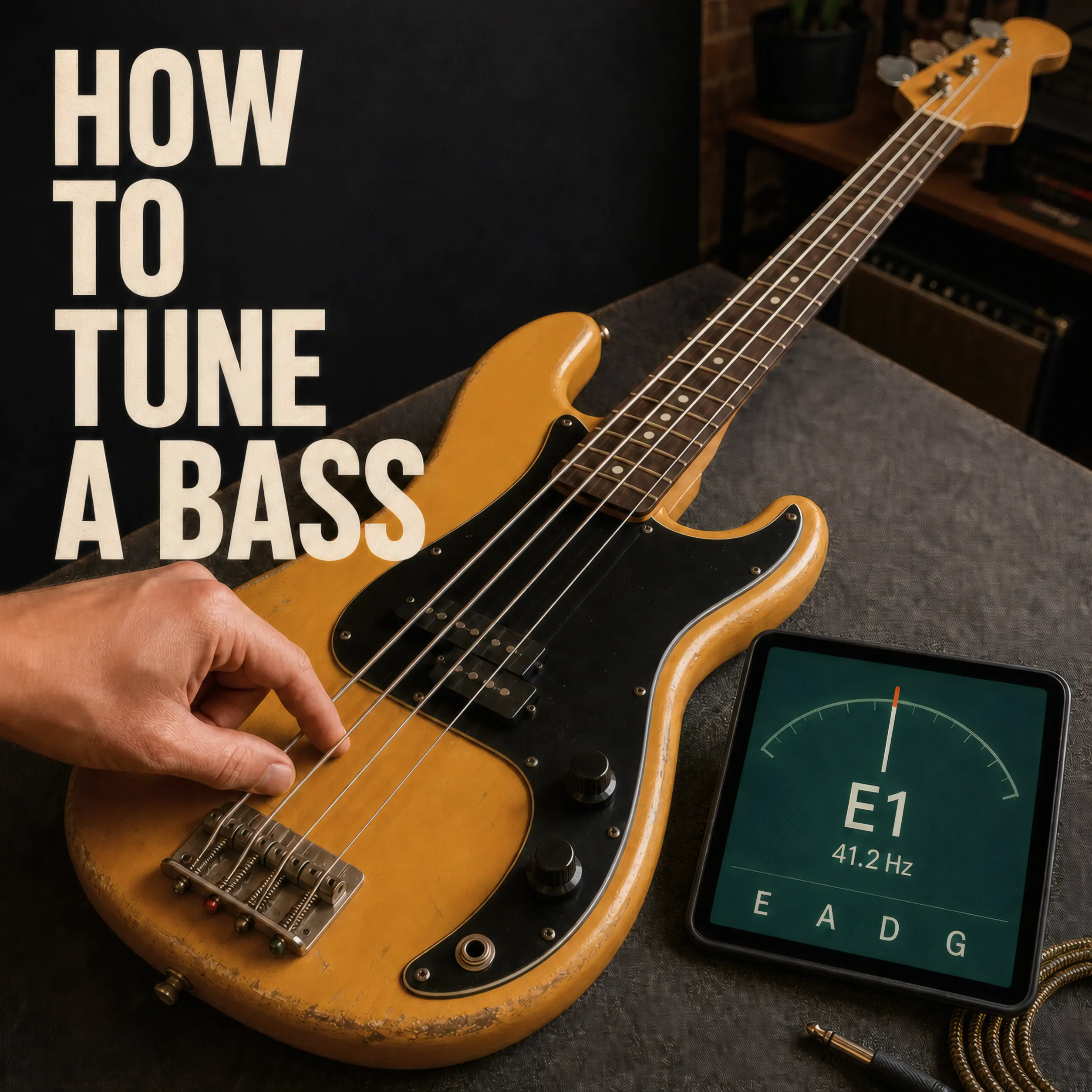
Everything here assumes your bass is in tune. If it's been a while, take thirty seconds with the bass tuner first. Scales practiced on an out-of-tune bass train your ears wrong.
Basic Music Theory for Bassists
You don't need a theory degree to use scales. You need four ideas.
The notes on the bass
Your four open strings, from lowest (thickest) to highest (thinnest):
E - A - D - G
Each fret raises the note by one half step. The E string goes E (open), F (1st fret), F# (2nd), G (3rd), and so on. If you ever need to look up a note name, the scale finder tool can help; just know its fretboard view is laid out for guitar, so the note names are right but the string layout won't match your bass.
Whole steps and half steps
A half step is one fret. A whole step is two frets. Every scale is just a recipe of whole steps (W) and half steps (H). Learn the recipe once, and you can build the scale starting from any note.
Scale degrees
Scale degrees number the notes of a scale from the root, 1 through 7, then it repeats at the octave. When someone says "play the 5" they mean the fifth note of whatever scale you're in. Bass players live on 1, 3, and 5 (root, third, fifth) because those notes define the chord.
Why this matters on bass
Guitarists think in chord shapes. Bassists think in scale degrees. When the guitarist plays an A minor chord, your job is usually to play A (the 1), and your color options come from the A minor scale. That chord-to-scale connection is the whole game.
The Major Scale on Bass
The major scale is the reference point for everything else in Western music. Its formula:
W - W - H - W - W - W - H
Whole, whole, half, whole, whole, whole, half. On the bass: two frets, two frets, one fret, two frets, two frets, two frets, one fret.
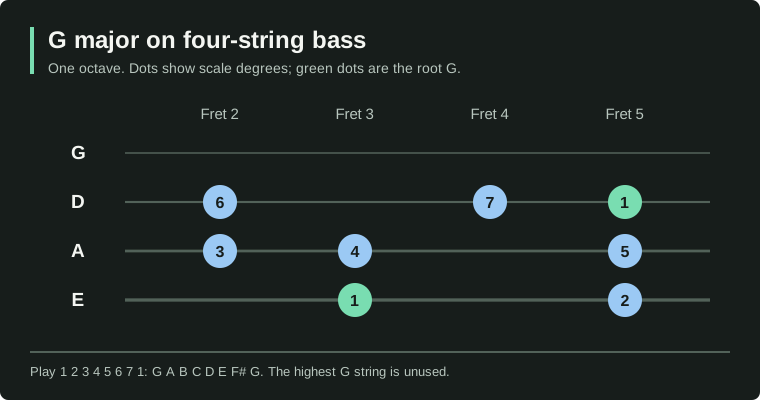
G major, one octave (starts at the 3rd fret, E string)
Starting from G at the 3rd fret of the E string, here is one full octave. The lines are labeled by string: G is your thinnest string, E the thickest:
G|-------------------------|
D|-------------2---4---5---|
A|-----2---3---5-----------|
E|-3---5-------------------|
Played in order, that's:
G - A - B - C - D - E - F# - G
Check it against the formula: G to A is a whole step (frets 3 to 5), A to B is a whole step, B to C is a half step (frets 2 to 3 on the A string). The half steps land between degrees 3–4 (B–C) and 7–1 (F#–G). Every major scale has its half steps in exactly those two places.
G major fingering
Use one finger per fret across frets 2–5: index on 2, middle on 3, ring on 4, and pinky on 5. On the E string, use middle then pinky; on A, index, middle, pinky; on D, index, ring, pinky. There are no open strings. If that span feels too wide, use small relaxed shifts rather than forcing the stretch.
The note map
Here's what you just played, degree by degree:
| Degree | Note | Fret (string) |
|---|---|---|
| 1 | G | 3 (E) |
| 2 | A | 5 (E) |
| 3 | B | 2 (A) |
| 4 | C | 3 (A) |
| 5 | D | 5 (A) |
| 6 | E | 2 (D) |
| 7 | F# | 4 (D) |
| 1 (octave) | G | 5 (D) |
Memorize where 1, 3, and 5 sit. Those are your money notes when you build bass lines.
The Natural Minor Scale
The natural minor scale sounds darker and sadder than major. Its formula:
W - H - W - W - H - W - W
Compared to major, the 3rd, 6th, and 7th degrees are lowered by a half step. That flatted 3rd is most of the "minor" sound.
A natural minor, one octave (starts at the 5th fret, E string)
A minor is the perfect first minor scale because it uses no sharps or flats, the same notes as C major, just starting from A:
G|-----------------|
D|---------5---7---|
A|-5---7---8-------|
E|-5---7---8-------|
In order:
A - B - C - D - E - F - G - A
Count the steps: A to B is a whole step (frets 5 to 7), B to C is a half step (7 to 8), then whole, whole, half, whole, whole. The half steps sit between degrees 2–3 and 5–6, different places than major, which is why the mood changes.
A natural minor fingering
Use one finger per fret across frets 5–8: index on 5, middle on 6, ring on 7, and pinky on 8. On E and A, play index, ring, pinky; on D, play index then ring. The middle finger has no note in this pattern. Use small relaxed shifts if needed rather than forcing the stretch.
This A natural minor pattern is its own shape. Moving the G major shape up two frets gives A major (A B C# D E F# G# A), not A natural minor. Relative keys share notes instead: G major and E minor share all their notes, while A minor and C major share all theirs.
The Pentatonic Scales
Pentatonic means "five notes." You take the seven-note scale and drop two notes, which removes the half steps that can clash. What's left almost always sounds good.
The two pentatonic formulas
- Major pentatonic: degrees 1 - 2 - 3 - 5 - 6 (major scale minus the 4th and 7th)
- Minor pentatonic: degrees 1 - b3 - 4 - 5 - b7 (natural minor minus the 2nd and 6th)
A minor pentatonic box (5th fret position)
This is the single most-played scale shape on bass and guitar alike. Two notes per string:
G|---------5---7---|
D|-----5---7-------|
A|-5---7-----------|
E|-5---8-----------|
In order:
A - C - D - E - G - A - C - D
The b3 (C) sits right next to the root on the E string, frets 5 and 8, the widest gap in the box, a whole step plus a half step. Everything else is a comfortable whole step or two frets.
For contrast, here's G major pentatonic, built off the same G root you used earlier:
G|---------2---4---|
D|-----2---5-------|
A|-2---5-----------|
E|-3---5-----------|
That's G - A - B - D - E - G - A - B. Compare the two shapes slowly and hear the mood flip from dark to bright.
Why pentatonics are the bassist's everyday tool
Full scales are for learning. Pentatonics are for playing. Because the clashing notes are gone, you can grab almost any note in the box over a matching chord and it works. The bulk of classic rock, blues, and funk bass lines are pentatonic ideas with chord tones on the strong beats. When you jam and don't know the song, the minor pentatonic box is your survival kit.
Scale Patterns and Positions
One octave vs two octaves
Everything above is one octave: root to root. Two-octave shapes keep climbing past the octave to the next root higher up. Here's G major across two octaves:
G|-----------------2---4---5---7---9---11--12--|
D|-------------2---4---5-----------------------|
A|-----2---3---5-------------------------------|
E|-3---5---------------------------------------|
The notes run G A B C D E F# G A B C D E F# G. Past the octave (G at the 5th fret of the D string) you continue up the G string, and past the 7th fret you'll slide your whole hand up the neck for the 9th, 11th, and 12th frets. That slide is a position shift. It's awkward for the first week and automatic after that.
Movable scale boxes
Here's the idea that makes all of this pay off: none of these shapes use open strings, so every one of them is movable.
- Slide the G major shape up two frets (root at E-string 5th fret) and you're playing A major.
- Slide the A minor shape down two frets and it's G minor.
- The minor pentatonic box works from any starting fret: root on the E string, box built around it.
One shape, twelve keys. Find the root you need on the E string, plant your index finger there, and the shape does the rest. This is why learning the note names along the E and A strings matters; those two strings are your root-finding map.
Don't collect shapes yet
There are five or more positions for every scale. Ignore that for now. One major shape, one minor shape, one pentatonic box, played cleanly in several keys, beats five shaky positions every time.
Fingerings and Technique
Good scale practice is really technique practice in disguise.
Alternate plucking
Pluck with two fingers (index and middle) and strictly alternate them: i, m, i, m, no matter which string you're crossing to. The string crossings are the trap. Going from the A string to the D string, beginners want to repeat whichever finger feels ready. Don't. Force the alternation until it's boring, because consistent alternation is what makes even bass lines possible later.
Keep the plucking hand loose and let each note ring into the next.
One finger per fret
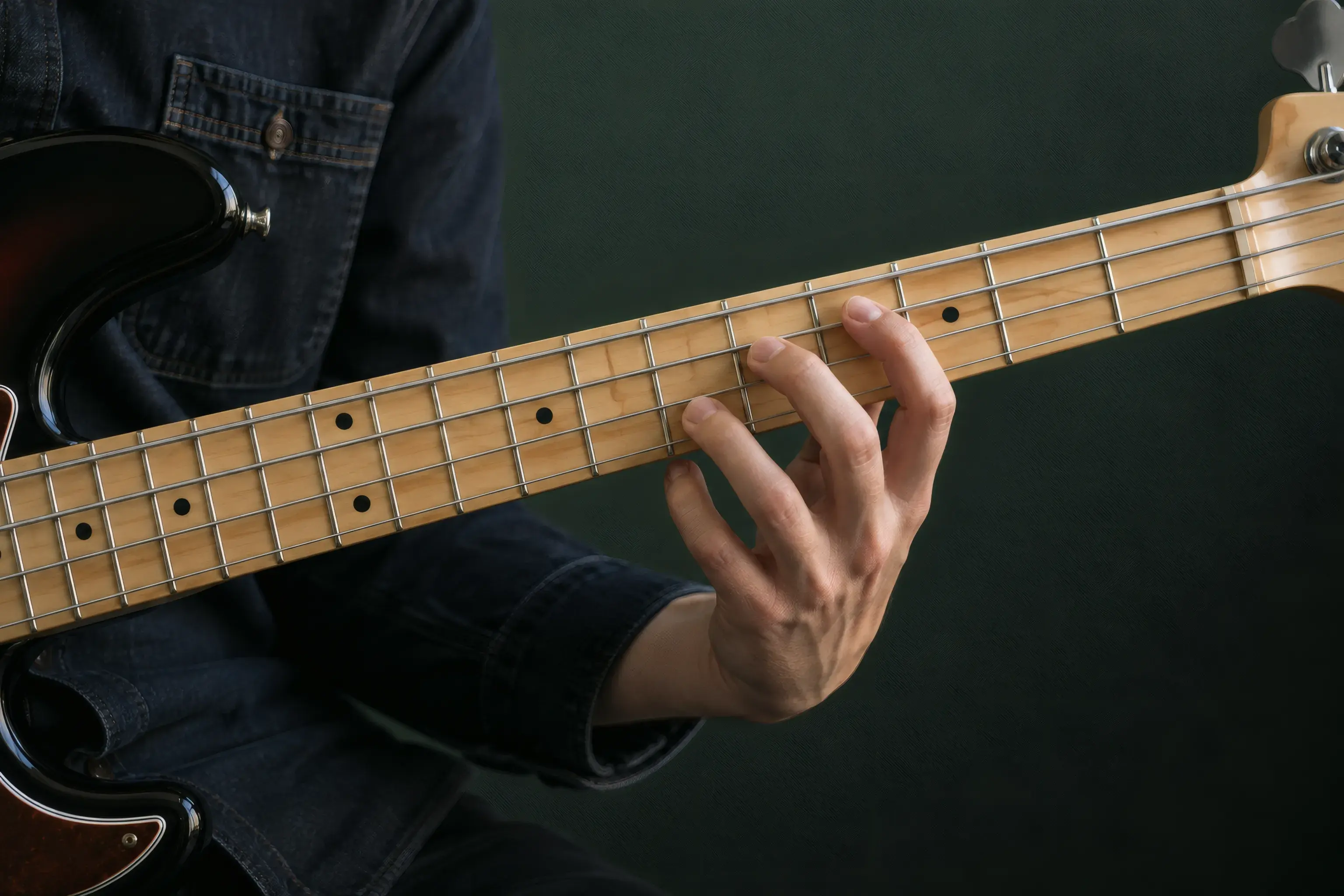
For the G major pattern, cover frets 2 through 5: index on 2, middle on 3, ring on 4, and pinky on 5. Keep your fingertips just behind the fret wire and your thumb behind the neck. Use small relaxed shifts if that span is uncomfortable; do not force a stretch. The G major pattern uses the pinky on fret 5 of the E, A, and D strings.
Metronome practice at 60–100 BPM
Open the metronome and set it to 60 BPM. Play one note per click, quarter notes. When a scale survives four clean passes, move to 70, then 80. Only approach 100 BPM when your slow playing is genuinely even. A rushed scale at 100 teaches your hands mistakes; a patient scale at 60 teaches them the truth.
Two click tricks once quarter notes feel solid:
- Play two notes per click (eighth notes) at the same tempo.
- Set the click to land on beats 2 and 4 only, like a drummer's snare. Much harder, much groovier.
For more on building this habit, the approach in metronome practice for chord changes transfers directly to scale work.
Practice Exercises
Three exercises, fifteen minutes, most days. Short daily sessions beat one long weekend session.
1. G major, up and down, four times
At 60 BPM, play the G major scale up and back down, four passes without stopping. One note per click. On the way down, say the note names in your head: G, F#, E, D, C, B, A, G. Descending is where beginners fall apart, so give it extra attention. When it's clean, move the shape to the 5th fret (A major) and repeat.
2. A minor pentatonic improvisation over a groove
Put on any slow A minor backing track, or loop yourself playing A at the 5th fret on beats 1 and 3. Over it, improvise using only the five notes of the A minor pentatonic box. First-week rules: always land on A when the chord comes back around, and keep every phrase short, two or three notes, then silence. The silences make it sound like music instead of a scale exercise.
3. Scale sequences
Straight up and down gets stale fast. Sequences break the scale into patterns and build real finger independence. In G major, play:
1-2-3, 2-3-4, 3-4-5, 4-5-6, 5-6-7, 6-7-1
That's G-A-B, A-B-C, B-C-D, and so on, groups of three, each starting one degree higher. Then reverse it coming down. Harder than it looks, and it teaches your fingers the scale as a neighborhood instead of a staircase. When groups of three are easy, try fours: 1-2-3-4, 2-3-4-5, and up.
Audio and Backing Tracks
Hearing the difference between these scales matters as much as fingering them. Two things to do, and two clips we're producing for this page.
Hear major vs minor side by side
Play your G major scale across frets 2–5, then shift your hand up three frets to play A natural minor across frets 5–8 using its own fingering. Record both on your phone and listen back. Notice the different interval patterns as well as the different starting notes. On playback you're not busy fingering, so you can focus on how each scale sounds.
Practice the pentatonic box over an Am groove
For exercise 2 above, a loop in A minor at 80–90 BPM is ideal: drums and a simple Am chord, space left for the bass. Until ours is ready, use any "A minor bass backing track" you find, or make your own: record two minutes of yourself playing A on beat 1 and E on beat 3, and improvise over it. Listen for how the root (A) feels like home, the b3 (C) adds blues tension, and the 5 (E) sits comfortably anywhere.
FAQ
Which scale should I learn first?
The major scale, in G, exactly as written above. It's the reference point every other scale is measured against, and the one-octave shape is gentle on your fingers. Once it's clean, add the A minor pentatonic box; that's the one you'll actually use when you jam. Natural minor comes third, and it will feel familiar because it shares so much DNA with the other two.
How do I know which scale to use over a chord?
Match the chord's root and quality. Over an A minor chord, play A minor pentatonic or A natural minor. Over a G major chord, play G major or G major pentatonic. When a song moves through several chords in one key (say G, C, and D), you can usually stay in one scale (G major covers all three) and emphasize each chord's root as it arrives. That covers most pop, rock, and folk songs you'll meet.
Do I need to learn all 12 keys?
Eventually, yes, but not by memorizing twelve separate things. Because every shape here is movable, learning "all twelve keys" mostly means learning the note names on your E and A strings so you can park the shape on any root. Pick a new key each week, slide the same patterns to it, and within a few months the whole neck is covered without a single new shape.
Put the click on and climb
Tune up with the bass tuner, set the metronome to 60 BPM, and run the G major scale four times up and down. That's day one. Do it most days for two weeks, add the pentatonic box, and you'll feel the fretboard start to make sense under your hands, the whole point of learning bass scales in the first place.
If your tuning is the shaky part right now, start with how to tune a bass and come back. Everything here sounds better in tune.