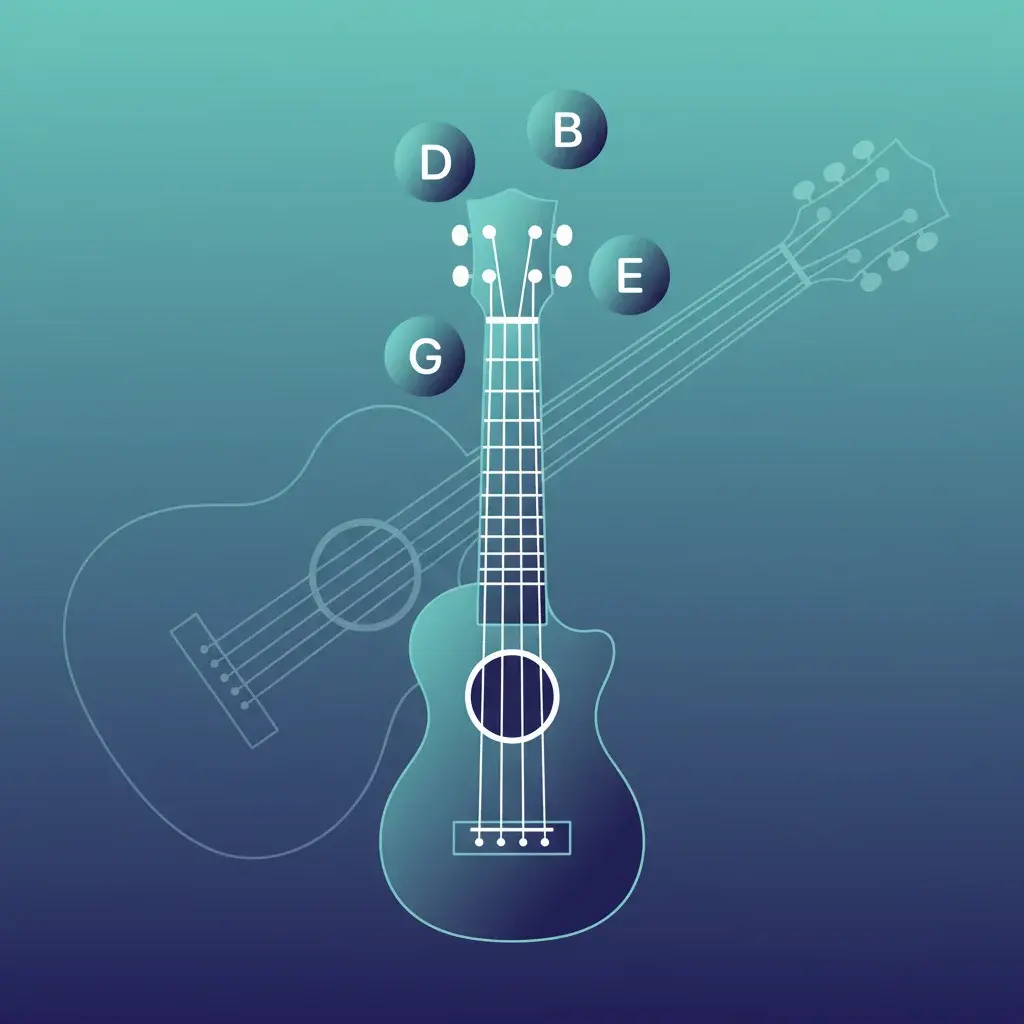
Standard baritone ukulele tuning is D3 G3 B3 E4, low to high. Those are the same pitches as the top four strings of a guitar, so a baritone sounds lower and more guitar-like than a soprano, concert, or tenor ukulele.
Tune it now:
- Open the baritone ukulele tuner for the D3 G3 B3 E4 preset
- Looking for fingerings instead? Use the separate baritone ukulele chord chart
Baritone ukulele tuning notes and frequencies
This chart assumes the modern concert reference of A4 = 440 Hz.
| String | Target | Frequency | Role |
|---|---|---|---|
| 4, thickest | D3 | 146.83 Hz | lowest open string |
| 3 | G3 | 196.00 Hz | a perfect fourth above D3 |
| 2 | B3 | 246.94 Hz | the one major-third step in the tuning |
| 1, thinnest | E4 | 329.63 Hz | highest open string |
The notes rise steadily from D3 to E4. That makes standard baritone tuning linear. It does not use the high, re-entrant G found on many standard ukuleles.
The guitar comparison is exact, not approximate: guitar strings 4, 3, 2, and 1 are D3, G3, B3, and E4. That is why guitar chord shapes transfer so cleanly. The full chord guide handles that topic; this page stays focused on getting the four open strings right.
How to tune a baritone ukulele
- Open the D G B E baritone tuner and allow microphone access.
- Hold the ukulele in playing position. Start with the thickest string, D3.
- Pluck once with a medium-soft attack and let the note settle before moving the tuning peg.
- If the pitch is above the target, loosen below it. Then approach the note from flat to in tune.
- Repeat for G3, B3, and E4, muting the other strings as you work.
- Check D3 G3 B3 E4 again. Adjusting one string can slightly change the tension felt by the others.
Tune upward into the target rather than stopping while the pitch is falling. The wraps around the post and the string at the nut tend to settle more predictably that way.
When the tuner cannot hear the low D
D3 is not extremely low, but an unplugged electric baritone or a very soft string can still be hard for a phone microphone to isolate.
- Move the device within 20 to 30 cm of the sound hole.
- Pluck closer to the middle of the string for a stronger fundamental.
- Mute the three strings you are not tuning.
- Turn away from fans, televisions, and other instruments.
- If the display keeps choosing A or another overtone, pluck more softly and wait through the first instant of pick noise.
Do not keep tightening because the screen shows the wrong note. Stop, mute everything, and identify whether the string is already near D before making another large turn.
D G B E versus standard G C E A ukulele tuning
| Baritone ukulele | Soprano, concert, and most tenor ukuleles | |
|---|---|---|
| Standard notes | D3 G3 B3 E4 | G4 C4 E4 A4 |
| Pitch order | linear, low to high | commonly re-entrant, with a high G |
| Familiar comparison | top four guitar strings | traditional C6 ukulele tuning |
| Correct TuneMode preset | Baritone D G B E | Standard G C E A |
Using the wrong preset is the most common reason a baritone feels impossibly far out of tune. If a tuner is asking the thick D string to become G4, stop. That target is far above standard baritone pitch and may put the string under unsafe tension.
Kala's baritone ukulele guide also identifies D G B E as the standard baritone tuning. When an instrument or replacement string package specifies another tuning, follow that manufacturer's target rather than assuming every large ukulele uses the same set.
Why a correctly tuned baritone can still sound wrong
The strings are new
Fresh nylon and fluorocarbon strings stretch. Tune, play for a few minutes, and tune again. Several passes during the first few sessions are normal. Pulling hard on a new string to speed up stretching can damage it or create uneven wraps; ordinary playing and patient retuning are enough.
A chord chart was written for G C E A
A shape does not keep the same chord name when the open-string tuning changes. A standard-ukulele C shape, for example, is not a C chord on a D G B E baritone. Use a chart that explicitly says baritone or D G B E. Tune first, then move to the baritone chord chart.
Open strings are right but fretted notes are sharp
That points to setup or technique, not an open-string tuning problem. Press only hard enough to stop the note cleanly. If the 12th-fret note remains noticeably sharp while the open string and 12th-fret harmonic agree, the saddle compensation may need attention.
One string changes pitch in jumps
The string may be binding in its nut slot. Loosen it slightly and tune upward again. Persistent pings, jumps, or a string that will not return to pitch deserve a check by a repair technician, especially if the nut slot looks tight or damaged.
Alternative baritone tunings
D G B E is the right starting point for almost every beginner, lesson book, and baritone chord chart. Alternatives exist, but they need strings intended for the new pitch range.
- High D or re-entrant D G B E: the note names stay the same, but the fourth string is raised an octave. This changes voicings and picking patterns.
- G C E A on a baritone: purpose-made string sets can put familiar ukulele tuning on the longer scale. Do not tune an ordinary D G B E set up to G C E A unless its maker says it is designed for that use.
- A step down: C F A D lowers every string by a whole step. A normal set may feel loose, so check the string maker's range before committing to it.
Changing tuning by several semitones is a string-selection decision, not just a tuner setting. Scale length, material, and gauge determine whether the result is playable.
A two-minute tuning check before practice
- Tune D3 G3 B3 E4 with the baritone preset.
- Play each open string twice and listen for an even decay without beating or rattling.
- Play the 12th-fret harmonic on each string. It should register as the same note name one octave higher.
- Strum one familiar chord from the baritone chord guide.
- Recheck any string that moved, then start the practice session.
This catches the wrong preset, a poorly seated string, and most microphone mistakes before they become ten minutes of confused chord checking.
FAQ about baritone ukulele tuning
What is standard baritone ukulele tuning?
Standard baritone ukulele tuning is D3 G3 B3 E4 from the thickest string to the thinnest. It is normally a linear tuning, so each string is higher than the one before it.
Is baritone ukulele tuning the same as guitar?
It matches the top four strings of a standard guitar exactly. A guitar also has low E2 and A2 strings, which the baritone ukulele does not have.
Should a baritone ukulele tuner be set to 440 Hz?
Yes for ordinary modern playing. A4 = 440 Hz is the reference used by the TuneMode preset and by most current tuners. Only change the reference pitch when an ensemble or recording specifically uses another standard.
Can a regular guitar tuner tune a baritone ukulele?
A chromatic guitar tuner can read D3 G3 B3 E4. A tuner locked to six-string guitar mode may expect two extra strings or label string numbers differently, so a baritone-specific preset is less confusing.
Can I put baritone strings on a tenor ukulele?
Only use a set that explicitly supports your tenor's scale length and intended tuning. Some manufacturers make tenor D G B E sets, but an arbitrary baritone set can have the wrong length, gauge, or tension.
Why does my baritone ukulele keep going out of tune?
New strings, loose post wraps, temperature changes, and a string binding at the nut are common causes. New strings usually settle with repeated tuning and playing. Sudden jumps or persistent slipping need a closer hardware check.
Tune first, then choose the right chart
Open the baritone ukulele tuner, set the four strings to D3 G3 B3 E4, and make a second pass. Once the open strings hold steady, the baritone ukulele chord guide is the right next page.


