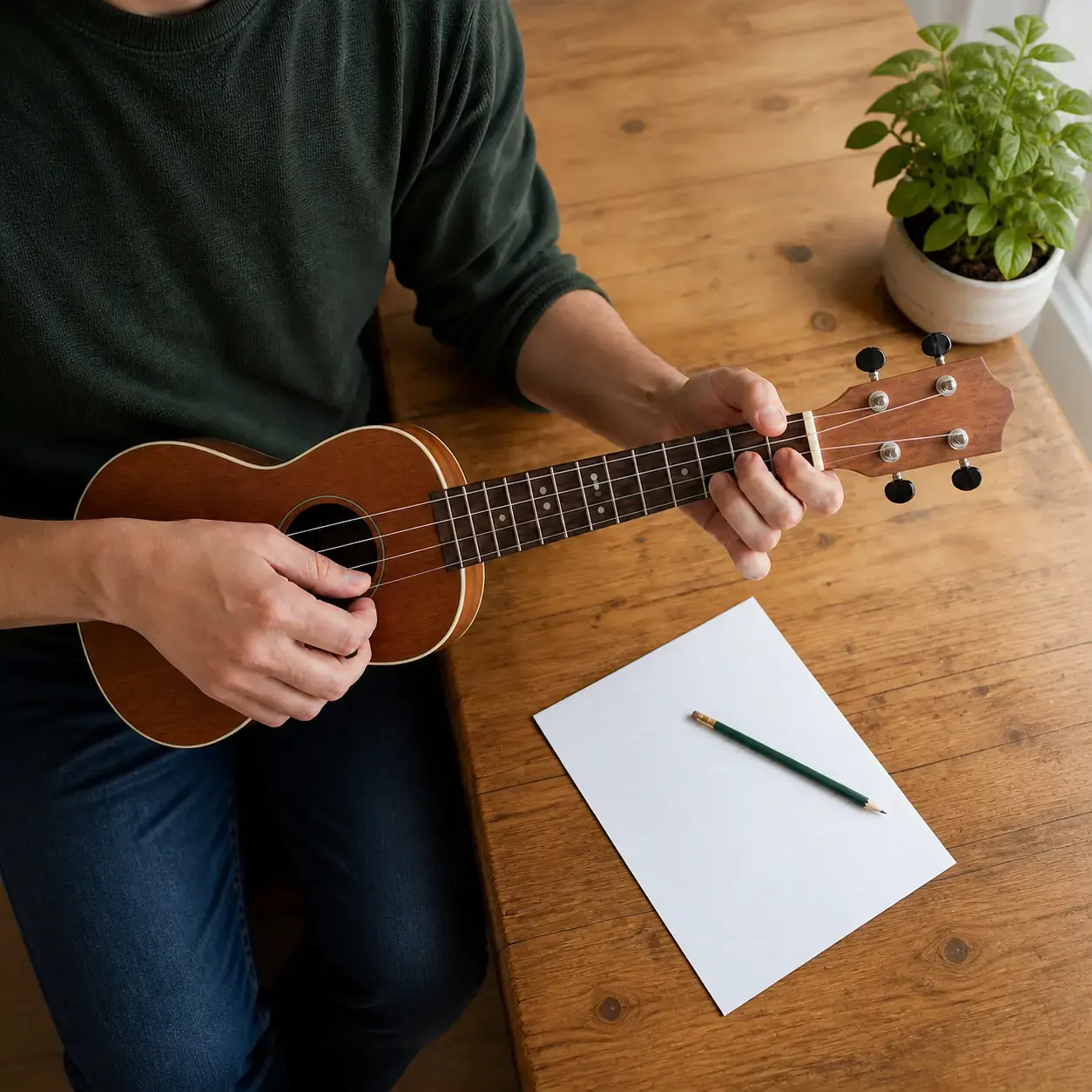
A student in my Saturday group class once spent a whole week practicing from a chart she'd printed at the library. Sounded lovely. Every chord was wrong. The chart was written for a soprano ukulele in GCEA, and on her baritone every shape came out a fourth away from what the page promised.
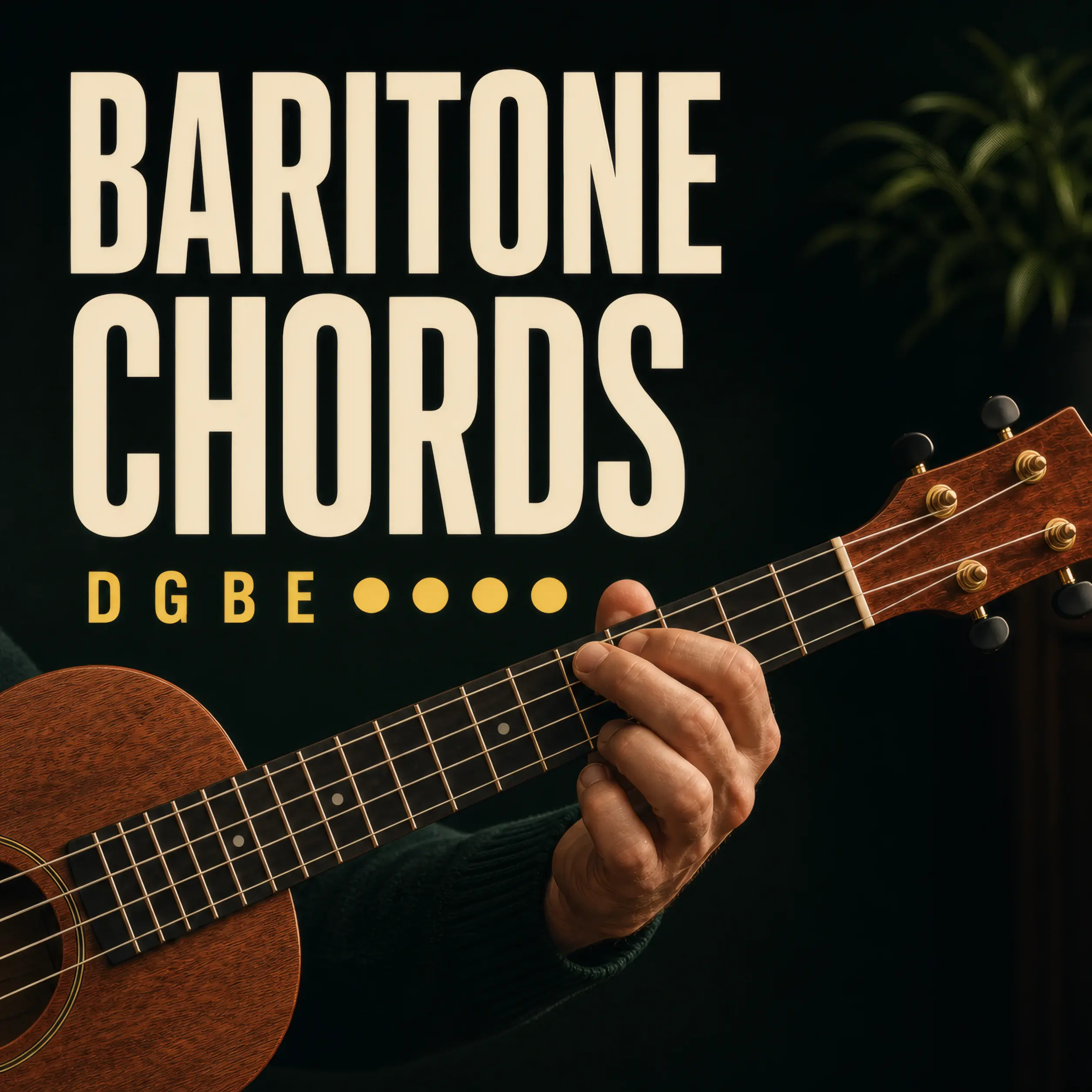
So before anything else, check which instrument is in your hands. If your uke is the big one, around 19 inches of scale, it's a baritone and it's tuned D G B E low to high. The chords below are for that instrument and no other.
Grab these first:
- Baritone ukulele tuner preset so the strings are actually at D G B E before you judge any shape
- Chord library for shapes beyond this page
Baritone ukulele chord chart
Eight shapes cover a very large share of the songs beginners want. Fret numbers read low string to high, a dot means fret it, a small o means play it open.

Same shapes as a table, with the notes you're actually sounding.
| Chord | Frets (low to high) | Notes |
|---|---|---|
| G | 0 0 0 3 | D G B G |
| C | 2 0 1 0 | E G C E |
| D | 0 2 3 2 | D A D F# |
| Em | 2 0 0 0 | E G B E |
| Am | 2 2 1 0 | E A C E |
| E | 2 1 0 0 | E G# B E |
| A | 2 2 2 0 | E A C# E |
| D7 | 0 2 1 2 | D A C F# |
G deserves a comment. One finger. The open strings already hand you D, G, and B, so your ring finger on the top string's third fret finishes the chord. When a new player lands that and hears a full, warm G on the first try, the instrument has usually sold itself.
Guitar players already know these
Baritone tuning matches guitar strings 4 through 1. Not similar. Identical.
Which means any guitar chord you can voice on the top four strings transfers with zero changes. The C above is the guitar C shape with the two bass strings left off. Em is the guitar Em. Your D chord is the guitar D, finger for finger.
Two things do change, and they catch converts.
- There's no low E or A string, so shapes that lean on a bass root (the guitar G, the full E) lose some floor. The chord is still correct, it just sits higher than your ear expects.
- Barre shapes work but nylon strings and the shorter neck change the effort. A baritone F at 3 2 1 1 needs a two-string mini-barre and takes most people a week or two of sore-finger patience. Worth it.
I moved a retired gentleman from guitar to baritone two winters ago because arthritis had made full barres miserable, and he keeps a laminated copy of the chart above inside his case lid. He learned exactly nothing new. That's the pitch for this instrument in one sentence.
The next five chords
Once the first eight feel automatic, these fill in most remaining songbook gaps.
| Chord | Frets (low to high) | Notes |
|---|---|---|
| F | 3 2 1 1 | F A C F |
| Dm | 0 2 3 1 | D A D F |
| G7 | 0 0 0 1 | D G B F |
| B7 | 1 2 0 2 | D# A B F# |
| Bm | 4 4 3 2 | F# B D F# |
G7 is the easiest chord on the whole instrument, one finger on the top string, first fret. B7 shows up constantly in older songs and blues. Bm is your first real stretch, and it's fine to park it for a month.
Three progressions that make the shapes stick
Drilling chords in isolation is slow. Loops are faster, and a click keeps you honest. Open the online metronome, set 70 BPM, four beats per chord.
- G, C, D, G. The classic. "You Are My Sunshine" and a few hundred campfire songs live here.
- G, Em, C, D. Adds the minor color. Anything doo-wop adjacent runs on this loop.
- C, Am, F, G7. The F earns its keep here. Slow it to 60 if the F change keeps arriving late.
Change shapes on the "and" before beat one, a half-beat early. The wound third string will squeak a little as your fingers slide. Normal. New nylon sets also drift for a few days, so retune with the baritone preset at the start of every sesion.
A ten-chord walkthrough with diagrams on screen — useful for watching finger placement on the shapes from the chart above.
How to tune a baritone ukulele (the short version)
Low to high, the targets are D3, G3, B3, E4. Open the baritone ukulele tuner, let it hear one string at a time, and bring each up to pitch. The preset page has the full walkthrough, reference tones included, so I won't repeat it here.
One habit worth stealing from guitar players. Always tune up to the note, and if you overshoot, drop below and come back. Nylon holds better that way.
About those GCEA charts
Soprano, concert, and tenor ukes are tuned G C E A. A baritone is D G B E, a perfect fourth lower. Same shape, different chord — the GCEA "C" shape lands on a baritone as G.
That's the trap my Saturday student fell into, and the internet is absolutely carpeted with GCEA charts that never say which tuning they mean. If a chart doesn't name the tuning, assume it's GCEA and skip it. And if your instrument is actually a soprano, concert, or tenor, use the separate beginner GCEA ukulele chord guide.
The baritone ukulele's history explains the tuning, by the way. It appeared in the late 1940s, built deliberately guitar-like, and TV host Arthur Godfrey put it in front of millions of viewers in the 50s. It was designed as a bridge instrument. The chord transfer isn't a coincidence, it's the point.
FAQ: baritone ukulele chords
Are baritone ukulele chords the same as guitar chords?
The shapes are the same as guitar shapes played on the top four strings. A guitar adds two lower strings, so full six-string voicings sound deeper, but nothing about the fingering changes. If you already play guitar you can be strumming a baritone in about ninety seconds.
Can I use a regular ukulele chord chart for baritone?
No. Regular charts assume G C E A tuning. Every shape on them will sound a fourth off on your baritone. Use a chart that says D G B E on it, like the one above, or set the instrument to baritone in the chord library.
What baritone chords should I learn first?
G, C, D, and Em, in that order. G needs one finger and the other three are two or three fingers each. Those four alone carry an enormous number of folk and country songs, and the progressions section above turns them into practice loops.
Why does my chord sound right but low?
It probably is right. Baritone sits a fourth below other ukes and much of what you hear online is recorded on soprano or tenor. Play along with baritone-specific videos, or just enjoy it — the warmth is why people buy this size.
Do I need to read music for this?
Not at all. Every chord on this page is fret numbers and dots. Reading helps later if you get into chord-melody arrangements, but strumming from charts will carry you for years.
Put the chart to work
Tune to D G B E with the baritone ukulele tuner, then loop G, C, D, G with the metronome at 70 until the changes stop feeling like events. The chord library has every shape past these thirteen when a songbook throws you something strange.