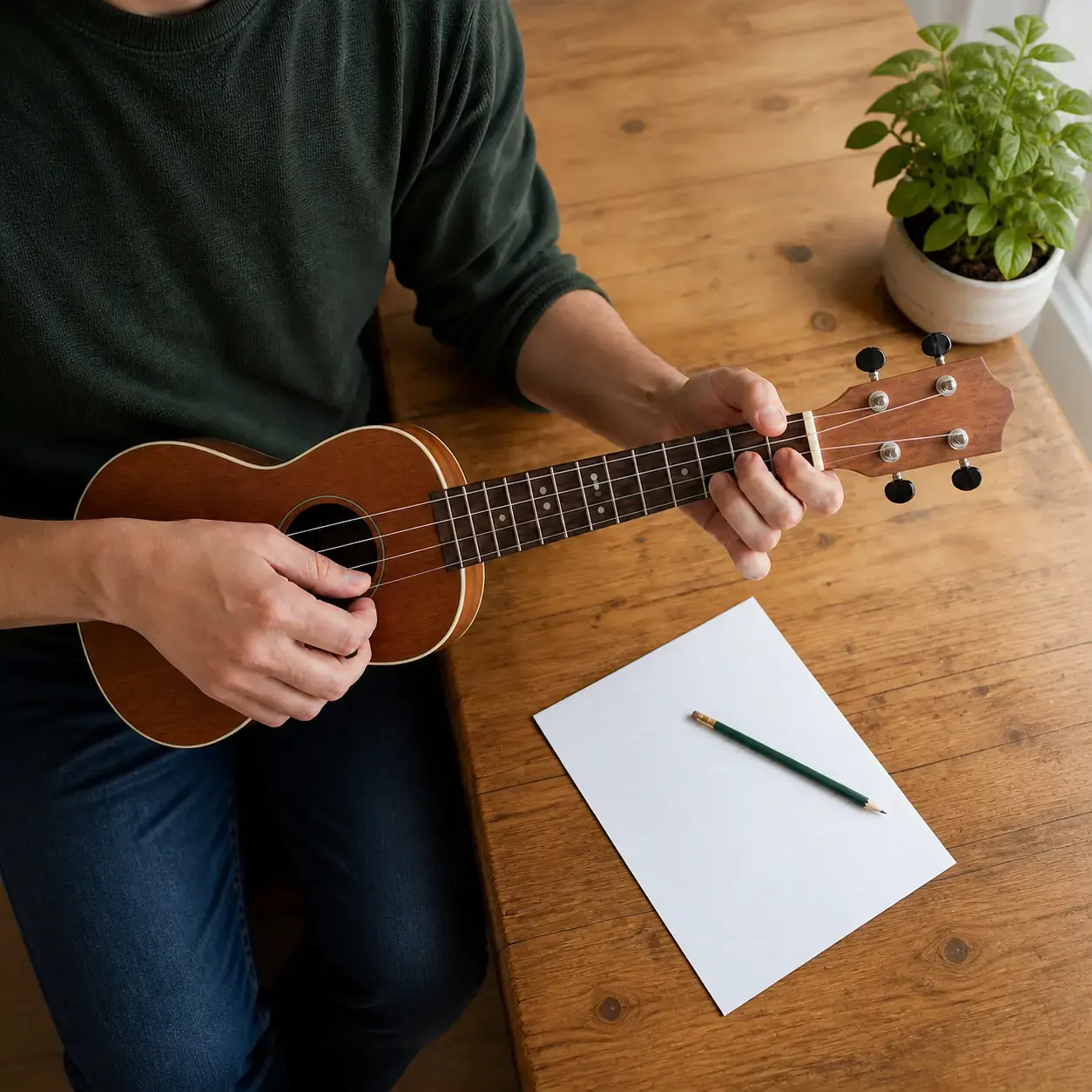
An open ukulele tuning arranges the strings so a strum with no fretted notes is already a chord. That changes the instrument from a familiar G C E A chord machine into a resonant writing tool: barring one fret can move the open chord, repeated notes ring together, and a melody can sit above a sustained harmony.
This guide compares TuneMode's four open-ukulele presets. It does not replace the presets themselves. Pick a sound here, then use the matching tuner to reach the exact octave on every string.
Choose a preset:
Open ukulele tuning chart
The notes run from the fourth string, closest to your face in normal playing position, to the first string, closest to the floor.
| Tuning | Notes and octaves | Open chord | Compared with high-G standard | Best first use |
|---|---|---|---|---|
| Open C | G4 C4 E4 G4 | C major | lower A4 to G4 | easiest temporary experiment |
| Open D | A4 D4 F#4 A4 | D major | raise G4, C4, and E4 a whole step | bright, compact voicings with a suitable set |
| Open G | G3 B3 D4 G4 | G major | use low G3; lower C4, E4, and A4 | lowest range and linear melody work |
| Open A | A3 C#4 E4 A4 | A major | use low A3; raise C4 a semitone | open-A drone with a linear bass |
Standard high-G tuning is G4 C4 E4 A4. It is re-entrant because the fourth string is higher than the C4 and E4 beside it. Open C keeps that re-entrant character. The Open G and Open A presets start with G3 or A3, so their pitch order rises more like a small guitar.
The octave numbers matter. A string meant for G4 is not automatically suitable for G3, and trying to raise a string far beyond its intended pitch can break it or overload the instrument. If a preset calls for a different octave, use a string set or individual string made for that range.
Open C: G4 C4 E4 G4
Open C is the gentlest place to start on a standard high-G ukulele. Leave the G4, C4, and E4 strings alone, then lower the A4 string one whole step to G4.
The open notes are G, C, E, and G: the fifth, root, major third, and another fifth of a C major chord. The two G4 strings can produce a wide, chorus-like shimmer when they are closely matched.
Open C frequency targets
| String | Note | Frequency |
|---|---|---|
| 4 | G4 | 392.00 Hz |
| 3 | C4 | 261.63 Hz |
| 2 | E4 | 329.63 Hz |
| 1 | G4 | 392.00 Hz |
Use the Open C ukulele tuner, then strum all four strings. This version is useful for a quick songwriting change because returning to standard requires moving only the first string from G4 back to A4.
One warning: the two G4 strings do not have to feel identical. They began as strings of different gauges and materials, so match their pitch, not their physical tension.
Open D: A4 D4 F#4 A4
Open D spells the root, major third, and fifth of D major as A4 D4 F#4 A4. It is also re-entrant: the fourth-string A4 sits above the D4 and F#4 in the middle.
From ordinary high-G tuning, G4 rises to A4, C4 rises to D4, and E4 rises to F#4. Those are three whole-step raises. Do not assume a normal G C E A set or every ukulele can take that extra tension. A dedicated D-tuning set, a manufacturer's approved setup, or advice from a repair technician is the sensible route for regular use.
Open D frequency targets
| String | Note | Frequency |
|---|---|---|
| 4 | A4 | 440.00 Hz |
| 3 | D4 | 293.66 Hz |
| 2 | F#4 | 369.99 Hz |
| 1 | A4 | 440.00 Hz |
Once the strings and setup are appropriate, open D gives a bright D-major chord with doubled A notes. Use the Open D ukulele tuner and make several light passes; raised nylon strings continue settling after the first reading.
Open G: G3 B3 D4 G4
Open G is the lowest of these four presets. Its notes rise in order, G3 B3 D4 G4, to form root, major third, fifth, and octave of G major.
This is not standard high-G tuning with three pegs turned down. The fourth string must reach G3, one octave below G4. A normal high-G string tuned down to G3 will usually be too slack to play cleanly. Fit a low-G string intended for your ukulele, then lower C4 to B3, E4 to D4, and A4 to G4.
Open G frequency targets
| String | Note | Frequency |
|---|---|---|
| 4 | G3 | 196.00 Hz |
| 3 | B3 | 246.94 Hz |
| 2 | D4 | 293.66 Hz |
| 1 | G4 | 392.00 Hz |
The linear range makes bass-to-melody runs easier to visualize, while the doubled G anchors drones. Open the Open G ukulele tuner and let the low string speak for a moment before judging the display; its first transient can contain stronger upper harmonics than the fundamental.
Open A: A3 C#4 E4 A4
Open A is another linear tuning: root, major third, fifth, and octave. It preserves E4 and A4 from standard tuning, but the fourth string becomes a low A3 and C4 rises one semitone to C#4.
A high-G string cannot simply become A3. Even though the letter A can look like an upward move from G, A3 is lower than G4. Use a fourth string designed to produce the lower pitch at playable tension.
Open A frequency targets
| String | Note | Frequency |
|---|---|---|
| 4 | A3 | 220.00 Hz |
| 3 | C#4 | 277.18 Hz |
| 2 | E4 | 329.63 Hz |
| 1 | A4 | 440.00 Hz |
The Open A ukulele tuner checks the octave-specific targets. This tuning works well when a song needs a sustained A underneath a melody or when a singer's comfortable key is A.
Which open ukulele tuning should you choose?
Choose by the musical job and by the strings already on the instrument.
- Try Open C first when you want the smallest reversible change from standard high-G tuning.
- Choose Open D for its brighter register, but only with strings and an instrument setup suitable for three raised notes.
- Choose Open G for the lowest root, a linear range, and G-major drones.
- Choose Open A for a linear A-to-A octave and songs centered on A major.
A capo can substitute for the raised Open D setup. Put a capo at fret 2 on Open C (G4 C4 E4 G4) and the sounding strings become A4 D4 F#4 A4, exactly the same pitch layout and doubled fifth as the Open D preset. The tradeoffs are the capo's timbre and two fewer usable frets; the benefit is avoiding three raised open strings.
If you mainly want familiar ukulele chord shapes, stay with standard high-G tuning or low-G tuning. Open tunings deliberately change those relationships.
How to change tuning without chasing the tuner
- Confirm the installed strings. Check the package, manufacturer guidance, or the technician who fitted them. Do not guess at octave capability from the note letter alone.
- Lower strings before raising any. Releasing tension first gives you room to identify each target and reduces the chance of tightening the wrong peg.
- Pluck one string and mute the other three. Open tunings repeat notes, so a ringing neighbor can make a microphone tuner follow the wrong string.
- Approach each target from below. Small upward peg movements seat the string and reduce backlash at the tuner.
- Make two or three passes. Changing one string's tension affects the neck, bridge, and the other strings slightly.
- Test the open chord softly. A hard initial strum can bend a flexible nylon or fluorocarbon string sharp for an instant.
Stop if a raised string feels unusually tight, the bridge begins lifting, the top deforms, or the instrument makes a new cracking sound. A tuner can confirm pitch; it cannot confirm that a particular string and instrument are safe at that tension.
Simple chord movement in an open tuning
The open strings supply the home major chord. A full barre at another fret moves that same voicing up by one semitone per fret:
| Fret | Open C tuning | Open D tuning | Open G tuning | Open A tuning |
|---|---|---|---|---|
| 0 | C | D | G | A |
| 2 | D | E | A | B |
| 5 | F | G | C | D |
| 7 | G | A | D | E |
This is a useful sound check, not a complete chord vocabulary. A four-string barre moves every note together, so the major-chord relationship remains intact. Partial barres, melody notes, and open drones are where each tuning develops its own voice.
Open ukulele tuning FAQ
Is standard G C E A an open tuning?
Not in the open-major sense used by this guide. Strumming G4 C4 E4 A4 gives all four notes of C6 (C E G A), or the same notes reordered as Am7 (A C E G). The presets in this guide instead produce an unambiguous C, D, G, or A major triad on the open strings.
Can I use standard ukulele chord shapes in an open tuning?
No. Retuning changes the intervals between the strings, so standard G C E A diagrams no longer name the sounding chord correctly. Learn the open major chord, full-barre positions, and a few melody notes as a new system.
Which open tuning needs no special strings?
Open C is the most practical candidate on a normal high-G set because only A4 moves downward to G4. String construction and instrument condition still vary. Open G and Open A require a lower fourth-string octave, while Open D raises three strings.
Why does the tuner hear the wrong octave?
Small nylon strings produce strong overtones, and repeated notes can ring sympathetically. Mute the other strings, use a moderate pluck, and compare the displayed octave with the preset target. G3 and G4 share a letter name but are an octave apart.
Are these tunings for baritone ukulele?
They are TuneMode's four-string ukulele presets, not baritone D3 G3 B3 E4 tuning. A baritone uses different scale length, strings, and normal pitch range. Use the baritone ukulele tuner for that instrument.
Pick the chord, then tune to the exact octave
For the quickest low-risk experiment, lower standard A4 to G4 and open the Open C tuner. For Open D, G, or A, confirm the string set first. Then use the matching preset so a familiar note letter does not hide an octave mistake.