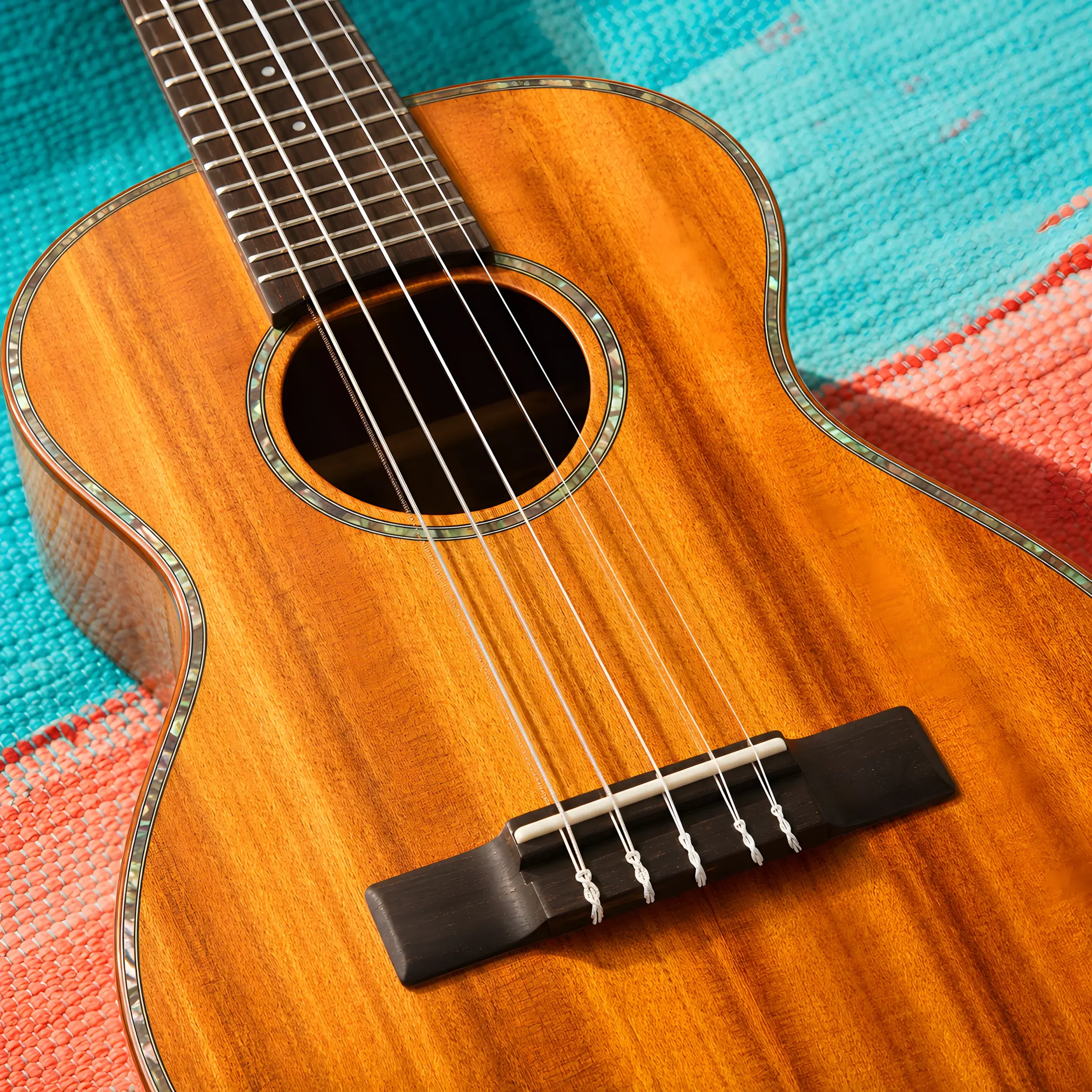
"Six-string ukulele" describes two different instruments. A traditional liliu has six strings arranged in four playing courses; a guitalele has six evenly spaced single strings. Tune the wrong system and at least two strings will be an octave off.
Use the custom tuner only after the 10-second identification check below.
6-string ukulele tuning: liliu or guitalele?
Look at the bridge, not the product name.
| What you see | Instrument | Tuning |
|---|---|---|
| Four gaps/playing positions; C and A are close pairs | 6-string liliu ukulele | G4, C4+C5, E4, A3+A4 |
| Six evenly spaced single strings | guitalele | A2 D3 G3 C4 E4 A4 |
Our opinion: any six-string ukulele guide that gives one six-letter sequence before making this distinction is incomplete. The same string count does not mean the same instrument.
Six-string ukulele notes and octaves
Liliu tuning
A liliu keeps the familiar G C E A chord layout but doubles the C and A courses an octave apart.
| Course | Target or pair | Frequency |
|---|---|---|
| G | G4 | 392.00 Hz |
| C pair | C4 + C5 | 261.63 + 523.25 Hz |
| E | E4 | 329.63 Hz |
| A pair | A3 + A4 | 220.00 + 440.00 Hz |
Kala writes its common physical arrangement as g-c-C-E-a-A, with lower-case letters marking the higher octave. Traditional layouts can reverse a pair, especially the A course. The reliable rule is physical: the thicker string and wider nut slot take the lower octave. Live Ukulele's liliu guide documents these course-order variants.
Guitalele tuning
A guitalele is tuned A2 D3 G3 C4 E4 A4, exactly like a standard guitar capoed at fret 5. It uses six independent courses, so guitar chord shapes work but sound a perfect fourth higher than their familiar names.
How to tune a 6-string liliu ukulele
- Count four courses and locate the doubled C and A pairs.
- In the custom tuner, create six targets: G4, C4, C5, E4, A3, and A4.
- Follow the physical string order on your instrument; do not assume the two strings in a pair match an online photo.
- Mute one string in the C pair. Tune the thicker string to C4 and thinner string to C5.
- Tune the single E string to E4.
- Mute one string in the A pair. Tune the thicker string to A3 and thinner string to A4.
- Tune G4, then play each pair together and listen for slow beating.
When an octave pair is correct, it sounds broad but stable. Fast pulsing means one string is a few cents off. Tune the sustained sound, not the sharp first millisecond of the pick attack.
How to tune a guitalele
Configure A2 D3 G3 C4 E4 A4, low to high. Tune it exactly as a guitar: mute five strings, approach each target from below, then make a second pass.
Do not use E A D G B E unless the manufacturer explicitly designed the instrument for guitar pitch. The shorter scale requires strings intended for A-to-A tuning; forcing a normal guitalele set down to E standard usually produces poor tension, while forcing an incompatible set upward risks breakage.
6-string ukulele chord compatibility
| Instrument | Shapes to use | What changes |
|---|---|---|
| Liliu | normal G C E A ukulele shapes | paired C and A strings fret together |
| Guitalele | normal six-string guitar shapes | every chord sounds a fourth higher |
On a liliu, press both strings in a doubled course with one fingertip. If one member of the pair buzzes, rotate the fingertip slightly; adding much more pressure usually pulls the higher string sharp.
On a guitalele, a guitar-shaped open E chord sounds as A. A guitar-shaped G sounds as C. Use shape names when rehearsing fingerings and concert-pitch names when speaking with other instruments.
Six-string ukulele tuning mistakes
Tuning both C strings to C4
That removes the octave shimmer and leaves the thin C string unusually slack. Most liliu sets use C4+C5; confirm against the string package or manufacturer if the pair is intentionally unison.
Tuning both A strings to A4
Some models use unison pairs, but the common liliu arrangement uses A3+A4. The thicker string belongs at A3. Never force a thick string upward merely to match its neighbor.
Copying a headstock diagram blindly
Course order can be reversed. Read string thickness and nut-slot width, then verify the manual. Kala's six-string reference specifies octave C and A pairs but does not make every brand's physical order universal.
Using a ukulele preset that only has four targets
The standard ukulele tuner is useful for the four course names, but it cannot tell C4 from C5 or A3 from A4. Use the custom tuner for all six octave-specific targets.
FAQ about six-string ukulele tuning
Is a six-string ukulele tuned like a guitar?
Only a guitalele is. A liliu uses ukulele tuning with doubled C and A courses.
Do normal ukulele chords work on a six-string ukulele?
They work on a four-course liliu because its course names remain G C E A. A guitalele uses guitar shapes and transposes their sounding pitch up a fourth.
Which string in an octave pair is lower?
The thicker string seated in the wider nut slot. Its position within the pair varies by maker and setup.
Can I replace one doubled string with a normal ukulele string?
Only if its material, length, and target octave match. Buy a set made for the instrument when possible; an ordinary C4 string is not a substitute for the thin C5 member of the pair.